

A gold coin's baseline value is its fine troy ounces multiplied by the current spot price, not its face value or the headline ounce price. With early-2026 gold above $5,300 an ounce as an illustration rather than a live quote, the difference between that headline and the cash offer can feel surprisingly large.
The popular advice to check gold's price before selling is useful, but incomplete. You also need to know what gold your coin contains, whether a collector would pay extra for it, and what the buyer subtracts before you receive payment.
If you're searching for “sell gold coins prices,” aim for something more useful than a promising percentage. Get a written calculation you can compare with another buyer's offer without guessing what's included.
Why Your Offer Sits Below the Gold Price
A high gold quote can still produce a lower coin offer. The quote is a starting point; the final amount depends on how the buyer values the coin and calculates the transaction.
The CFTC's precious-metals buying guidance explains that spot concerns immediate delivery of a troy ounce of metal and advises consumers to compare actual weight and price, ask about the buy-back price, and get fees in writing. The illustrative price above $5,300 an ounce should not substitute for a live benchmark when evaluating an offer.
Separate the offer into its parts
Ask the buyer to show how these four parts contribute to the amount offered:
- Melt value: The value of the coin's fine gold at the relevant benchmark.
- Bullion spread: The adjustment between the metal baseline and the buyer's bid for that bullion product.
- Numismatic premium: Any additional value supported by collector demand, rarity, grade, or history.
- Deductions: Any separate charges, such as testing, commissions, or shipping, that are not already included.
The breakdown works like a receipt: the melt value is the starting line, and each adjustment explains how the buyer arrives at the net offer. A percentage alone can hide whether a collectible premium was considered or a charge was subtracted.
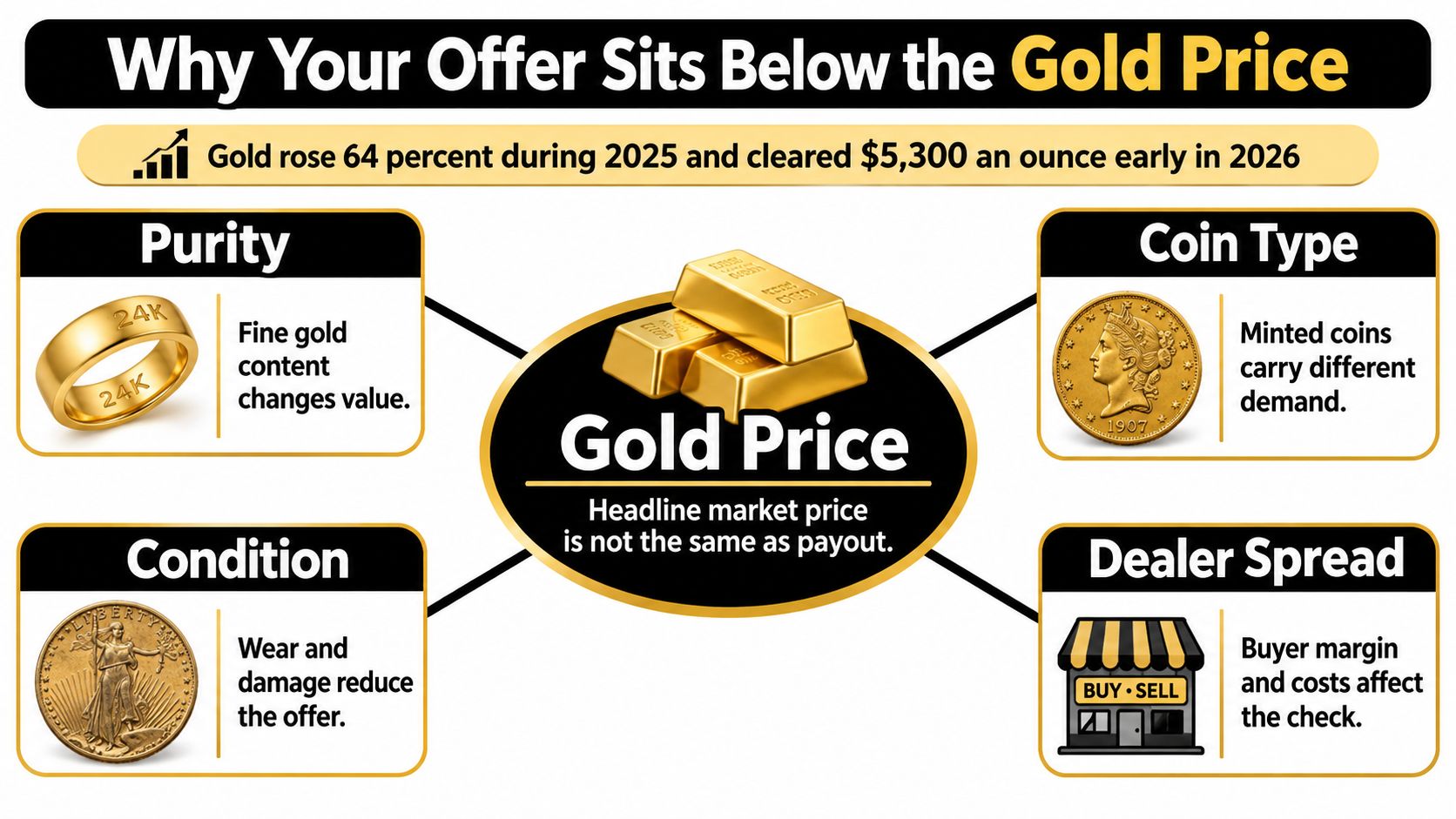
A high market doesn't guarantee the best bid
Buyers may change their margins when rapid price changes make inventory harder to price. Coin type and collector demand can also affect an offer: one buyer may price a coin mainly as bullion, while another may recognize a numismatic premium.
For a clear comparison, use a guide to what the gold spot price means to distinguish the market benchmark from a product-specific quote. Then ask:
What is the net buy-back amount for this coin, and which charges are already included?
Write down the benchmark and the four offer components before comparing bids. A verified local Boise sale can be a stronger choice than an online headline if the written offer clearly shows the net amount and its calculation.
Melt Value by Coin Size Before Any Fees
Estimated melt value = fine troy ounces × current benchmark price.
Use the coin's fine-gold content, not its denomination and not an unverified reading of its total weight. The following table uses a hypothetical benchmark for arithmetic only, not a current buying quote.
Illustrative melt value by fine-gold weight
At an illustrative $5,300 per fine troy ounce, the calculations are:
| Coin size | Melt near $5,300 | Effect of a $100 spot move |
|---|---|---|
| 1 troy oz American Eagle, Buffalo, Maple, or Krugerrand | $5,300 | About $100 |
| 1/2 troy oz | $2,650 | About $50 |
| 1/4 troy oz | $1,325 | About $25 |
| 1/10 troy oz | $530 | About $10 |
These are calculated examples using stated fine-gold weights and the formula above. They exclude any product premium, buyer margin, collectible value, or transaction charge.
The LBMA's precious-metal benchmark guide describes the LBMA Gold Price as being set at 10:30 and 15:00 London time, in U.S. dollars per fine troy ounce, for a benchmark defined for 995-fineness gold; the troy-weight conversion used for gold is 31.1035 grams per troy ounce.
A benchmark is a reference point. For an actual sale, note the benchmark's date and time alongside the buyer's quote so you aren't comparing offers prepared under different market conditions.
Avoid the American Gold Eagle purity trap
A coin's alloy purity and its stated fine-gold content answer different questions. An American Gold Eagle labeled as containing a full ounce of gold shouldn't receive an additional purity discount because its alloy also contains other metals.
The extra alloy contributes to the coin's gross weight. It doesn't remove gold from the stated fine-gold amount.
This distinction also matters when comparing American Eagles, American Buffalos, Canadian Maple Leafs, and Krugerrands. The relevant table row is determined by the coin's verified fine-gold content, not merely its diameter, color, or product-family name.
For older domestic coins and unfamiliar denominations, our guide to the gold content of U.S. coins can help you identify what needs checking before you accept a calculation.
Make your own inventory card
Prepare a short record for each coin:
- Identity: Record its type, date, and mint mark, if present.
- Specifications: Note stated fineness, fine-gold content, and gross weight separately.
- Weighing method: Use a calibrated scale displaying grams or troy ounces.
- Market reference: Save the benchmark and the time it was checked.
A kitchen scale that displays ordinary ounces doesn't display troy ounces. It may also lack the resolution needed to evaluate a small coin reliably, so don't treat a rounded kitchen reading as authentication.
Melt is a comparison baseline, not a guaranteed minimum offer. It tells you what metal value you're discussing before anyone prices the actual transaction.
Purity, Coin Type, Condition and Dealer Spread
A useful offer explains which characteristics changed the buyer's bid. “That's our percentage” doesn't tell you whether the buyer recognized the coin, evaluated its condition, or allowed anything for collector demand.
Physical coin demand is distinct from a quoted metal price. In a 1997 announcement, the United States Mint reported December Gold Eagle sales of 71,000 troy ounces, illustrating an established bullion distribution market, not a retail seller's guaranteed payout.
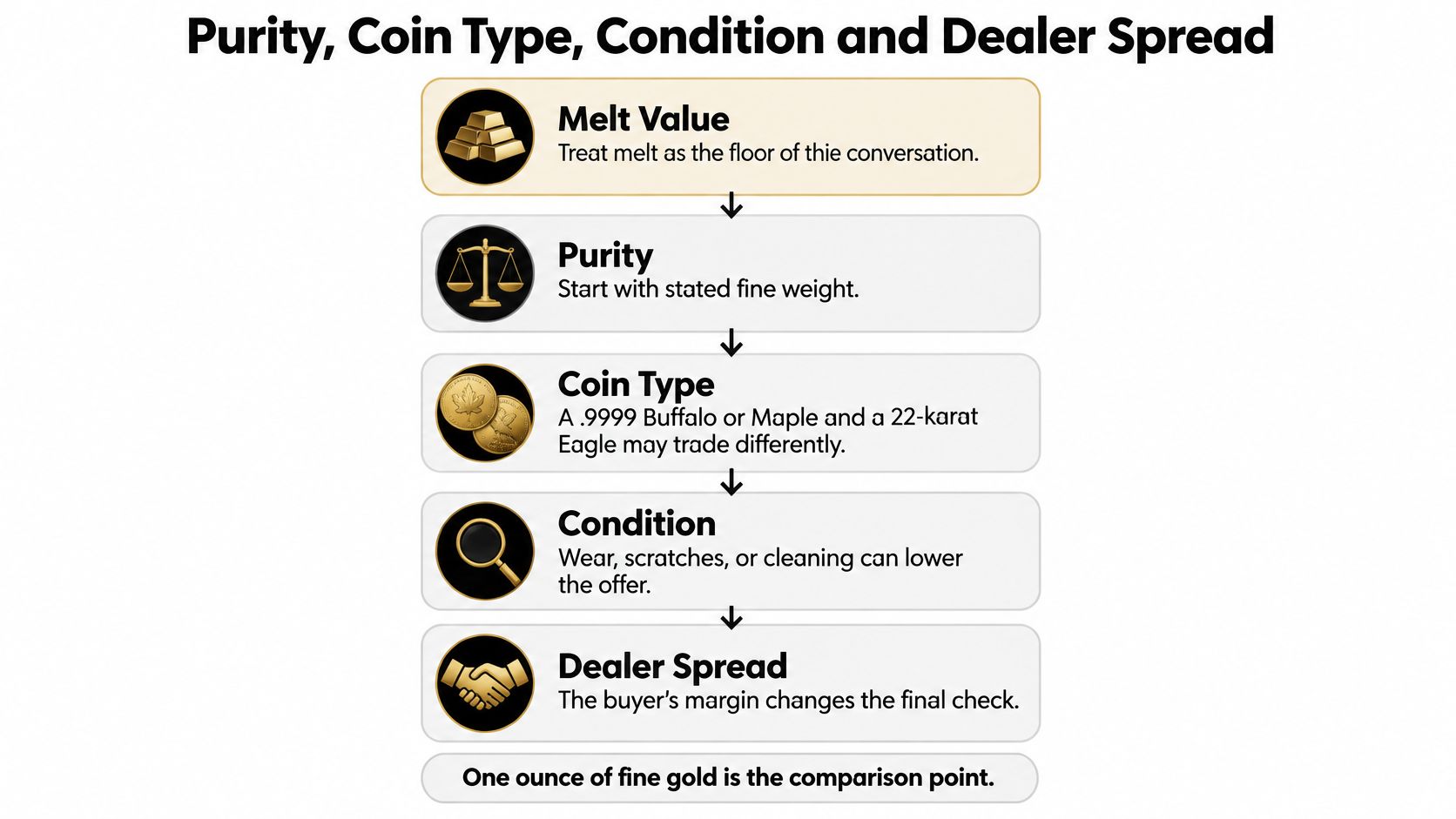
Purity identifies metal, coin type identifies the market
Start by checking that the buyer has used the correct fine-gold specification. Then ask what kind of buyer is likely to purchase the coin next.
A common bullion issue primarily serves someone buying gold. A scarce historical issue may serve a collector seeking a specific date, mint, or grade, which requires a different valuation approach.
Our guide to what numismatic coins are explains that distinction. A coin being old, attractive, or accompanied by a presentation box doesn't establish a collectible premium on its own.
The pricing factors fit together like this.
Condition changes the resale opportunity
Original surfaces, readable details, and an intact certified holder can matter to a collector. Cleaning, polishing, rim damage, or scratches can make a coin less desirable even when its gold remains present.
Don't clean a coin to prepare it for an evaluation. Keep certified pieces in their holders and bring any matching documentation.
Local demand also deserves a specific explanation, not an assumption. A Boise buyer may have a ready customer for a recognizable bullion product, while an unusual collectible may need a specialist.
- For bullion: Ask how the product's resale demand affects the bid.
- For collectibles: Ask which date, grade, or comparable sale supports the premium.
- For dealer margin: Ask whether testing and handling are included, so those costs aren't deducted twice.
A disagreement over a normal spread isn't automatically fraud. If a metals transaction involved alleged deception in an investment relationship, Kons Law's resource on FINRA arbitration for defrauded metals investors explains a potential avenue whose availability depends on the parties and circumstances.
Before accepting, identify which layer changed the number and why. That answer is more informative than a percentage without context.
Sample Sell Gold Coins Prices You Can Recheck
Say you bring a small inherited collection to a coin counter. You don't need a memorized price for every piece, but you do need a consistent way to read each offer.
For these hypothetical calculations, use $5,300 as an example benchmark, not a current quote. The dollar figures below are arithmetic illustrations, not promised payouts.
A common American Gold Eagle
Suppose the specifications confirm 1.000 fine troy ounce. Its illustrative metal baseline is $5,300, calculated as its fine weight multiplied by the hypothetical benchmark.
For a worn common-date example without an established collectible premium, the meaningful question is what the buyer bids for that bullion product. Ask for the dollar adjustment from the metal baseline and whether any additional charge remains.
An itemized offer should read like a calculation:
- Metal baseline: Verified fine weight multiplied by the chosen benchmark.
- Bullion adjustment: The product-specific addition or subtraction.
- Collector addition: Any separately supported numismatic value.
- Final deductions: Charges not already reflected in the bid.
The buyer shouldn't subtract a handling charge separately if the quoted margin already includes it.
A fractional Eagle
Suppose another coin contains one-tenth of a fine troy ounce. At the same hypothetical benchmark, its illustrative melt value is $530.
A small coin still requires identification, handling, and a payment transaction. A fixed dollar cost therefore represents a larger share of a fractional coin's value than of a larger coin's value.
That doesn't make every low offer reasonable. It means you should compare bids for the same fractional product rather than expecting every size to receive an identical percentage.
Compare the buyer's net dollar bid for the exact coin, not a percentage advertised for a different product.
A proof or certified coin
A proof or certified coin containing a fine troy ounce starts with the same illustrative $5,300 metal baseline, but the evaluation shouldn't stop there. Ask the buyer to identify the issue, verify the holder where applicable, and explain whether the date and grade attract a premium.
Proof manufacture doesn't automatically establish rarity. Nor does a certification label guarantee that a collector will pay the amount someone originally spent.
For another product-specific example, our discussion of American Buffalo gold coin pricing helps separate the coin's gold value from the price attached to the finished product.
A scratched common Krugerrand
If scratching hasn't removed a meaningful amount of metal, it doesn't by itself change the fine-gold calculation. It may, however, reduce what someone will pay for the coin above that baseline.
When the market changes, replace the old benchmark with the new one and have the buyer refresh the product bid. Don't adjust the final check blindly, because a buyer's product adjustment may change too.
A single percentage of the television gold price conceals these differences. A coin-by-coin calculation makes them visible.
A Written Offer Checklist Before You Sell
Before handing over a coin, create a record that lets you identify it and understand the proposed transaction. That's especially important when you're managing an estate collection or selling items whose history you don't know.
The CFTC's precious-metals fraud guidance warns that retail coin dealers generally aren't regulated by state or federal authorities and recommends independent reputation checks, credential verification, and written fee information. A professional-looking advertisement isn't a substitute for those checks.
Prepare the items and the record
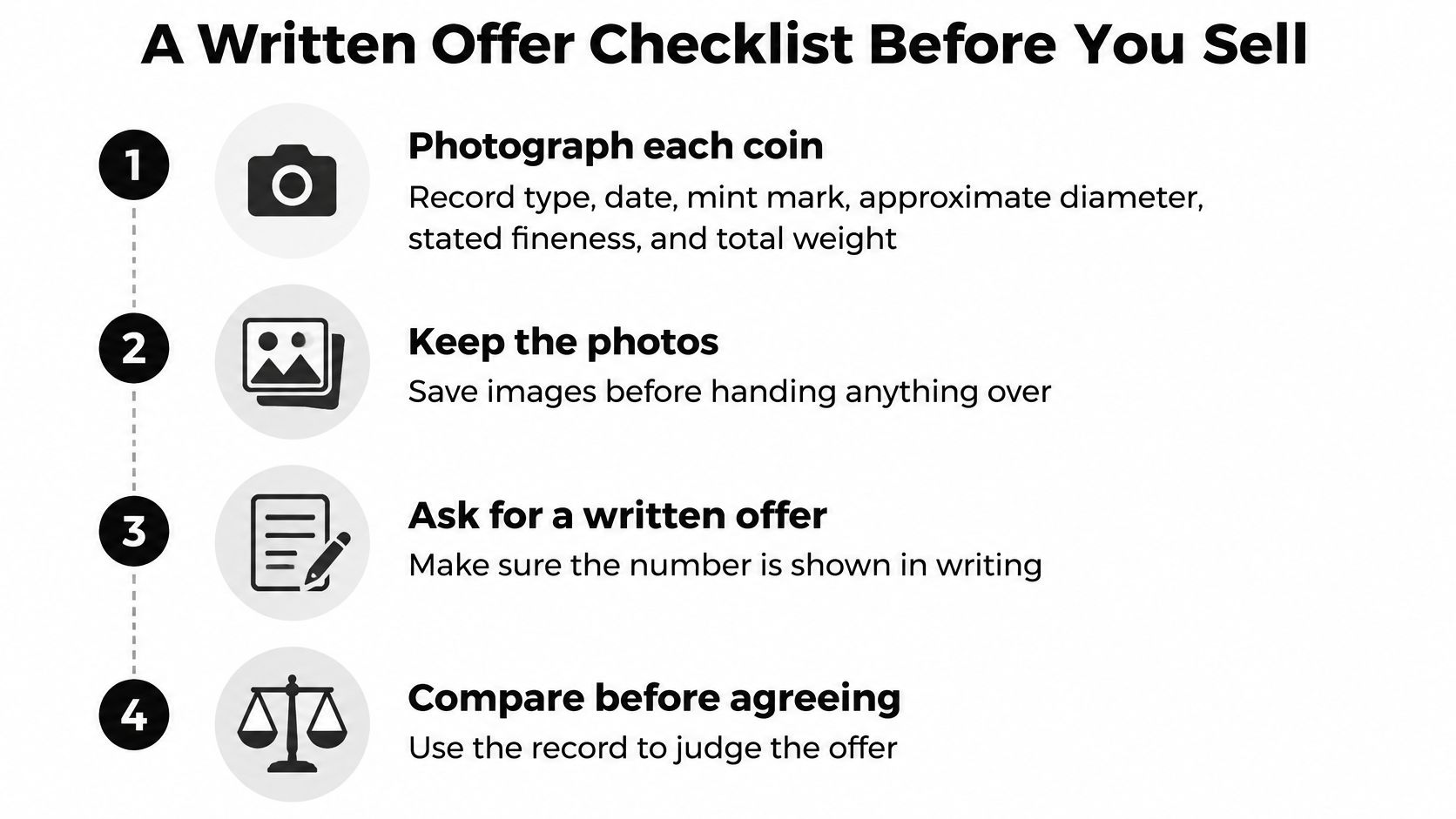
- Photograph each coin. Capture both faces and the edge where practical. Record type, date, mint mark, approximate diameter, stated fineness, and total weight, then keep the images with the offer.
- Clarify the testing method. Ask whether the proposed examination is nondestructive before consenting. X-ray scanning or electronic testing can help assess composition, but neither alone establishes a collectible grade or rarity.
- Protect estate documentation. Keep purchase records, certificates, holders, and estate inventory references together. For broader inherited household contents, the Clear It Services probate valuation guide offers useful organizational context, although an immediate cash offer and a formal estate valuation serve different purposes.
Use a checklist before anything leaves your possession.
Verify the transaction before accepting
- Require an itemized offer. It should identify the items, verified metal content, benchmark used, product or collector adjustments, and every separate charge. Ask how any commission is included in the spread.
- Confirm payment availability. Establish the method and when the funds become usable, not when someone says payment has been initiated. Resolve that before transferring ownership.
- Check the buyer independently. Read reviews beyond the buyer's own website, check complaint records, and verify claimed credentials. Decline unsolicited approaches, social-media buyers, traveling buyers, and anyone insisting on visiting your home.
- Separate evidence from expectations. A family description of a coin as rare is a reason to investigate, not proof of value. If authenticity or collectible status remains uncertain, seek an appropriate evaluation rather than accepting either an unsupported premium or an unexplained scrap classification.
- Retain the final receipt. Keep the itemized sale record with your photographs and acquisition documents for tax records and estate accounting.
Before you sign: The written net amount, payment terms, and items being transferred should match what you understood at the counter.
Authentication protects both sides. It can preserve a genuine collectible's value while preventing an uncertain identification from becoming a confident but misleading price.
Sell Locally in Boise Instead of Shipping
A higher advertised price does not always mean more money in your pocket. Compare the net amount after testing, shipping, insurance, and any other deductions. Selling in person lets you discuss the coin while it is there; shipping means understanding the custody, insurance, testing, and return terms before the package leaves your hands.
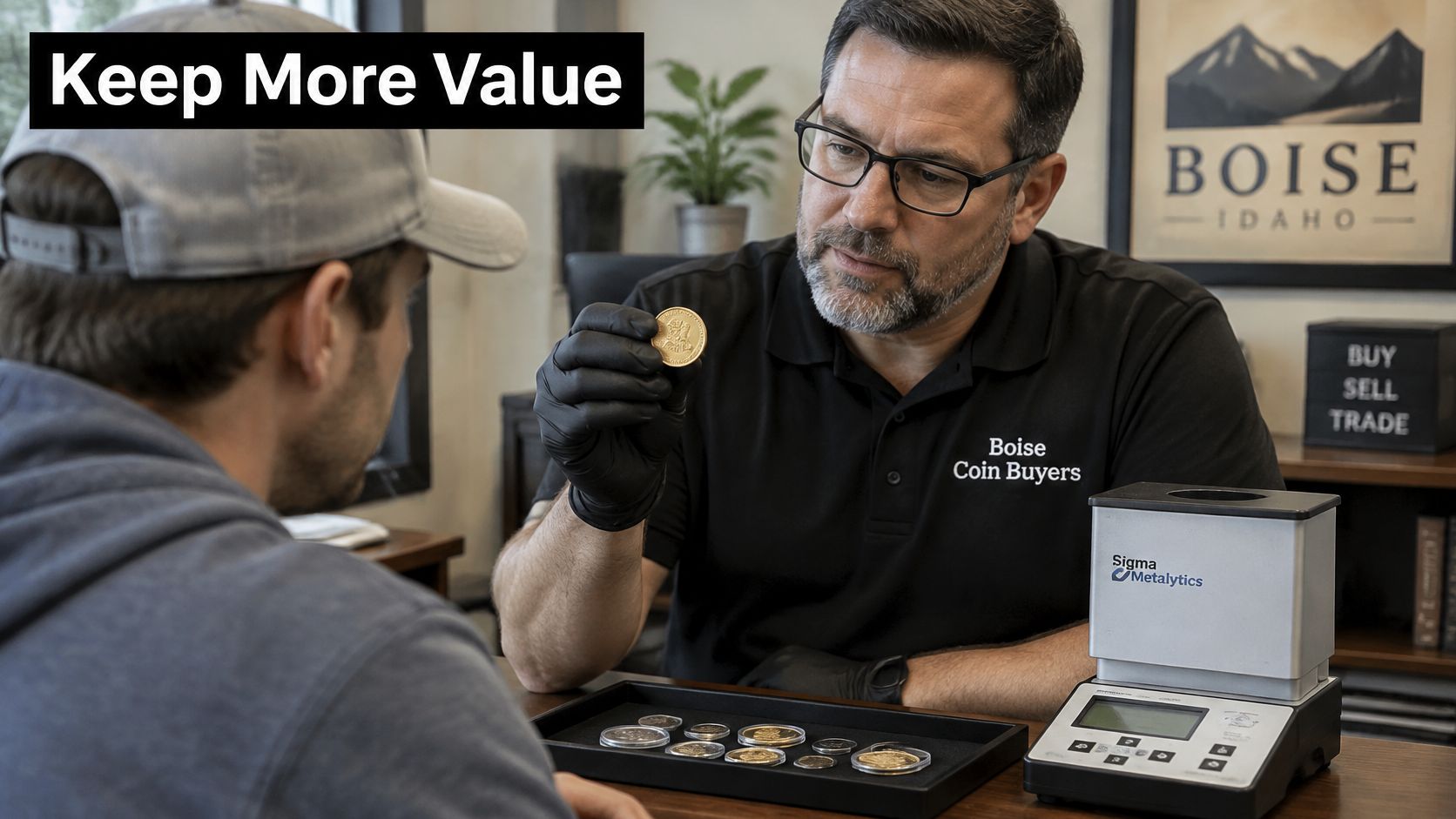
Local Boise sale versus shipping the coins
| Route | Control and testing | Costs that cut the check | When it fits |
|---|---|---|---|
| Walk-in Boise buyer | Coin can stay in sight; ask how its metal content and type are assessed | Dealer spread and any stated fees | Coins plus jewelry; useful when you want to discuss the offer in person |
| Insured mail-in buyer | You ship before the assay | Postage, insurance, possible rejection and return costs | Simple heavy bullion with a verified written bid |
| Traveling or social buyer | May involve a proposed home visit | Pressure and unclear fees | Rarely; unsolicited visits are a warning |
A local sale can cost less overall, but a storefront does not guarantee a stronger offer. Compare written net bids and payment terms, just as you would compare two receipts line by line.
Selling locally for more than an online shipment is a possibility, not a promise. The local net offer needs to exceed what remains from the shipped offer after postage, insurance, and other deductions.
Price Matching needs an equivalent offer
The FTC's advertising guidance says marketing claims should be truthful, non-deceptive, and evidence-based. For a useful price comparison, match the item, weight basis, market date, and transaction terms. A headline number is not the same as a net offer.
If you want the highest payout in Boise, collect comparable written bids. An online estimate subject to examination is not equivalent to an unconditional offer for an authenticated coin.
Our guide to local gold and silver dealers can help you frame that comparison. Bring the competing written offer so the underlying calculation, not just the advertising language, can be reviewed.
For a visual introduction to a local evaluation setting, watch the video below.
Prepare coins and jewelry separately
A coin's appearance alone cannot establish its metal content or collector value. Separate common bullion, certified or proof coins, jewelry, and suspected plated items before a visit. Leave coins uncleaned, and keep stones and other non-gold components identifiable rather than assuming the whole item's weight is gold.
If you're also organizing an inherited home, estate cleanout help from California Freedom provides context for the broader task. Set aside coins, certificates, and precious-metal items before household contents are cleared.
Carat 24 buys and sells gold, silver, bullion, coins, and other precious metals. Its local Boise team provides prices and insights on gold, silver, jewelry, and diamonds. Carat 24 also publishes live spot prices and product-related premiums, which include production, shipping, and other market costs.
Prices for items sold to Carat 24 are based on good, marketable condition. Significant wear or damage may lead to a lower offer or an item not being accepted. Before deciding, ask what the written offer includes and how its separate parts affect the net amount.
Carat 24 - Trusted Gold Experts buys and sells coins and other precious metals. Bring your sorted coins, certificates, and any competing written bid to Carat 24 - Trusted Gold Experts, and ask for a written offer that identifies the benchmark, product adjustments, and net amount before you decide.
