
That old half dollar sitting in a drawer could be worth a whole lot more than fifty cents. The real story behind a half dollar silver value comes down to two things: the precious metal it's made of (its melt value) and how much a collector might want it (its numismatic value).
It’s simple, really. Coins minted before 1965 are made of 90% silver, and those from 1965-1970 contain 40% silver. That silver content gives them a solid floor price that moves right along with the daily spot price of silver.
Your Half Dollar’s Two Sources of Value
Before you can figure out what your coins are worth, you have to get one thing straight: not all half dollars are created equal. Their value comes from two different places that sometimes overlap—the raw silver inside them and their appeal to a collector.
For over 170 years, the U.S. half dollar was a workhorse of American currency. The Coinage Act of 1792 set the standard, mandating that they contain 90% silver and 10% copper. Each 12.5-gram coin held about 0.3617 troy ounces of pure silver, basically making them portable silver bullion for the average person.
This chunk of silver is what gives the coin its intrinsic, or "melt," value. Think of it as the absolute minimum price; your coin will never be worth less than the silver it contains. For most common, well-circulated coins, this is where the value story begins and ends.
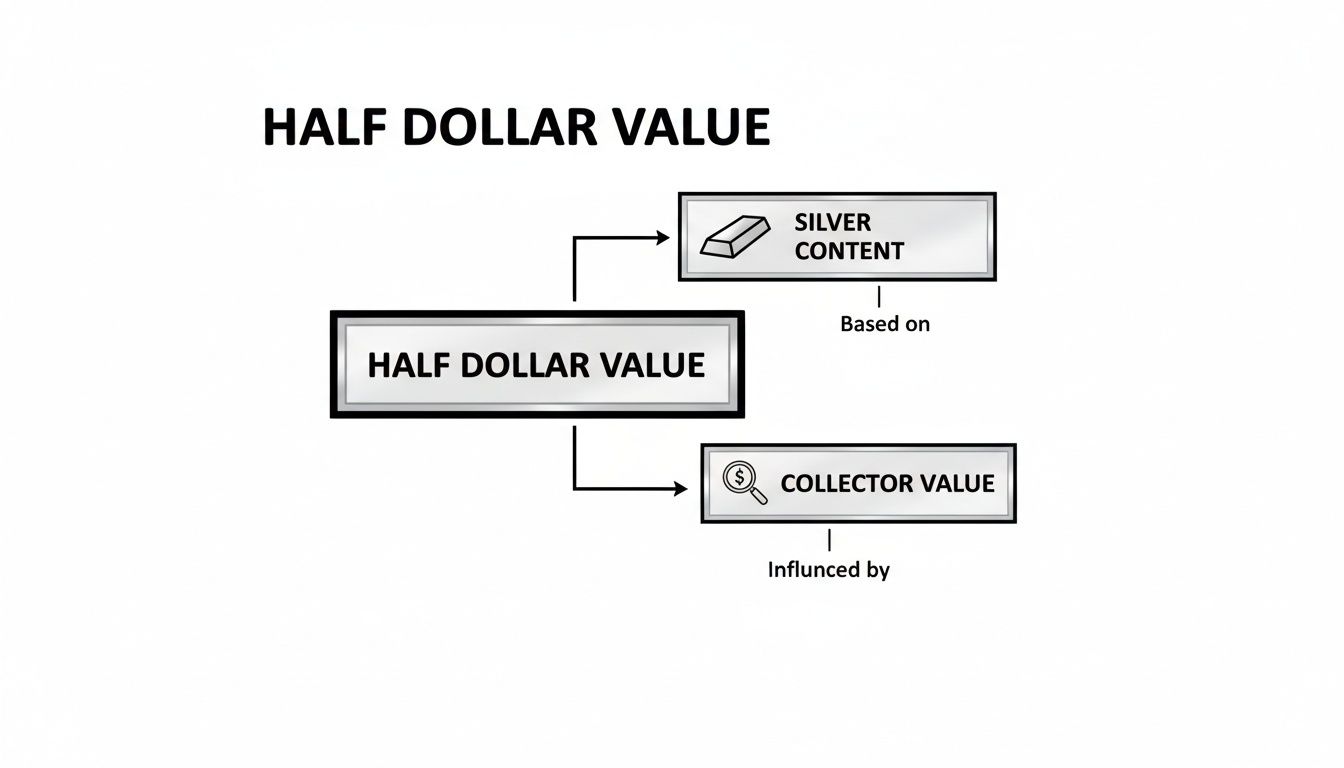
The key takeaway here is that every silver half dollar has that base melt value. But only some will get an extra boost from collector demand.
The Collector Premium Factor
The second source of value is what we call "numismatic value," and it's all about what collectors are looking for: rarity, condition, mintmarks, and historical importance. A run-of-the-mill 1964 Kennedy half dollar might just be worth its silver weight. But find a rare date in pristine, uncirculated condition? You could be looking at hundreds or even thousands of dollars.
So what elevates a coin from being just a piece of silver to a true collectible?
- Key Dates: Some years, the mint just didn't produce very many coins, making them much harder to find today.
- Mintmarks: Coins were made at different mints (like Philadelphia, Denver, or San Francisco), and certain mintmarks from specific years are scarcer than others.
- Condition (Grade): A coin that looks like it just left the mint, with sharp details and no wear, is always going to be more desirable than one that's been rattling around in pockets for decades.
- Errors and Varieties: Every now and then, a mistake happens during the minting process. These error coins can be incredibly rare and valuable.
Understanding these two different value paths is the first, most important step in figuring out what you have. For a deeper dive into specific years, check out our guide on which half dollars are silver. Knowing this dual-value system is critical before you decide to sell.
At Carat 24, we specialize in Gold and Jewelry Buying and offer free, professional evaluations. We use Xray Scanning and Gold Testing for free to determine the precise value of your coins, ensuring you get the highest payout in Boise. Our process is quick and provides hassle-free offers, letting you save the hassle and sell locally for more than online shipments. Our Price Matching policy gives you complete confidence.
The Classic Era of 90% Silver Half Dollars
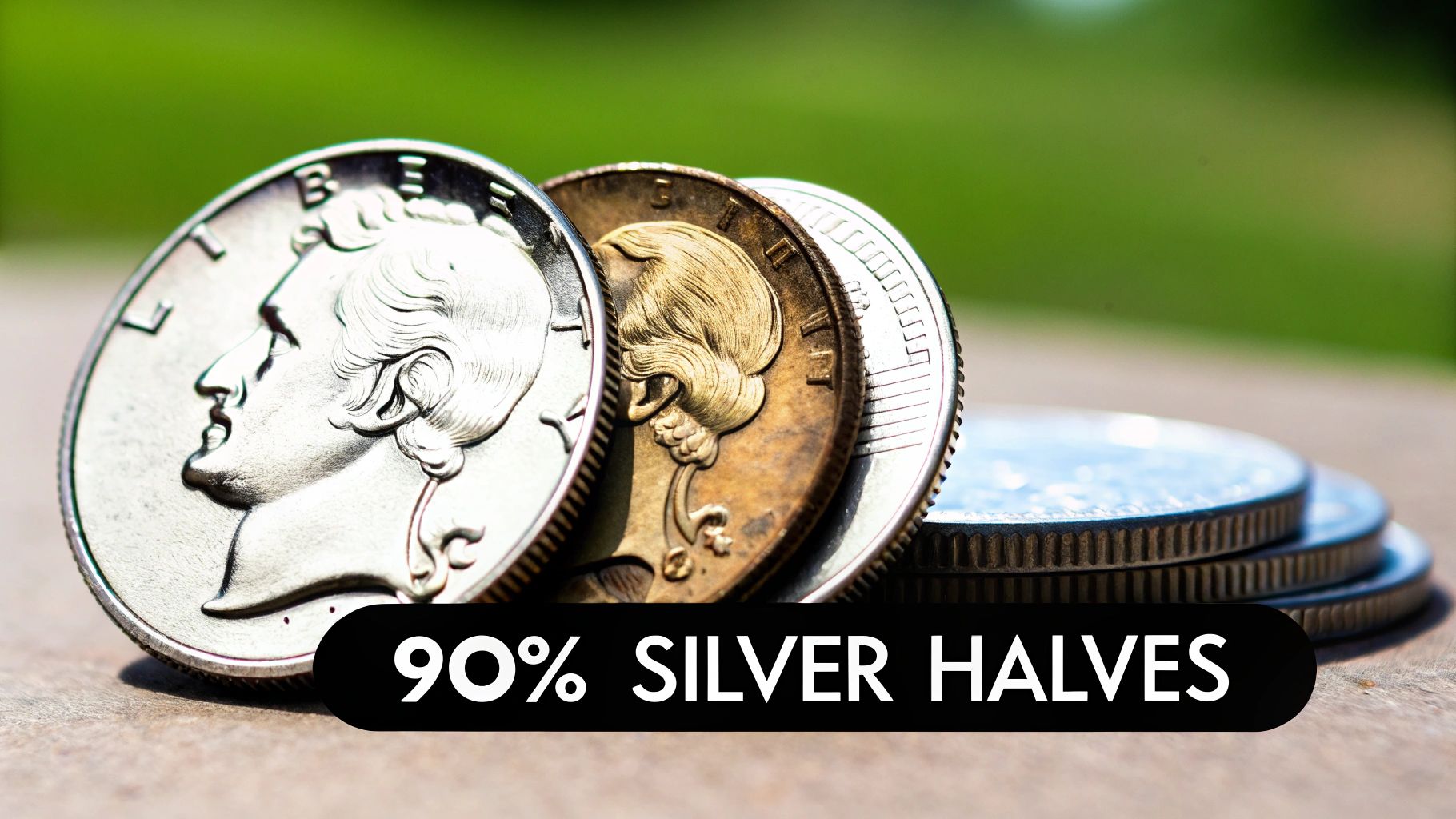
Before 1965, the half dollar in your pocket was something special—a solid piece of precious metal. This was a golden age for American coins, a time when our currency was made of 90% silver. These aren't just old coins; they're tangible assets with a real, measurable value based on the silver they contain. This era also gave us some of the most beautiful and iconic designs in U.S. history.
We're going to dive into the three key players from this period: the elegant Walking Liberty (1916-1947), the classic Franklin (1948-1963), and the historic 1964 Kennedy half dollar. Think of each one as a small, government-guaranteed silver ingot containing exactly 0.3617 troy ounces of pure silver.
Calculating Melt Value Made Simple
The starting point for any half dollar silver value is its "melt value." This is simply the raw value of the silver inside the coin. It’s the absolute floor for what the coin is worth, and it changes every day along with the global silver market.
Figuring it out is surprisingly easy. You just need the current spot price of silver and a quick bit of multiplication:
Silver Spot Price (per ounce) x 0.3617 = Melt Value of one 90% Silver Half Dollar
Let's say the spot price of silver is $30 per ounce. The melt value of your Walking Liberty, Franklin, or 1964 Kennedy half would be $30 x 0.3617 = $10.85. That simple math is exactly why you should never, ever spend one of these for just fifty cents!
You might hear these common-date silver coins called "junk silver." That term sounds bad, but it's a bit misleading. It just means the coins don't have a big collector premium beyond their silver value, which makes them a fantastic and straightforward way to own physical silver.
Iconic Designs and Collector Premiums
While melt value gives you a solid baseline, the real fun begins when you find a coin that a collector would pay much more for. Each of these 90% silver half dollar series has its own list of key dates, mintmarks, and special varieties that can send its value soaring far past its silver content.
Here’s a quick look at what to watch for in each series:
-
Walking Liberty Half Dollar (1916-1947): Often called the most beautiful coin ever minted by the U.S., this series is a huge favorite among collectors. Because the design is so detailed, it wears down easily, making coins in great condition quite rare and valuable. Keep an eye out for early dates from the 1910s and 1920s, especially those with an "S" (San Francisco) or "D" (Denver) mintmark. A coin like the 1921-D is a legendary key date, worth hundreds even in rough shape. To see a full breakdown of what these coins can be worth, learn more about Walking Liberty half dollar values in our detailed guide.
-
Franklin Half Dollar (1948-1963): This is a great series for someone just getting into collecting. Most dates are pretty common, but a few, like the 1949-S or the 1955, had lower mintages and fetch higher prices. The real prize for Franklin halves is finding one with "Full Bell Lines" (FBL). This means the coin was struck so perfectly that you can see all the horizontal lines on the Liberty Bell—a detail that can make the coin worth 10 times more, or even higher.
-
Kennedy Half Dollar (1964 Only): The 1964 Kennedy half is a one-year wonder. It’s the only year this beloved design was struck in 90% silver for circulation. Issued right after President Kennedy's assassination, millions were squirreled away by the public as keepsakes. While they aren't rare, they are always worth their significant silver value.
When you bring your coins to Carat 24 for Gold and Jewelry Buying, our expertise goes far beyond just weighing precious metals. We provide free Xray Scanning and Gold Testing to pinpoint the exact makeup of your items. It's a transparent process that lets us make hassle-free offers and give you the highest payout in Boise. We even offer Price Matching, so you can save the hassle and sell locally for more than online shipments.
The Transitional 40% Silver Kennedy Half Dollars
The story of American coinage took a sharp turn in the mid-1960s. After decades of striking half dollars with a hefty 90% silver content, skyrocketing silver prices forced the U.S. Mint to make a dramatic change.
This shift created a unique and often misunderstood class of coins: the Kennedy half dollars minted between 1965 and 1970. These are the only U.S. half dollars ever produced with a 40% silver composition, making them a fascinating bridge between the classic silver era and the copper-nickel coins we use today.
Many of these halves were tucked away as mementos of President Kennedy, while others were melted down when silver prices spiked in the late '70s and early '80s. They represent a fascinating moment when the government tried to keep precious metal in circulation while grappling with economic realities.
Understanding the Clad Composition
So what does "40% silver" actually mean? Unlike their solid 90% silver predecessors, these coins have a layered, or "sandwich," construction. Think of it as a metal Oreo.
The outer layers are a blend of 80% silver and 20% copper. These are bonded to a core that's mostly copper with just a touch of silver (21%). When you put it all together, the total silver content works out to exactly 40%.
This change wasn't random; it was mandated by the Coinage Act of 1965. Silver prices were climbing so high that the metal in the coins was becoming worth more than their face value. To prevent widespread melting, President Lyndon B. Johnson's administration moved to debase the coinage. The act specifically called for this new 40% silver composition in Kennedy halves, with each coin containing 0.1479 troy ounces of pure silver.
How to Calculate Their Melt Value
Just like the 90% silver coins, the base half dollar silver value for these 40% pieces is tied directly to their silver content. The formula is just as simple, but we use the lower silver weight:
Silver Spot Price (per ounce) x 0.1479 = Melt Value of one 40% Silver Half Dollar
Let's run a quick example. If the spot price of silver is $30 per ounce, the melt value of a 1965-1970 Kennedy half dollar would be $30 x 0.1479, which equals $4.44.
While that's less than half the silver value of a pre-1965 coin, it’s still nearly nine times its face value. That makes these coins a fantastic find, especially since they're often overlooked by people who don't know the difference.
Identifying 40% Silver Kennedy Halves
So, how can you tell if that Kennedy half in your hand is one of the valuable 40% silver versions or just a regular, non-silver coin made from 1971 onward? The easiest way is the "edge test." Just turn the coin on its side and take a look.
- Solid Silver Stripe: If you see a bright, solid silver stripe with no other colors, you've got a 90% silver 1964 Kennedy.
- Faint Copper Stripe: If you see a mix of silver with a very faint, thin copper-colored line running through the middle, it's a 40% silver half from 1965-1970.
- Obvious Copper Band: If the edge has a very prominent, thick copper stripe sandwiched between two silver-colored layers, it's a standard copper-nickel clad coin with no silver value.
This simple visual check is the quickest way to sort your Kennedy half dollars. For a complete picture of values across all years, you can explore our in-depth guide to the value of Kennedy half dollars by year.
Whether you have a few 40% silver halves or a large collection of coins and jewelry, getting an accurate appraisal is key. At Carat 24, we specialize in Gold and Jewelry Buying, providing the highest payout in Boise. We use free Xray Scanning and Gold Testing to verify your items precisely. Our hassle-free offers and Price Matching guarantee ensures you can save the hassle and sell locally for more than online shipments.
Discovering Modern Silver Proofs and Special Issues
Most people think the story of the silver half dollar just... stopped in 1970. That's the year the U.S. Mint quit making them for your pocket change, but it's far from the end of the story. In fact, a whole new chapter began, one written exclusively for collectors. The Mint never actually stopped making silver half dollars; they just started producing them as special issues you wouldn't find at the grocery store.
These modern coins, usually found in their pristine, official government packaging, can carry some serious half dollar silver value. They perfectly bridge the gap between the classic coins of yesterday and the savvy investments of today, opening up a new world for both dedicated collectors and silver stackers.
The Rise of Silver Proof Sets
The easiest way to get your hands on these modern silver treasures is through the annual Silver Proof Sets. Think of these as the "best of the best" for a given year—specially curated sets of coins struck with a stunning, mirror-like finish, created solely for the collector market.
Unlike their everyday copper-and-nickel cousins, the Kennedy half dollars tucked inside these sets are the real deal. While the coins made for circulation ditched silver after 1970, the U.S. Mint ramped up production of silver proofs for collectors. From 1992 to 2018, these annual sets featured Kennedy halves struck in the traditional 90% silver. Then, starting in 2019, the Mint upped the ante, striking them in gorgeous 99.9% fine silver.
These sets are a fantastic way to acquire high-quality silver coins, and because they're almost always kept in their original protective cases, they stay in immaculate condition. Getting a handle on what they're worth is key, which is why we've put together a detailed guide digging into the nuances of United States Proof Set values.
Special Issues and Bicentennial Silver
Beyond the yearly proof sets, the U.S. Mint has occasionally released other special edition silver half dollars. One of the most common ones you'll run into is the Bicentennial (1776-1976) Kennedy half dollar.
To celebrate the nation's 200th birthday, the Mint produced special collector's sets containing Bicentennial quarters, half dollars, and dollars struck in 40% silver. It's crucial to know that these are completely different from the billions of standard copper-nickel Bicentennial coins that flooded circulation.
So, how do you spot the silver ones? The silver versions were only sold in special mint packaging and were never meant to be spent. If you find one that's been broken out of its original holder, the same old "edge test" works. A solid silver-colored edge means you've got a 90% coin, while a faint stripe with a hint of copper tells you it's a 40% silver planchet. These special issues are a great reminder that even modern-looking coins can pack a surprising silver punch.
When you bring your collection to us, you can be confident you're getting an expert evaluation. We are a trusted name for Gold and Jewelry Buying and offer the highest payout in Boise. Our process includes free Xray Scanning and Gold Testing to accurately assess every item. We provide hassle-free offers and even have a Price Matching policy. You can save the hassle and sell locally for more than online shipments.
How to Sell Your Silver Coins in Boise for the Highest Payout
Now that you're armed with the knowledge to figure out your half dollar's silver value, the next logical step is finding the best place to sell. It can be tempting to look at online marketplaces or mail-in companies, but they often come with risks, delays, and hidden costs that can chip away at your profits. The anxiety of shipping valuable precious metals and waiting for a verdict from a buyer you'll never meet is a real concern for many.
This is exactly why a local, in-person sale offers unmatched peace of mind—and often, a better financial outcome. You can skip the hassle of packing, insuring, and shipping your collection and instead get immediate, transparent service from a trusted expert. When you sell here in Boise, you stay in control of the entire process from start to finish.
Why Selling Locally Is the Smarter Choice
Choosing a local buyer means you can walk in, get your coins evaluated, and leave with cash in hand—often in less than an hour. Forget waiting days or weeks for a check to arrive in the mail. More importantly, you get to be part of the evaluation, asking questions and seeing firsthand exactly how your coins are assessed.
At Carat 24, we specialize in Gold and Jewelry Buying, and we bring that same level of expertise to your silver coins. We’ve built our reputation on total transparency and providing the highest payout in Boise.
Our commitment is simple: make the selling process as straightforward and rewarding as possible. We believe that when you understand how your items are valued, you can sell with complete confidence, knowing you received a fair and competitive offer.
Selling your coins shouldn't be complicated or stressful. We designed our process to be quick, clear, and completely pressure-free. Our goal is for you to feel comfortable and informed from the moment you walk through our doors.
The Carat 24 Advantage: A Transparent and Accurate Process
To make sure you receive the absolute best price, we rely on state-of-the-art technology, not just a magnifying glass. We provide Xray Scanning and Gold Testing for free, which allows us to determine the exact metallic composition of your coins and jewelry with scientific precision. This isn't guesswork; it's a verifiable, data-driven assessment.
This advanced testing removes all doubt and lets us make you an accurate, on-the-spot offer based on the true value of your silver. Our team is trained to identify not just the melt value but also any numismatic premium your coins might carry from being rare or in exceptional condition.
Here’s a quick look at how it works:
- Step 1: Expert Evaluation: Our specialists will carefully examine your collection right in front of you, identifying key dates, mintmarks, and conditions.
- Step 2: Advanced Testing: We use our non-invasive X-Ray Fluorescence (XRF) scanner to confirm the exact silver purity of each coin.
- Step 3: Transparent Offer: Based on the hands-on evaluation and testing, we’ll give you a clear, itemized offer.
- Step 4: Immediate Payout: If you accept, you get paid right then and there. No waiting.
This simple, four-step approach ensures a smooth and positive experience every time.
Hassle-Free Offers and a Price Match Guarantee
We get it. You want the best possible price for your valuables. That’s why we provide hassle-free offers with absolutely no obligation to sell. We’re confident in our pricing, and we want you to be, too. There are no hidden fees or surprise charges—the price we quote is the amount you receive.
Even better, we stand behind our commitment to offering the best value in the area with our Price Matching guarantee. If you bring in a better written offer from another local buyer, we will match it. This promise ensures you never have to wonder if you’re getting the top deal for your silver half dollars.
For anyone looking to learn more about turning their silver into cash, our guide on how to sell silver coins offers even more insights and tips.
Ultimately, selling your silver coins, gold, or jewelry should be a secure and profitable experience. By choosing a reputable local buyer like Carat 24, you eliminate the uncertainty of online transactions and gain the assurance of working with a trusted expert dedicated to giving you the highest possible payout. Save the hassle and sell locally for more than online shipments.
Common Questions We Hear About Half Dollar Value
Even after you get the hang of how silver content, dates, and condition affect a half dollar's silver value, it's totally normal to still have a few questions. This is the section where we tackle the most common things people ask us, clearing up any confusion and making sure you feel confident when you’re ready to sell your collection.

Which Half Dollars Are the Most Valuable?
This is the big one! A coin's total worth is really a blend of its silver content, its rarity, and its physical condition. While a standard 1964 Kennedy half dollar will always be worth something because of its 90% silver, its collector premium is usually minimal since millions were minted and saved.
On the other hand, a Walking Liberty half from a tough year like 1921-D can be worth hundreds of dollars, even if it’s seen a lot of wear. Find that same coin in pristine, uncirculated condition, and you could be looking at tens of thousands. The bottom line is that the most valuable coins almost always combine rarity (like a low-mintage key date) with exceptional preservation.
How Do I Know If My Kennedy Half Is 90% or 40% Silver?
Figuring this out is easier than you'd think, and you don’t need any special tools. All it takes is the "edge test."
- Grab the coin and turn it on its side.
- Look closely at the thin edge running around the coin.
If you see a solid silver stripe with no other colors peeking through, you've got a 90% silver 1964 Kennedy. If you see a layered stripe with a faint, coppery-brown line sandwiched between silver layers, it's a 40% silver coin from 1965-1970. A thick, obvious copper band means it’s a modern, non-silver coin made after 1970.
Should I Clean My Silver Coins Before Selling Them?
Let me make this crystal clear: no, absolutely not. It’s a tempting thought—making those old coins look shiny and new again—but cleaning them is one of the most damaging things you can do to their value.
Serious collectors and dealers prize coins in their original, untouched state. The natural toning, or "patina," that forms on a silver coin over many decades is actually a desirable trait that proves its age and authenticity. Cleaning, even gently, strips away that history and leaves microscopic scratches, permanently ruining the coin's surface. This can instantly slash a coin’s numismatic premium down to zero, leaving it worth only its base melt value.
Can I Still Find Silver Half Dollars in Circulation?
Believe it or not, yes, but it’s a long shot these days. Most silver was snatched out of circulation by savvy individuals decades ago. Still, every once in a while, an old collection gets spent by someone who doesn't realize its value, or a stray silver coin turns up in a bank roll.
This hobby, known as "coin roll hunting," is still popular. While you're far more likely to stumble upon 40% silver Kennedy halves from 1965-1970 than the older 90% silver coins, the thrill of the hunt keeps people searching.
Where Can I Get a Free Coin Appraisal in Boise?
Getting a professional, honest appraisal is the single most important step before you sell. Here at Carat 24, we specialize in Gold and Jewelry Buying, and we provide expert evaluations for your silver coins completely free of charge. We pride ourselves on offering the highest payout in Boise through a process that’s transparent and easy.
We use advanced equipment, including free Xray Scanning and Gold Testing, to verify the exact metal content of your items on the spot. This lets us make you a precise, hassle-free offer with no pressure to sell. We even offer Price Matching against any written offer from another local buyer. You can save the hassle and sell locally for more than online shipments, knowing you’re working with a trusted local expert who understands the real value of your collection.
Ready to discover what your silver coins, gold, and jewelry are really worth? Visit Carat 24 in Boise for a free, no-obligation evaluation and get the highest payout, guaranteed. Stop by our store today or learn more at https://carat24boise.com.
