

Here’s one of the oldest tricks in the book and still the quickest way to get a feel for a pearl’s authenticity: the tooth test. Just gently rub the pearl against the front of your tooth. A real pearl will feel slightly gritty, almost like fine sandpaper, due to its natural nacreous layers. Imitations, on the other hand, are usually glass or plastic and will feel perfectly smooth. It’s a simple, classic method that jewelry lovers have trusted for generations.
The Enduring Allure of Genuine Pearls
There’s a reason real pearls become cherished heirlooms, passed down from one generation to the next. They carry a timeless elegance and a personal history. But with so many convincing fakes on the market today, how can you be certain that treasured strand is the real deal?
This guide will walk you through practical, real-world ways to tell genuine pearls from imitations. We'll cover simple tests you can do right at home and touch on the more advanced techniques the pros use. Getting this right is crucial, whether you're sizing up a flea market find, confirming a new purchase, or trying to understand the value of your own collection. A genuine pearl tells the story of its creation inside a living mollusk—a story no factory-made bead can ever replicate.
Why Authenticity Matters
Knowing whether your pearls are real is about more than just satisfying curiosity. It’s about appreciating their true value, their unique history, and the natural beauty that makes them so special. The authenticity of a pearl is what defines its worth, from classic single-strand necklaces to modern designs like a beautiful black pearl ring.
This knowledge becomes especially important if you ever consider selling your jewelry. You need an accurate assessment to ensure you get a fair price.
As Boise's trusted experts in Gold and Jewelry Buying, we believe in full transparency. Selling locally means you skip the hassle and risk of shipping your valuables and can be confident you’re getting the best offer. You can save the hassle and sell locally for more than online shipments.
Your Local Boise Experts
When you need a definitive answer, nothing beats a professional evaluation. Here at Carat 24, we specialize in providing clear, honest assessments for your jewelry. We offer free, no-obligation evaluations, complete with Xray Scanning and Gold Testing for free, so you can have total confidence in what you own.
Our entire goal is to make the process easy and provide you with hassle-free offers backed by a Price Matching guarantee. We're committed to making sure you receive the highest payout in Boise. By working with a local expert, you protect your investment and unlock its true value without the uncertainty of dealing with distant, online buyers.
Simple At-Home Tests for Pearl Authenticity
Before sending your jewelry off for a professional opinion, there are a handful of surprisingly effective tests you can do right at home. These are the classic, hands-on methods that jewelers and savvy buyers have relied on for generations. You don’t need any fancy equipment—just a good eye, a sense of touch, and a little bit of know-how.
Let’s start with one of the most famous (and strangest-sounding) methods: the Tooth Test. It’s a classic for a good reason—it works.
Did you know the global pearl market was valued at over $10 billion in 2023? According to industry reports, a shocking 70-80% of "pearls" sold in major markets are actually imitations or heavily treated fakes. This is exactly why simple tests have been a go-to since the early 20th century, a time when a single strand of top-tier South Sea pearls could fetch the equivalent of $1 million today.
To do the tooth test, just gently rub a pearl against the edge of your front tooth.
- Real Pearls: You’ll feel a distinct, slightly gritty, or sandy texture. This is due to the microscopic crystalline structure of the nacre, which is built up in layers by the mollusk over 1-3 years.
- Imitation Pearls: Fakes made of glass, plastic, or ceramic will feel perfectly smooth and slippery. There’s no friction at all.
This test became wildly popular after World War I, right around the time cultured pearls from Japan first hit the market in 1921. This influx caused prices to plummet by 90% and, you guessed it, opened the floodgates for a wave of convincing counterfeits.
For a quick rundown of what to look for, this table breaks down the key differences between the real deal and the fakes.
Real Pearls vs Imitation Pearls at a Glance
| Characteristic | Real Pearls (Cultured or Natural) | Imitation (Fake) Pearls |
|---|---|---|
| Tooth Test | Gritty, sandy friction | Smooth, slippery, no texture |
| Luster | Deep, inner glow; soft, reflective | Shallow surface shine; looks glassy or plasticky |
| Surface | Minor blemishes, pits, or ridges | Perfectly smooth and flawless |
| Shape & Size | Slightly irregular shapes; minor size variations | Perfectly round and uniform in size |
| Temperature | Cool to the touch, warms slowly | Room temperature, warms up instantly |
| Weight | Feels heavier than it looks for its size | Feels lightweight, like plastic |
| Drill Hole | Sharp, well-defined edges | Chipped coating or rounded, uneven edges |
As you can see, nature is rarely perfect, and those little imperfections are often the very signs that tell you you're holding something genuine.
Examining Luster and Overtone
Beyond texture, a pearl’s glow is its soul. Real pearls have a unique quality called luster, which isn’t just surface shine—it’s a deep, rich light that seems to come from within. This beautiful effect is created by light reflecting through countless microscopic layers of nacre.
Hold the pearls under a good light source and take a close look.
- A real pearl will have a soft, deep glow. You should be able to see your reflection on its surface, even if it’s a bit blurry.
- An imitation pearl typically has a shallow, glassy shine that sits right on the surface. It might look overly bright or even cheap, but it will lack that unmistakable inner depth.
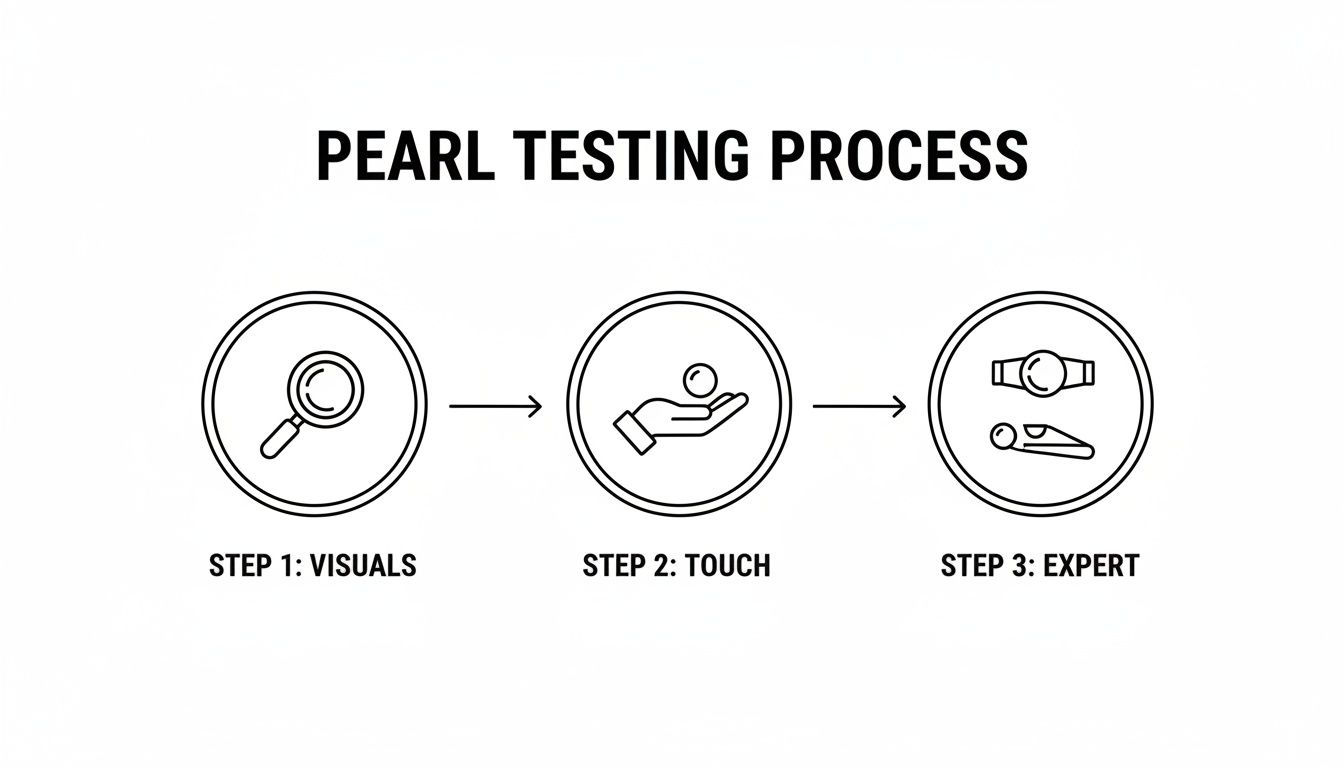
This simple flowchart shows how the process works. You start with visual and touch tests at home, but for a piece you believe has real value, a professional evaluation is the only way to be 100% certain.
The Feel Test: Temperature and Weight
Another great clue is right at your fingertips. Before you even put them on, hold the pearls in your hand.
Genuine pearls will feel cool to the touch. It takes them a few moments to warm up against your skin because nacre, the natural material they're made of, is dense and stays cool. In contrast, most plastic imitations will feel room temperature right away or warm up almost instantly.
Weight is another dead giveaway. Real pearls are surprisingly dense and often feel heavier than they look. If you pick up a strand and it feels unusually light for its size, you're likely holding plastic. Some fakes use glass beads to mimic the heft, but when you combine the weight test with the coolness test, the truth usually comes out.
Key Takeaway: If a strand of pearls feels light and warms up immediately in your hand, that’s a huge red flag. You're probably not dealing with a genuine piece.
Imperfections Are a Good Sign
In the world of pearls, perfect is suspicious. Because they are created by living organisms, real pearls are almost never flawless. This is where you want to embrace the imperfections!
Look closely at each pearl on the strand. You should be able to spot minor variations in:
- Shape: Most real pearls aren't perfectly spherical. You’ll find slightly oval, off-round, or even baroque shapes.
- Surface: Look for tiny blemishes, pits, or ridges. These are like little birthmarks that prove the pearl’s natural origin.
- Size: The pearls on a single strand will almost always have very slight differences in their measurements.
If you have a strand where every single pearl is perfectly round, flawlessly smooth, and exactly the same size, it was almost certainly mass-produced in a factory.
These at-home tests are fantastic starting points, much like the quick visual checks we cover in our guide on how to tell if diamonds are real. But for any piece with significant potential value, nothing beats a professional opinion.
Getting a Closer Look: Advanced Visual Checks
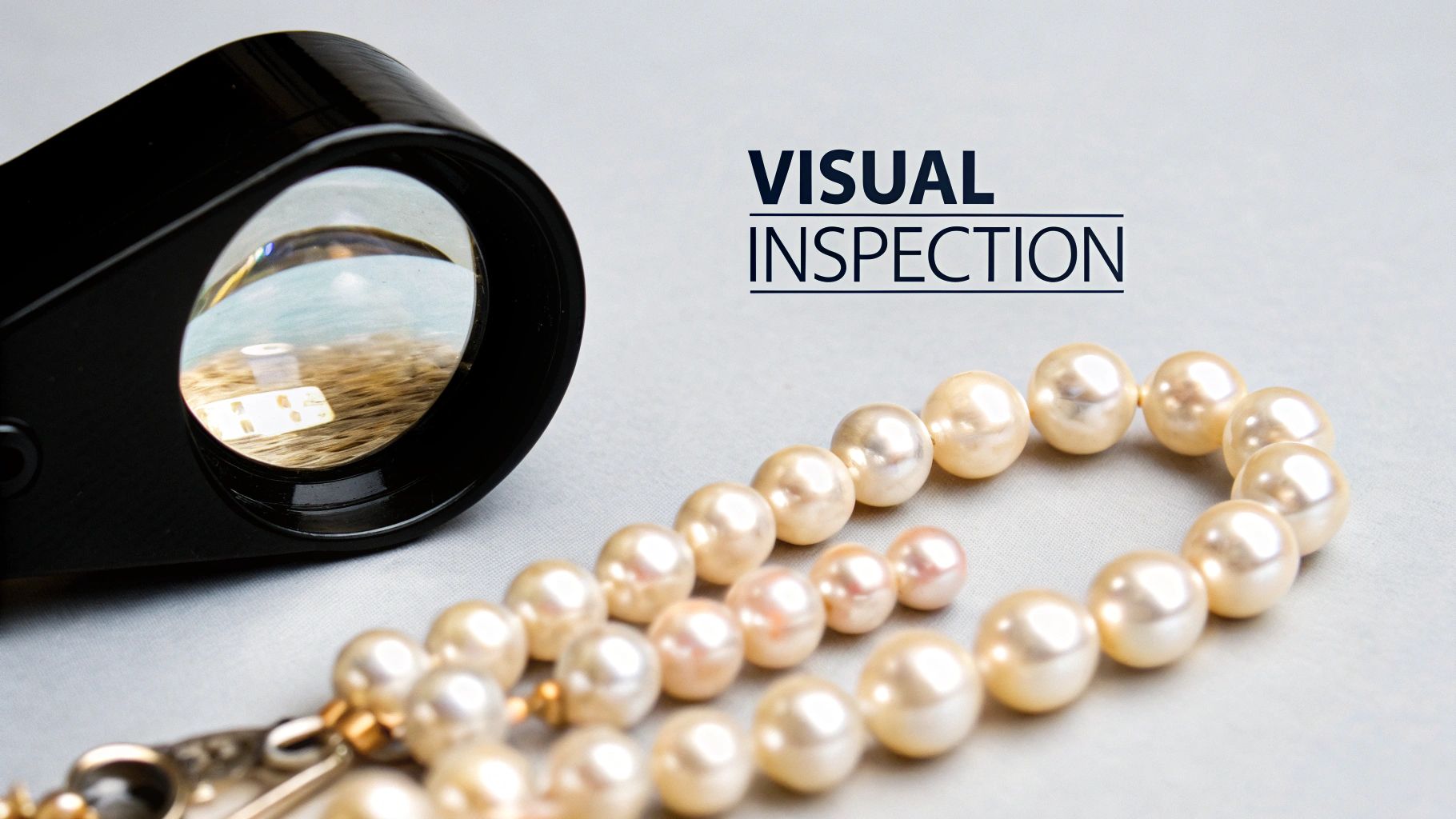
While the simple weight and feel tests are great starting points, the real story of a pearl is often hidden in the details. To truly separate a genuine treasure from a convincing fake, you need to look closer and inspect the jewelry with a more discerning eye—just like we do.
These next few visual checks are where many high-quality imitations finally give themselves away.
The Drill Hole Tells a Story
One of my favorite places to look for clues is the drill hole. If you have a magnifying glass, now is the time to grab it. Take a close look at where the string runs through each pearl.
- Real pearls will almost always have a clean, sharp drill hole. Because nacre is a strong, layered material, it drills cleanly, leaving a well-defined edge.
- Imitation pearls often show their weakness right here. Look for chipped paint, peeling coatings, or ragged, uneven edges around the hole. The outer layer on a fake bead just can't stand up to the pressure of drilling and tends to flake off.
This one tiny detail says so much. A crisp, clean hole points to a solid, natural structure, while a messy one is a dead giveaway for a simple coated core.
The Secret Language of Overtone and Color
Another signature of a genuine pearl is its overtone. This isn't the main body color; it's the subtle, secondary color that seems to shimmer and float across the surface as you turn the pearl in the light. A white pearl might have a beautiful rosy, creamy, or silvery overtone.
This stunning iridescence is created by light interacting with thousands of microscopic layers of nacre. It's an incredibly complex optical effect that fakes just can't get right. An imitation might have a flat, uniform color or a cheap-looking iridescent finish, but it will lack the soft, shifting depth you see in a real pearl.
When you're looking at a full strand, watch for those subtle variations. Nature rarely creates perfect uniformity, so if every single pearl is the exact same color, that can be a red flag. Digging into the composition of jewelry is always revealing, much like in our guide on how to determine gold purity, as it adds another layer of certainty.
Weighing the Evidence: The Science of Specific Gravity
Going beyond what the eye can see, a pearl’s density is one of the most reliable scientific indicators of its authenticity. This is where specific gravity—a method used since the 18th century—comes in. It’s a simple measure of an object's density compared to water.
Real pearls, made of dense aragonite and calcite, have a specific gravity of 2.72-2.78 g/cm³. By contrast, hollow glass fakes are under 2.0 g/cm³, and plastic imitations are even lighter at 1.3-1.5 g/cm³. According to lab reports, this method is 98% reliable for identification. Professionals will often use special heavy liquids to see how pearls behave; genuine ones sink uniformly. You can find more details on these professional pearl testing methods on sartorbohemia.com.
This scientific principle is exactly why the simple at-home weight test works so well. Your own hands can feel the surprising density of a real pearl strand compared to a feather-light plastic one. It’s a physical property that’s incredibly hard for fakes to replicate.
At Carat 24, we combine meticulous visual inspections with advanced tools like free Xray Scanning to provide a definitive authentication. This ensures you get a hassle-free offer and the highest payout for your jewelry, letting you save the hassle and sell locally for more than online shipments.
Our 8-step authentication process for all fine jewelry is built on these same professional techniques. When you need a certain answer, especially for a piece with sentimental or financial value, bringing it to an expert is the right move. We offer Gold Testing for free and are committed to Price Matching, so you can be confident you’re getting the best possible value right here in Boise.
When to Seek Professional Pearl Authentication
While the DIY tests are fantastic for weeding out obvious fakes, some of the modern imitations out there are incredibly sophisticated. If you're dealing with a family heirloom, a potentially expensive piece, or you just need a definite answer, it's time to call in the professionals.
Honestly, knowing when to get an expert opinion is the single most important step in understanding the true nature—and value—of your pearls.
Professionals don't just rely on feel or a quick glance. We use advanced technology to see what's going on inside the pearl. This is where scientific certainty replaces educated guesses, which is absolutely critical for high-value items where authenticity can mean the difference of thousands of dollars.
The Power of X-Ray Technology
The truly definitive methods for pearl authentication involve looking beneath the surface, and that's where gemological labs and expert buyers come in. We use specialized equipment to analyze a pearl's internal structure, revealing clues that are completely invisible to the naked eye.
Two key technologies make all the difference:
- X-ray Microradiography (RTX): This is like giving the pearl a CT scan. It allows an expert to see the internal growth structure. A real cultured pearl will show a clear bead nucleus with concentric growth rings of nacre around it, much like the rings of a tree. A natural pearl will show only those concentric rings from the very center. An imitation? It will just look solid and uniform, or in some cases, even hollow.
- X-ray Fluorescence (XRF): This technology is all about chemistry. It analyzes the elemental makeup of the item. Real pearls are made almost entirely of calcium carbonate. An XRF scan can instantly flag materials that have no business being in a pearl, like the lead in a glass core or the plastics and polymers used in many fakes.
This level of scientific analysis removes all doubt. It's the only way to be 100% sure.
GIA Standards and Modern Advancements
This scientific approach isn't some new fad. In fact, X-ray microradiography (RTX) was pioneered by the Gemological Institute of America (GIA) way back in the 1950s and it's still the gold standard for separating real pearls from fakes.
It provides a clear view of the internal structures with over 95% accuracy in GIA labs, which process thousands of samples every year. Real-time digital imaging shows the delicate nacre layering formed over 6-24 months inside the mollusk—a natural signature that imitations simply can't replicate. While old-school film X-rays were phased out by 2010, today's digital technology has made this process even more precise.
At Carat 24, we bring this same level of professional scrutiny directly to our clients. Our 8-step authentication process for gold, diamonds, and luxury goods mirrors these high standards, ensuring every evaluation we perform is both thorough and accurate.
Your Boise Destination for Expert Jewelry Buying
Knowing the real story behind your pearls is crucial, especially if you're thinking about selling them. A professional evaluation confirms authenticity and gives you a clear understanding of market value—an essential step before you even think about getting a formal appraisal. You can learn more about this in our guide on how to get jewelry appraised.
This is exactly why choosing the right local expert for Gold and Jewelry Buying is so important. Here in Boise, we've built our business on providing a transparent, pressure-free environment where you can get the answers you need. We know that selling valuable items can be an intimidating process, so we've built our service around trust and convenience.
We offer:
- Xray Scanning and Gold Testing for free so you can see the science behind our evaluation for yourself, at no charge.
- Hassle-free offers that are clear, direct, and made right on the spot.
- A Price Matching guarantee to ensure you always get the best value for your items.
Why deal with the uncertainty and risk of mail-in services? You can save the hassle and sell locally for more than online shipments. By visiting us, you get the peace of mind that comes with a face-to-face interaction and the confidence of knowing you’re receiving the highest payout in Boise. Whether it’s a strand of pearls, a diamond ring, or gold bullion, we're here to provide a definitive, professional assessment and a fair offer.
Your Trusted Partner for Jewelry Buying in Boise
Now that you know how to spot the real deal, what's next? Understanding what your pearls—or any other fine jewelry—are actually worth is a whole different ball game. Making a smart decision about your valuables, whether you're thinking of selling, managing an estate, or just simplifying your collection, really comes down to having an expert you can trust.
Here at Carat 24, we specialize in Gold and Jewelry Buying, and we’ve built our name on a simple promise: providing the highest payout in Boise. We believe trust starts with transparency, which is why we’ve invested in technology that puts you in the driver's seat.
Why Selling Locally is the Smarter Choice
Tempted to use an online mail-in buyer? It’s a route filled with uncertainty. You’re asked to package your most precious items, send them off to a faceless company, and just hope for a fair number on the other end. You can save the hassle and sell locally for more than online shipments.
Working with a local expert gives you advantages you just can't get online:
- Immediate Service: No waiting for shipping kits or wondering if your package arrived. We offer face-to-face consultations and can make an offer right on the spot.
- Complete Transparency: You’re part of the entire evaluation. Sit with us, ask questions, and see exactly what we see.
- Enhanced Security: Your jewelry never leaves your sight until you decide to sell. There’s zero risk of it getting lost or damaged in transit.
- Direct Payment: When you accept our offer, you get paid. No delays, no processing windows, no hidden fees.
Our whole process is designed to be straightforward and comfortable. We want you to feel confident the moment you walk through our door.
Our Commitment to You
To give you complete peace of mind, we provide a couple of complimentary services that set us apart. We offer Xray Scanning and Gold Testing for free right in front of you, giving you scientific proof of your jewelry’s composition. This isn't about guesswork; it's about clear, objective data that forms the basis of our valuation.
We provide hassle-free offers for every single piece we look at. Our commitment also includes Price Matching, guaranteeing you get the absolute best value for your items, right here in Boise.
We get it—every piece of jewelry has a story. Whether it’s an inherited strand of pearls, a diamond ring you no longer wear, or gold bullion, our only goal is to help you unlock its true worth. If you're still weighing your options, our guide on where to sell jewelry offers more tips to help you make the best choice.
We invite you to come in for an expert consultation. Let our team give you the clarity and value you deserve, ensuring you walk away with the highest possible payout for your treasures.
Answering Your Questions About Real Pearls
Even after running through the home tests and learning about professional methods, it's totally normal to have a few questions left. Understanding the difference between a real pearl and a convincing fake comes down to knowing the little details—the nuances that separate nature's gems from something made in a factory.
Let's dive into some of the most common questions we hear from clients. These quick answers should help clear things up and give you more confidence when looking at your own jewelry.
Can You Tell If a Pearl Is Real Just by Its Shape?
Shape is a fantastic clue, but it's not the whole story. Real pearls are organic gems, and nature isn't a fan of perfect spheres. You’ll almost always find subtle variations and beautiful, unique forms like oval, baroque, or drop shapes.
If you see a strand where every single pearl is an identical, flawless circle, that's often a huge red flag for an imitation. The tricky part? The absolute finest, most valuable cultured pearls can be exceptionally round, which can definitely throw you off. That's why you always need to pair your observation of the shape with other tests, like the gritty feel of the tooth test or a close look at the luster.
Does the Price of Pearls Indicate If They Are Real?
Price can be a major hint, but it can also be misleading. The old saying holds true: if a deal on pearls seems way too good to be true, it almost certainly is. Real pearls, whether natural or cultured, are the product of a long, delicate process, and that gives them inherent value.
A strand of huge, shiny "pearls" selling for a rock-bottom price is practically guaranteed to be fake. On the flip side, some sellers might put a high price on top-quality fakes to trick buyers who don't know better. Trusting price alone is a risky move. The best way forward is to do your own physical checks or, for any big purchase or sale, get a professional opinion. When you're involved in Gold and Jewelry Buying, knowing the true market value is everything.
What Is the Difference Between Natural and Cultured Pearls?
This is a great question and one that trips up a lot of people. The single most important thing to remember is that both natural and cultured pearls are considered real pearls. Both are formed inside a living mollusk and are made of genuine nacre.
The difference is all about how they get started.
- A natural pearl forms on its own when an irritant, like a tiny grain of sand, gets into a mollusk completely by chance.
- A cultured pearl is created when a person intentionally inserts an irritant and a piece of mantle tissue to kick-start the nacre-making process.
Because natural pearls are incredibly rare, almost every real pearl on the market today is cultured. Both are valuable, but natural pearls fetch much higher prices simply because they are so rare. Imitation pearls, on the other hand, are completely man-made from glass, plastic, or ceramic—no mollusk involved.
My Pearls Are Old—Does That Mean They Are Real?
Age isn't a guarantee of authenticity. While there's a good chance your grandmother's heirloom pearls are real, high-quality imitations have been around for over a century. For example, Majorica pearls—a famous type of high-end imitation from Spain—were first made way back in the late 1800s.
Plenty of beautiful vintage and antique jewelry pieces feature simulated pearls that have been fooling people for generations. The only way to know for sure what you have is to get an expert to take a look.
Here at our Boise location, we specialize in evaluating estate jewelry. We can use our advanced tools, like our Xray Scanning and Gold Testing for free, to tell you the true nature of your treasured family pieces. The process is quick, hassle-free, and ensures you get the highest payout in Boise if you decide to sell.
When you're dealing with heirlooms, guessing just won't cut it. An expert evaluation gives you the definitive answer you need. By choosing to save the hassle and sell locally for more than online shipments, you can be sure your valuables are handled with care, backed by our Price Matching and commitment to transparent Gold and Jewelry Buying.
At Carat 24 - Trusted Gold Experts, we’re committed to providing clear, honest, and expert evaluations for all your precious items. Visit us in Boise for a free, no-obligation offer and discover the true value of your jewelry. https://carat24boise.com
