
More than just a piece of gold, the Indian Head gold coin is a snapshot of American history you can hold in your hand. Its design was a bold departure from anything that came before it, and understanding its story is the first step to knowing its real worth.
If you've inherited one of these coins or are sorting through an estate collection, you're in the right place. We'll walk you through what makes these coins special and how to confidently figure out their value.
A Guide to Your Indian Head Gold Coin
Minted from 1907 to 1933, the Indian Head gold coin series is a high point in American artistry. These coins are celebrated for more than just the gold they contain; their stunning, incuse (sunken) design and rich history make them true collector's items. They come from a fascinating period in the nation's past, making them a unique blend of art and investment.
Figuring out what you have is key to unlocking its full value. This is especially true when it comes to selling gold, where tiny details can make a huge difference in the offer you receive.
Let's take a quick look at the different coins in this series.
Indian Head Gold Coin At a Glance
The Indian Head series was produced in three different denominations, each with its own unique specifications. This table gives you a quick rundown of what to look for.
| Denomination | Years Minted | Designer | Gold Content (Ounces) | Key Feature |
|---|---|---|---|---|
| $2.50 Quarter Eagle | 1908-1915, 1925-1929 | Bela Lyon Pratt | 0.1209 oz | First U.S. coin with an incuse design |
| $5 Half Eagle | 1908-1916, 1929 | Bela Lyon Pratt | 0.2419 oz | Shares the same sunken design as the Quarter Eagle |
| $10 Eagle | 1907-1916, 1920, 1926, 1930, 1932-1933 | Augustus Saint-Gaudens | 0.4838 oz | Features a standing eagle, different from the smaller coins |
As you can see, while they share a name, the "Indian Head" on the $10 Eagle is actually Lady Liberty wearing a feathered warbonnet, a completely different design from the authentic portrait on the smaller coins.
Why Expert Evaluation Matters
Before you even think about selling, getting a professional appraisal is a must. An expert can tell you the difference between the coin's melt value (the price of its gold content) and its much higher numismatic value, which is what a collector would pay. At Carat 24, we specialize in Gold and Jewelry Buying and do this for free, using the right tools to get it right.
Here's how we do it:
- Free Xray Scanning and Gold Testing: We use non-invasive tech to check the exact metal makeup of your coin without leaving a single scratch.
- Professional Gold Testing: Our specialists will precisely determine the gold's purity and weight, which forms the baseline for any fair offer.
- Hassle-Free Offers: We give you a clear, no-pressure offer right on the spot. We’ll also walk you through every factor that went into that price.
We are absolutely committed to offering the highest payout in Boise and will even offer Price Matching to prove it. When you work with us, you can be sure you're getting the best possible value for your treasures.
Save the hassle and sell locally for more than online shipments. Forget the stress and risk of shipping your valuables off to some unknown online buyer. Selling locally means you get more for your Indian Head gold coin, and you get the peace of mind that comes with a secure, face-to-face transaction.
The Story Behind America's Most Revolutionary Coin
The story of the Indian Head gold coin doesn't start in a mint. It starts in the White House, with a president who was frankly tired of how bland and uninspired America's money looked. President Theodore Roosevelt felt the nation’s coins didn't reflect its growing power and artistic maturity on the world stage. He wanted a "Renaissance of American Coinage," and he knew just the person to help him get it done.
Roosevelt tapped the most celebrated sculptor of the era, Augustus Saint-Gaudens, for the job. Their first collaboration gave us the stunning $20 Double Eagle and the legendary $10 Indian Head Eagle. This partnership completely reset the bar for coin artistry, blending classical beauty with a spirit that was uniquely American.
A New Vision for Coinage
While Saint-Gaudens was busy with the larger gold pieces, the task of redesigning the smaller $2.50 Quarter Eagle and $5 Half Eagle fell to one of his former students, Bela Lyon Pratt. Pratt took Roosevelt's vision and ran with it—in a completely new and radical direction. He created something America had never seen before on its money.
Instead of the familiar raised designs, Pratt introduced a groundbreaking incuse design.
An incuse design is one where the images and lettering are stamped into the surface of the coin, sitting below the flat fields. This is the opposite of a traditional relief design, where the features are raised above the surface.
This radical technique gave the coins a distinct, sculptural quality that was impossible to ignore. The powerful portrait of a Native American chief on the front and the stoic eagle on the back were literally sunken into the gold, which had the practical benefit of protecting them from the wear and tear of daily circulation.
Controversy and Innovation
This bold new look wasn't exactly a hit with everyone. When the coins were first released in 1908, some bankers and citizens voiced concerns that the recessed areas would trap dirt and germs, making them unsanitary. These fears were, of course, completely unfounded, but the controversy itself made the coins a hot topic of public debate.
Despite the early skepticism, the sheer artistic merit of Pratt's work was undeniable. The incuse design was a triumph of minting technology and a bold aesthetic statement that set the Indian Head series apart from everything else. It was the perfect embodiment of the innovative spirit behind Roosevelt's "Renaissance." If you're curious about what makes a coin like this valuable beyond its gold content, you can learn more about numismatic coins and their unique appeal.
An Abrupt End and Lasting Rarity
These beautiful coins were minted for over two decades, but their run as circulating money came to a sudden, dramatic halt. In 1933, smack in the middle of the Great Depression, President Franklin D. Roosevelt issued Executive Order 6102.
This order demanded that all Americans turn in their gold coins to the U.S. Treasury, where most were unceremoniously melted down. The Gold Recall Order decimated the surviving population of Indian Head gold coins, instantly transforming them from everyday currency into rare historical artifacts. This single act is the main reason why so few of these coins exist today, especially in high-grade condition.
This history is absolutely critical when you're thinking about selling. The rarity and the incredible story behind your Indian Head gold coin are huge parts of its value. Understanding this is the first step toward getting the fair price you deserve. At Carat 24, we specialize in both Gold and Jewelry Buying, and we're known for offering the highest payout in Boise. We make it easy with hassle-free offers and provide free Xray Scanning and Gold Testing to verify your coin's authenticity and true value. Save the hassle and sell locally for more than online shipments by bringing your piece of history to experts who appreciate its full story.
Identifying the Three Types of Indian Head Gold Coins
The Indian Head series isn't just one coin; it's a family of three distinct denominations, each with its own backstory, specifications, and design quirks. Learning how to tell them apart is the first real step toward understanding what you’re holding. This guide will walk you through how to confidently identify which Indian Head gold coin you have.
These iconic designs were born from President Theodore Roosevelt's personal mission to create an American "coinage renaissance," an effort to make U.S. coins as beautiful as those from ancient Greece.
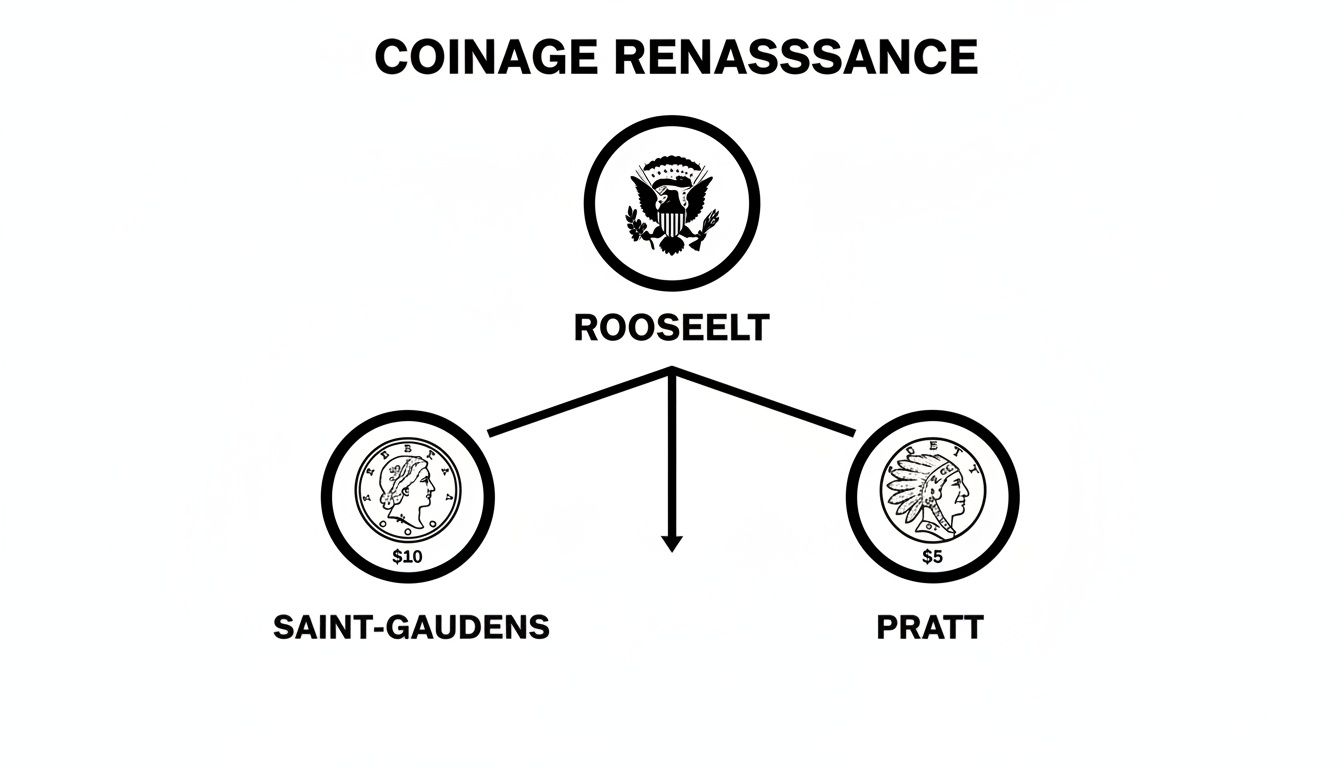
As the diagram shows, Roosevelt was the driving force, commissioning the legendary sculptor Augustus Saint-Gaudens for the $10 Eagle and Saint-Gaudens' gifted student, Bela Lyon Pratt, for the smaller, more radical incuse-design coins.
The $10 Indian Head Eagle
The biggest and oldest of the trio is the $10 Eagle. Designed by the renowned Augustus Saint-Gaudens, it was minted from 1907 to 1933. It's often the most recognizable of the bunch, thanks to its larger size and classic raised design.
- Obverse (Front): Features a bold profile of Lady Liberty adorned with a Native American feathered warbonnet. Thirteen stars representing the original colonies arc above her head.
- Reverse (Back): Showcases a powerful eagle perched proudly on a bundle of arrows intertwined with an olive branch—a symbol of peace through strength.
- Edge: This is a key detail. Early coins from 1907 to 1911 have stars on the edge for each state in the Union at the time of minting. From 1912 onwards, this was standardized to 48 stars.
This substantial coin contains nearly half an ounce (0.4838 ounces) of pure gold.
The $5 Indian Head Half Eagle
Next up is the $5 Half Eagle, minted from 1908 to 1929. Designed by Bela Lyon Pratt, this coin and its smaller sibling are famous for their revolutionary "incuse" design.
Instead of being raised, the images and lettering are sunken into the coin's surface. This was a radical departure from tradition and makes the $5 and $2.50 Indian Heads instantly stand out from any other U.S. gold coin ever produced.
The $2.50 Indian Head Quarter Eagle
The smallest of the series is the $2.50 Quarter Eagle, minted between 1908 and 1929. It shares the same groundbreaking incuse design by Bela Lyon Pratt as the $5 piece, featuring a strikingly realistic portrait of a Native American chief on the front.
These coins represent a truly fascinating chapter in American money. Pratt's incuse design was the first and only one of its kind for U.S. gold, making these coins unique historical artifacts. Production was intermittent over their 21-year run, resulting in about 15 different date-and-mint combinations.
The undisputed king of rarity for this series is the 1911-D, with a tiny mintage of just 55,680 coins. Finding one in high-grade condition is the dream of many collectors.
Key Identifying Markers and Mint Marks
Beyond just the denomination, you'll want to look for a tiny letter on the back of the coin. This is the mint mark, and it tells you where the coin was made—a detail that can have a massive impact on its value. You can find it on the reverse, just to the left of the eagle.
- No Mint Mark: It was struck at the Philadelphia Mint. This was the main mint, so no mark was needed.
- D: Struck at the Denver Mint.
- S: Struck at the San Francisco Mint.
- O: Struck at the New Orleans Mint (this mark appears only on the 1909 $5 Half Eagle).
Certain combinations of dates and mint marks are known as "key dates" because they are much rarer and more sought-after by collectors. A 1911-D Quarter Eagle or a 1909-O Half Eagle, for example, can be worth many times more than their more common counterparts. To get a better handle on this, check out our guide on understanding coin key dates.
How to Accurately Determine Your Coin's Value
Figuring out what your Indian Head gold coin is really worth is more art than science, and it goes way beyond just its weight in gold. The final price you'll see comes from two totally different, but equally important, factors working together. Getting a handle on both is the key to knowing you’re getting a fair shake.
First up is the melt value. This is the foundational price, the absolute floor based on how much physical gold is in the coin and what the market price for gold is on any given day. But for a piece of American history like an Indian Head, that's just the starting point of the conversation.
The second, and often much bigger, piece of the puzzle is the numismatic value. This is the extra premium collectors are willing to pay for things like rarity, historical significance, condition, and just how much people want it. With an Indian Head gold coin, the numismatic value almost always leaves the melt value in the dust.
Understanding Coin Condition and Grading
A coin’s physical condition—what collectors call its "grade"—is probably the single biggest driver of its numismatic worth. The tiniest scratches or a little bit of wear can make a massive difference in the final price. Experts use a really detailed scale, but you can get a good feel for it with these simpler terms:
- Good to Fine: The coin has clearly been around the block. You can see the main design, but a lot of it might be flattened or worn smooth.
- Very Fine to Extra Fine: It’s seen some use, but the details are still pretty sharp. You'll notice light wear on the highest points, like the cheekbones on the portrait.
- About Uncirculated (AU): This one looks almost brand new. You might see the faintest trace of friction on the very highest points, but you'd likely need a magnifying glass to spot it.
- Mint State (MS): The coin is perfect, looking just like it did the day it was minted. It has its original shine and has never been in circulation.
The price gap between these grades can be absolutely staggering. A common-date Indian Head in "Good" shape might sell for a little over its gold value. That very same coin in "Mint State" condition? It could be worth thousands more.
This gets even more dramatic with the rarer dates. Take the $5 Indian Head half eagles, minted from 1908 to 1929. Out of a total mintage of 14,078,066, certain years are incredibly scarce. The 1909-O, for example, had a tiny run of just 34,200. Even more telling, only about 1.3% of all coins from the entire series have ever been professionally graded in Mint State, showing just how much pristine condition multiplies a coin's value. You can dive deeper into the rarity of these impressive coins on RareCollectiblesTV.com.
The Crucial Role of Professional Evaluation
Because the little details in grading have such a huge impact, getting a professional evaluation isn't just a good idea—it's essential. An expert can nail down the exact grade, spot any fakes, and give you a true market value based on both the gold content and collector demand. This is where having a trusted local expert really pays off.
At Carat 24, we offer free, no-obligation appraisals for all your Gold and Jewelry Buying needs. Our entire process is transparent, built to give you total confidence in the value we place on your Indian Head gold coin.
We use a thorough 8-step authentication process, which includes free Xray Scanning and Gold Testing. This advanced, non-destructive tech verifies the exact metal makeup of your coin, proving its authenticity without leaving so much as a scratch.
We believe in making hassle-free offers right on the spot, and we back them with our guarantee to provide the highest payout in Boise. We’ll even offer Price Matching to make sure you walk away with the best possible value. If you're curious about what elevates a coin to investment-grade, check out our guide on understanding certified gold coins.
When it comes down to it, you can save the hassle and sell locally for more than online shipments. Skip the risks of mailing your valuables and come get a clear, expert opinion on your coin's total worth today.
Why Selling Locally in Boise Gets You the Best Payout
When it's time to sell a valuable piece like an Indian Head gold coin, the biggest question on your mind is simple: "How do I get the most money for it?" While those online mail-in services might look easy, they often come with a bundle of risks and hidden costs that can eat into your final payout. The truth is, selling right here in Boise is the smarter, safer, and ultimately more profitable way to go.

Let's be honest, the thought of shipping a rare gold coin across the country is nerve-wracking for a reason. You're left worrying if it will get lost, damaged, or even stolen. Dealing with insurance is a headache, and then comes the long, anxious wait for someone to finally look at your coin and send you a check. It’s a stressful process.
The Problem with Online Buyers
Online mail-in companies operate completely out of sight. Once your coin is in the mail, you've lost all control, hoping a faceless stranger gives you a fair assessment.
Here's what we see happen all the time:
- Hidden Fees: Suddenly, your offer is reduced by surprise charges for shipping, insurance, and "processing."
- Lowball Offers: Without a face-to-face conversation, it's easy for them to give you a low, take-it-or-leave-it price.
- Long Delays: The entire ordeal, from mailing your coin to getting paid, can drag on for weeks.
Save the hassle and sell locally for more than online shipments. A direct, in-person transaction cuts out all these risks and puts you in the driver's seat from beginning to end.
The Carat 24 Advantage in Boise
Here at Carat 24, we’ve built our entire Gold and Jewelry Buying service on transparency and trust. Our goal is to give our Boise neighbors maximum value. We believe you deserve to see exactly how your Indian Head gold coin is graded and to walk out the door feeling confident you got the best possible price.
Our process is simple and designed for your peace of mind. We give hassle-free offers with zero pressure. You can watch us perform a free Xray Scan and Gold Test right in front of you, using state-of-the-art tech to confirm your coin's authenticity and makeup. This hands-on approach means you understand every single factor that goes into its value.
We're so sure of our process that we guarantee the highest payout in Boise.
And we back it up. With our Price Matching promise, if you bring in a better written offer from another local buyer, we won’t just match it—we’ll beat it. We want to make sure you never have to second-guess your decision. You get paid on the spot and get the satisfaction of working with local experts who truly value your business. For more tips on selling your precious metals, check out our guide on the best places to sell gold coins.
Expert Tips for Selling Gold Coins and Jewelry
The core principles that drive the value of an Indian Head gold coin—its rarity, condition, and gold content—actually apply to almost any valuable asset. Whether you have a single coin, an inherited diamond ring, or a luxury watch, a little bit of prep work can make a huge difference in what you walk away with. These tips have proven true time and time again, and they’ll help you approach any sale with confidence.
First and foremost, especially when dealing with collectible coins, you have to resist the urge to clean them. What might look like simple dirt to an untrained eye is often a coin's "patina," a natural toning that has formed over decades, sometimes even centuries. Collectors cherish this originality. Trying to polish or scrub a coin can leave behind microscopic scratches, tanking its numismatic value in an instant.
Prepare for Your Appraisal
Before you bring your items in for an offer, take a few minutes to gather any related materials you have. It’s a simple step, but it can add real value and make the whole appraisal process smoother.
- Original Packaging: For things like luxury watches or designer jewelry, having the original box is a huge plus for collectors.
- Documentation: Got a certificate of authenticity? An old receipt? A previous appraisal? These documents help tell the item’s story and prove its history.
- Loose Stones: If a diamond or another gemstone has fallen out of a piece of jewelry, be sure to bring it with you.
These pieces help establish provenance and authenticity, which makes it much easier for a buyer to give you the best possible price. Our guide on how to properly sell collectible coins dives even deeper into getting your items ready for a professional evaluation.
Know What You Are Selling
It's absolutely key to understand where your item's value is coming from. Is it the raw material, or is it the history and rarity? For example, a simple gold chain is valued almost entirely on its gold content, or its "melt value." On the other hand, a vintage Patek Philippe watch or a rare Indian Head gold coin has a collectible value that can soar far beyond the price of its raw materials.
At Carat 24, we specialize in comprehensive Gold and Jewelry Buying. We provide free Xray Scanning and Gold Testing to accurately determine both the material and collectible worth of your items. This ensures you get a fair, transparent offer every single time.
Take the $10 Indian Head gold eagles, for instance. These aren't just lumps of gold; they're numismatic treasures with 17 distinct varieties from different branch mints. The 1914-D, with a tiny mintage of just 343,500, might be worth around $890 in average circulated condition. But find one in pristine Mint State 65 condition, and that value can jump to an incredible $15,500.
This is exactly why getting a professional evaluation is so critical. We offer hassle-free offers and a Price Matching guarantee to ensure you always get the highest payout in Boise. You can save the hassle and sell locally for more than online shipments. And if you do decide to sell online, remember that presentation is everything. To make your collection truly stand out, great photography is a must; services offering AI product photos for jewelry can give your listings a professional edge.
A Few Final Questions About Selling Your Gold Coins
When you're thinking about selling a piece of history like an Indian Head gold coin, it’s natural to have a few last-minute questions. Getting clear, honest answers is the final step before you can move forward with total confidence. Here are some of the most common things we hear from sellers right here in Boise.
What’s the Difference Between Melt Value and Numismatic Value?
Think of melt value as the floor price for your coin. It's simply the value of the raw gold inside, based on its weight and whatever the market price for gold is on a given day.
But numismatic value is where things get interesting. This is the extra premium collectors are willing to pay. This added worth comes from a coin's rarity, its historical significance, and of course, its physical condition. For a classic piece like an Indian Head gold coin, the numismatic value almost always pushes its worth far beyond what the gold itself is worth.
Do I Need to Make an Appointment for an Appraisal?
Not at all. We believe in being accessible, so no appointment is ever needed at Carat 24. Just walk into our Boise shop anytime during business hours, and we’ll give your coin a free, thorough evaluation.
Our team provides hassle-free offers on the spot. We use advanced tools like Xray Scanning and Gold Testing to give you a completely transparent and precise appraisal while you watch. It's a cornerstone of our Gold and Jewelry Buying service.
A word of caution: You should never, under any circumstances, try to clean an old coin. Cleaning can leave microscopic scratches and strip away the original patina that collectors prize, which can severely damage its numismatic worth. A coin in its original, untouched state will always command the highest offer.
How Can I Be Sure I’m Getting the Best Price?
Our promise is simple: to provide the highest payout in Boise. We stand by that commitment.
We’re so sure of our pricing that we offer a Price Matching guarantee. If you get a written offer from another local buyer, bring it to us, and we will beat it. Our transparent process means you see exactly how we determine your coin's value, giving you complete peace of mind.
Plus, when you work with us, you save the hassle and sell locally for more than online shipments. You get to skip the risks of mail-in services, their hidden fees, and the long waits for payment. At Carat 24, you walk out with immediate payment, certain you received the absolute best price for your treasure.
Ready to see what your gold coins, jewelry, or luxury items are really worth? Visit Carat 24 - Trusted Gold Experts at our Boise location for a free, no-obligation appraisal and get the highest payout, guaranteed.
