
If you've stumbled upon a U.S. gold dollar coin, you're holding a fascinating piece of American history. Its value is a compelling blend of its actual gold content and its desirability as a collectible, which often means it's worth hundreds, sometimes thousands, more than its one-dollar face value. To figure out how much a gold dollar coin is worth, you need to look beyond the daily gold market and step into the world of numismatics.
Your Gold Dollar Coin Is Worth More Than Its Weight in Gold
It’s a common assumption that a gold dollar's value is simply tied to the current spot price of gold. While that's a good starting point, it’s only a fraction of the story. The real potential often lies in its numismatic value—the premium collectors are willing to pay for a specific coin based on how rare it is and the condition it's in.
This is especially true for the classic U.S. gold dollars minted between 1849 and 1889. These aren't just chunks of precious metal; they are genuine artifacts from a unique era in American expansion. A common-date coin that's seen a lot of circulation might only fetch a price close to its melt value. But find a rare date or a coin in pristine, uncirculated shape, and its value can skyrocket.
Key Factors That Determine Your Gold Dollar's Value
Before you can know what your coin is worth, you need to understand the different elements that build its final value. Think of it as a recipe—each ingredient contributes to the final result.
Here's a quick breakdown of what goes into pricing a gold dollar coin.
| Factor | Description | Impact on Value |
|---|---|---|
| Melt Value | The baseline price, determined by the coin’s gold content and the live market price of gold. | Sets the absolute floor for the coin's worth. It can't be worth less than this. |
| Numismatic Premium | The extra value added by collector demand, historical importance, and rarity. | Can be minimal for common coins or add thousands of dollars for rare ones. |
| Condition (Grade) | The state of preservation, professionally graded from heavily worn to flawless. | One of the most significant drivers of price. A higher grade equals a higher value. |
| Mint Mark & Date | The year the coin was made and the specific U.S. Mint facility that produced it. | Can dramatically alter rarity. A specific mint mark can make an otherwise common year very valuable. |
Each of these factors plays a critical role, and overlooking even one can mean leaving money on the table.
Understanding these components is the first step, but putting them all together for an accurate appraisal is where expertise comes in. You can learn more about what are numismatic coins in our detailed guide.
Getting the best price for your coin is about more than a quick calculation. It requires an expert who understands both the bullion and collector markets to ensure every factor adding to its value is recognized and rewarded.
Why Selling Locally in Boise Makes Sense
When it's time to sell, the process of Gold and Jewelry Buying can feel overwhelming. Shipping a valuable coin online is nerve-wracking, between the high insurance costs and the risk of a package getting lost. Plus, how do you really know you can trust a buyer you've never met?
To save the hassle and sell locally for more than online shipments, consider working with a trusted expert right here in your community. Here in Boise, we provide hassle free offers and a completely transparent evaluation process. We use Xray Scanning and Gold Testing for free to verify your coin’s authenticity without causing any damage.
With our promise to offer the highest payout in Boise and our Price Matching guarantee, you can sell with total confidence. You'll know you’re getting the best possible value for your treasure.
Identifying Your Gold Dollar Coin Type, Date, And Mint Mark
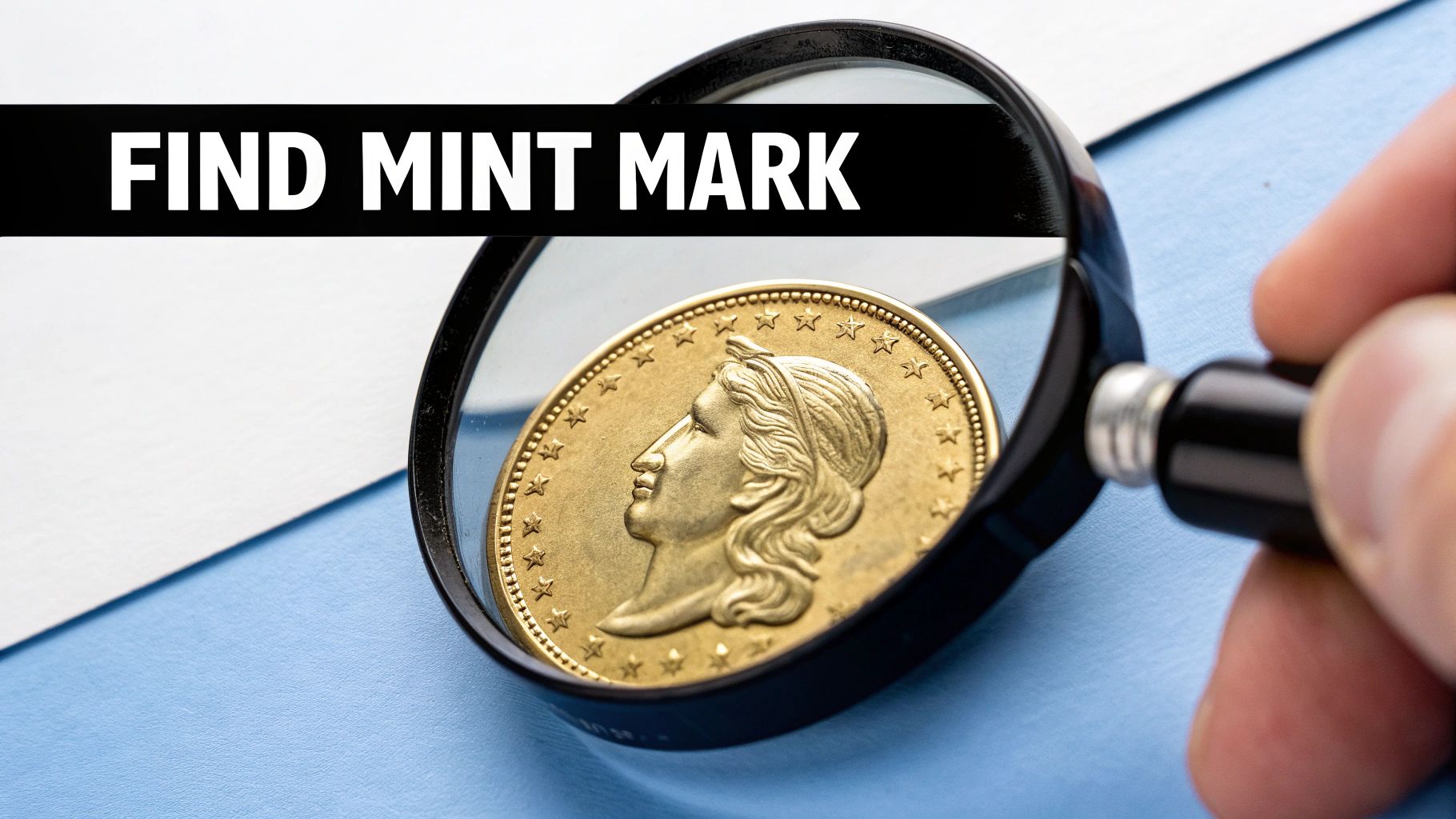
Before you can figure out how much a gold coin dollar is worth, you've got to play detective for a minute. The first clues are its design, the year it was made, and a tiny letter called a mint mark. These details are what separate a common piece from a truly valuable find.
The U.S. Mint actually produced three different types of gold dollars, and each one has its own unique look. Figuring out which one you're holding is the very first step.
- Type I Liberty Head (1849-1854): This is the smallest of the group, measuring just 13mm across. It features that classic portrait of Lady Liberty wearing a coronet.
- Type II Small Indian Head (1854-1856): The design shifted to an "Indian Princess" and the coin itself got a little bigger, bumped up to 15mm. This type is the rarest of the three since it was only made for a couple of years.
- Type III Large Indian Head (1856-1889): The last version is similar to the Type II but with a larger, more detailed portrait of the Indian Princess. It's also 15mm in diameter.
Locating The Date And Mint Mark
Once you've nailed down the type, the next critical step is to find the date and mint mark. The date is easy enough to spot—it's right on the back (reverse) of the coin, just below the wreath. That tells you the year it was struck.
The mint mark is a small letter that tells you which U.S. Mint facility produced the coin, and believe me, this single letter can change its value dramatically. You'll find it on the reverse as well, right below the bow of the wreath. You'll be looking for letters like:
- C for Charlotte, North Carolina
- D for Dahlonega, Georgia
- O for New Orleans, Louisiana
- S for San Francisco, California
If you don't see a mint mark, that means your coin came from the main U.S. Mint in Philadelphia.
For example, an 1855 gold dollar from Philadelphia is pretty common. But an 1855-D from Dahlonega? That's a serious rarity worth many, many times more, all because of that tiny "D."
First minted back in 1849 during the California Gold Rush, the gold dollar was created to handle all that new gold flooding the country. A Type I coin weighs 1.672 grams and is 90% pure gold. At a gold price of $2,330 per ounce, its basic melt value is around $112.
But its numismatic value—what a collector will pay—is often way higher. High-grade examples can fetch thousands. A pristine 1854 Type I MS65, for instance, can command $10,000, which just goes to show how much condition and rarity can amplify a coin's worth far beyond its weight in gold. You can explore more about gold dollar coin prices on PCGS.com.
Get A Professional Evaluation In Boise
Telling all these details apart can be tricky, but you don't have to go it alone. Experts in Gold and Jewelry Buying can give you the clarity you need. Knowing the difference between a common date and a rare one is everything, and you can learn more by checking out our guide on understanding valuable coin key dates.
To save the hassle and sell locally for more than online shipments, just bring your coin to a trusted buyer. Here in Boise, we provide Xray Scanning and Gold Testing for free to verify authenticity and specifics without ever damaging your coin. We make hassle free offers, have a Price Matching guarantee, and offer the highest payout in Boise. We'll make sure you get the true value for your historic piece.
How Coin Condition Unlocks Numismatic Value
Ever wonder why two gold dollar coins that look almost identical can be worlds apart in price? The secret, almost every time, is the coin's condition. A coin's state of preservation, what we call its grade, is one of the most powerful forces driving its value—often pushing it way beyond the simple worth of its gold.
Think about it this way. An 1853 gold dollar that’s been passed around, rattling in pockets and cash drawers for decades, is going to show a lot of wear and tear. Now, imagine another 1853 coin that was stashed away safely the moment it left the mint. It still has that sharp detail and brilliant shine. Both coins have the same gold, but that pristine, untouched example is incredibly rare and far more desirable to collectors.
This crucial difference is captured by a formal grading scale, which runs the gamut from heavily worn grades like 'Good' all the way up to a flawless 'Mint State.' Even a tiny step up on that scale can mean a price jump of hundreds, sometimes even thousands, of dollars.
What to Look For When Assessing Your Coin
You don't have to be a seasoned numismatist to get a solid first impression of your coin's condition. The key is to examine it under a good, bright light—a magnifying glass will be your best friend here. Always focus on the highest points of the coin's design, as that’s where wear first becomes obvious.
- Look for Wear: On a Liberty Head gold dollar, check the very top of Liberty's hair and the tips of the leaves in the wreath. For the Indian Head type, the feathers in the headdress are the first thing to lose detail. If these areas look flat or smooth, you know the coin has been in circulation.
- Check for Luster: A coin that has never been used will have its original mint luster. This isn't just a simple shine; it's a unique, almost cartwheeling effect that happens when light hits the surface of a freshly struck coin. Circulated coins lose this and start to look dull.
- Identify Scratches and Dings: Look closely for any noticeable scratches, dings on the rim, or other distracting marks. Every imperfection will pull down the coin's grade and, consequently, its value.
By far, the biggest mistake a new collector can make is trying to clean their coin. Polishing, scrubbing, or using any kind of abrasive will permanently strip away the coin's original surface. In the eyes of an expert, a cleaned coin is a damaged coin, and its numismatic value can be instantly destroyed.
For anyone looking to dive deeper into the subtleties of coin preservation, our article on the difference between proof and uncirculated coins is a great next step.
The Role of Professional Grading
While your own inspection is a fantastic start, the final, definitive grade really needs to come from a professional grading service like PCGS or NGC. These third-party experts will authenticate your coin, assign it a precise numerical grade, and then seal it in a tamper-proof protective holder. A certified grade takes all the guesswork out of the equation and dramatically increases a coin's value and how easily you can sell it.
Figuring out a coin's condition can feel a bit complex, but it’s an absolutely essential step. Here at our Gold and Jewelry Buying location in Boise, we provide a free, professional condition assessment on the spot. Our specialists use non-invasive Xray Scanning and Gold Testing for free to verify your coin's authenticity and evaluate its preservation, giving you hassle free offers based on its true market potential. We guarantee Price Matching and the highest payout in Boise, so you can save the hassle and sell locally for more than online shipments.
Calculating the Total Worth of Your Gold Coin Dollar
Alright, you’ve done the detective work—you know your coin's type, date, and general condition. Now it's time to put all those pieces together and figure out what it's really worth.
The total value of a gold dollar coin isn't just one number. It’s actually a combination of two separate things: its basic gold value and its added collector value. Getting this right is how you truly answer the question, "how much is a gold coin dollar worth?"
First up is the coin’s intrinsic or melt value. This is the straightforward worth of the actual gold in the coin, determined by its weight, purity, and the day-to-day what is gold spot price. Think of this as the absolute floor price for your coin—it can never be worth less than the gold it’s made of.
But that’s just the starting point. The real excitement often comes from the numismatic premium, which is the extra value collectors are willing to pay for things like rarity, historical importance, and fantastic condition. This premium is what can turn a simple one-dollar gold piece into an asset worth thousands.
From Melt Value to Collector Value
Let’s get practical. A common 1853 Type I gold dollar that's been in circulation for a while might only sell for a little bit over its melt value. Its worth is mostly tied to the fluctuating gold market.
But the moment rarity enters the equation, the entire valuation game changes.
Take the Type II gold dollar, for example. It was only minted for three short years, from 1854 to 1856. With fewer than two million ever made, it’s the scarcest of the three designs. This rarity alone makes them a huge prize for collectors. An 1856-S Type II is what we call a "key-date" coin, and it commands a massive premium. While its melt value might be around $160, a high-grade example can fetch $25,000 or more. That’s a perfect illustration of how numismatic demand can completely overshadow the base gold content.
You can dive deeper into the story of the prized Type II gold dollar at StacksBowers.com.
This visualization really brings home how a coin’s condition journey—from a worn "Good" to a flawless "Mint" state—unlocks exponentially higher value along the way.
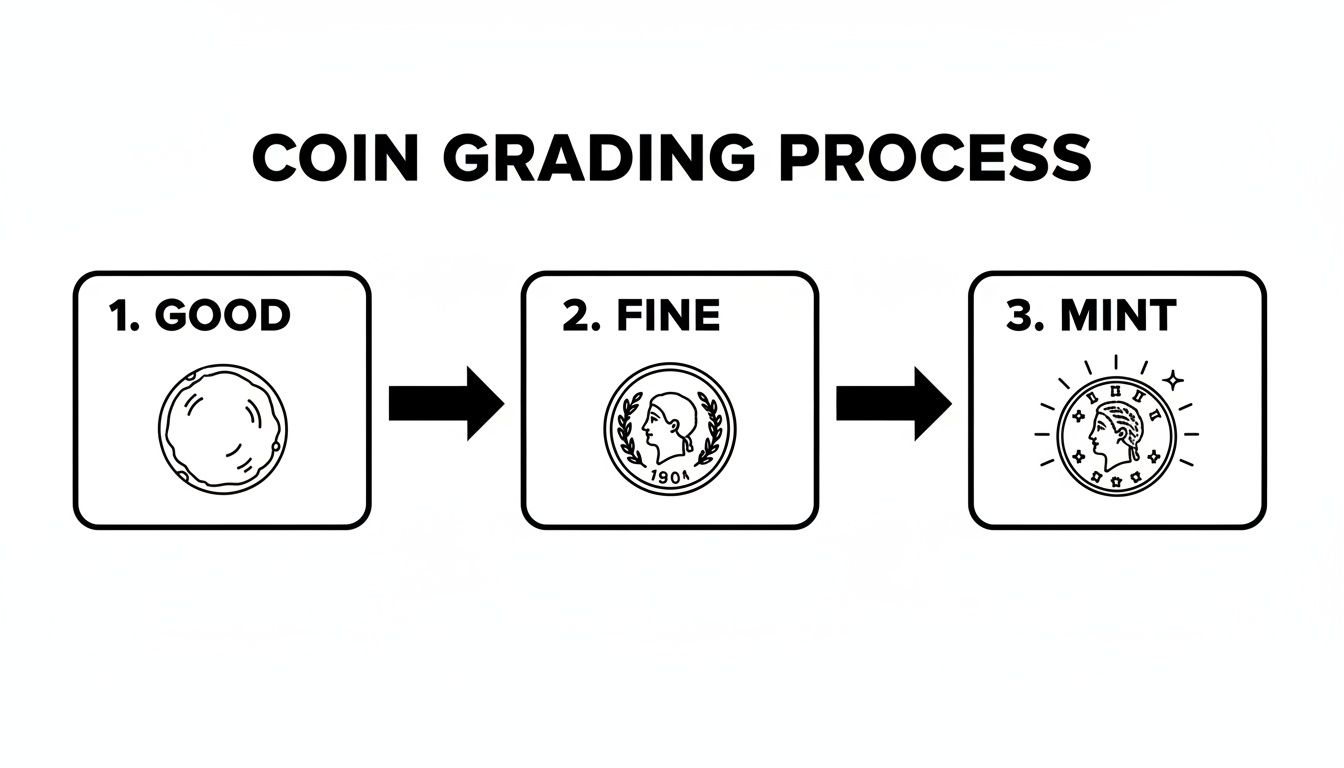
As you can see, the leap from a heavily used coin to a pristine, uncirculated one directly inflates its collector premium and, ultimately, its total worth.
Getting a Fair and Competitive Offer
Knowing how this calculation works is your best defense. It empowers you to spot a fair offer and walk away from a bad one. Any offer based only on melt value is an incomplete offer, especially for a coin with any collector appeal. A reputable buyer will always look at both sides of the coin—literally and figuratively—to land on a final price.
This two-part valuation system includes:
- Calculating the Melt Value: This is done using the live market price of gold.
- Assessing the Numismatic Premium: This requires factoring in the coin's rarity, specific grade, and current collector demand.
A truly accurate valuation looks at every single detail. An expert won't just throw your coin on a scale; they'll analyze its history, condition, and market desirability to make sure you get paid for its full, combined value.
Here at our Gold and Jewelry Buying center in Boise, we specialize in providing this kind of complete and transparent assessment. We pride ourselves on offering the highest payout in Boise, backed by our Price Matching guarantee. You can save the hassle and sell locally for more than online shipments with our easy, hassle free offers. We use Xray Scanning and Gold Testing for free to ensure our evaluation is spot-on, so you walk away with the best possible price for your treasured coin.
Where to Sell Your Gold Coin in Boise for the Highest Payout
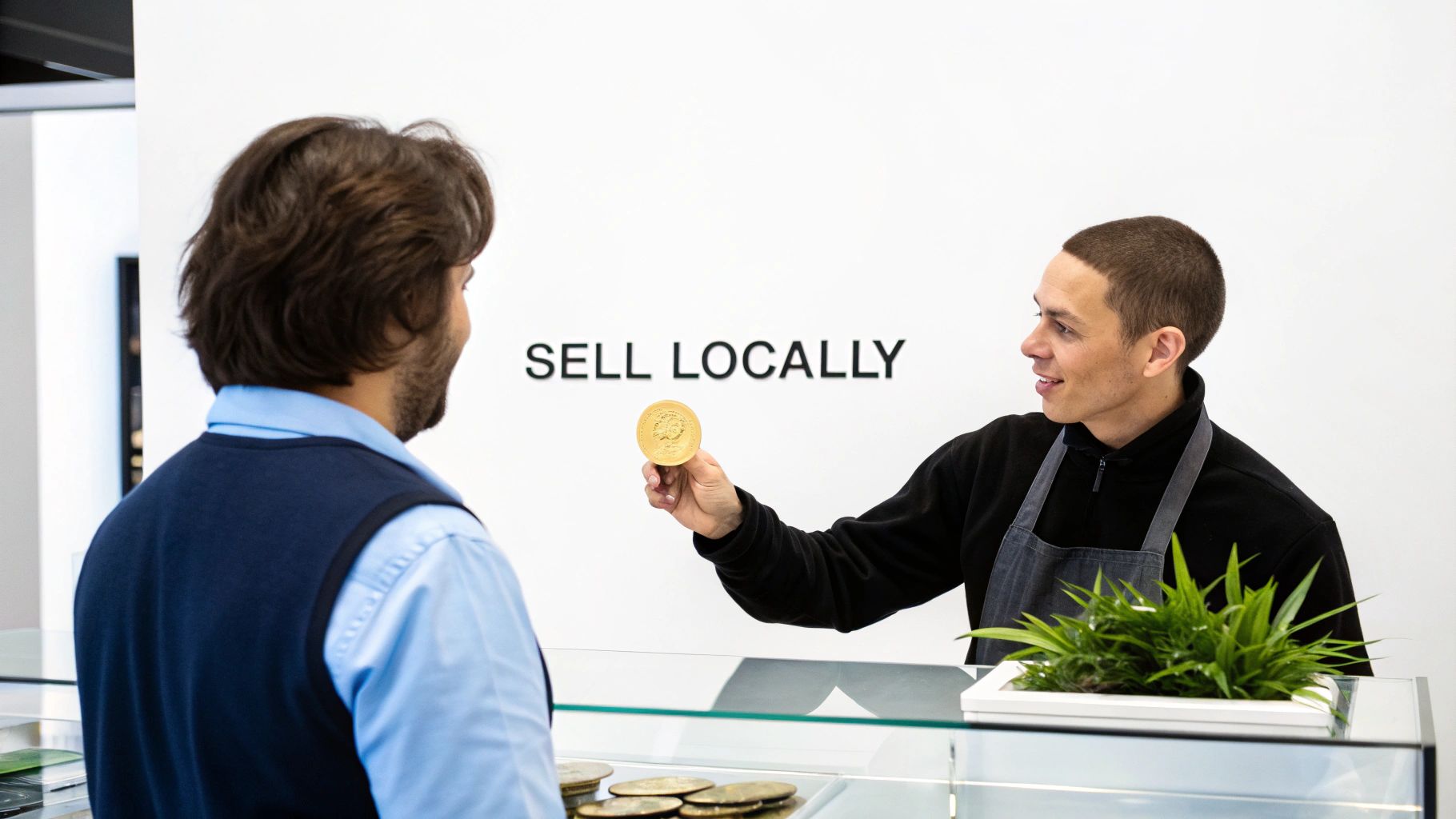
Knowing what your coin might be worth is one thing, but actually turning that potential into cash in your hand is the real goal. Once you decide to sell, you’ll face a choice: do you risk it with an online buyer, or do you work with a local expert? Believe me, the path you take can make a huge difference in both your final payout and your peace of mind.
Online marketplaces might seem easy on the surface, but they come with a lot of hidden headaches. You're looking at steep insurance costs for shipping, the very real risk of your coin getting lost in transit, and the complete uncertainty of dealing with a faceless buyer who's probably going to hit you with a lowball offer. It's a process that can be filled with stress.
This is exactly why so many sellers choose to save the hassle and sell locally for more than online shipments. A face-to-face transaction with a professional you can trust eliminates all those risks and keeps you in control from start to finish.
The Clear Advantage of Selling Locally
When you bring your gold dollar coin to a reputable Gold and Jewelry Buying specialist, the entire experience is different. Instead of sending your treasure off into the unknown, you get a transparent, immediate, and secure process. Here in Boise, it’s simply the best way to sell your valuables with total confidence.
The benefits are immediate and tangible:
- No Shipping Risks: Your coin never has to leave your sight until you've agreed on a price.
- Instant Payment: You walk out the door with cash in hand, same day. No waiting, no wondering.
- Expert Evaluation: You get an in-person, professional assessment from someone who truly understands both gold content and numismatic value.
At Carat 24, we’ve built our entire reputation on trust and transparency. We believe selling your gold coin should be a straightforward and rewarding experience, not a source of anxiety.
Why Carat 24 Offers the Highest Payout in Boise
We are committed to providing an unmatched selling experience right here in our Boise location. Our whole process is designed to be completely transparent and get you the absolute best value for your coin. It all starts with a free, no-obligation evaluation of your gold dollar.
We use state-of-the-art, non-invasive technology like Xray Scanning and Gold Testing for free to verify your coin's authenticity and composition without causing any damage whatsoever. This scientific approach ensures our offers are precise and accurate, reflecting the true, full worth of your item.
Our promise is simple: hassle free offers based on a complete and honest understanding of your coin's value. We also stand by our Price Matching guarantee, ensuring you always receive the highest payout in Boise. If you're wondering where to sell gold coins for the best price, the answer is a local expert who values your business and your trust.
Skip the stress and uncertainty of selling online. Visit us at 3780 W. State St. in Boise to experience a secure, transparent, and profitable way to sell your gold coin dollar.
A Few Final Questions Before You Sell
As you get ready to sell your gold dollar, a few common questions tend to pop up. I get it—you want to walk in feeling confident and knowing you’re making the right move. Let’s tackle some of the most frequent things people ask right before they come see us.
One of the biggest questions is about where to go. People often wonder if they should head to a pawn shop or find a dedicated gold buyer, and the answer can make a huge difference in your final offer.
Pawn Shop or Specialized Gold Buyer?
Let me be direct: it's almost always better to sell to a specialist in Gold and Jewelry Buying instead of a general pawn shop. Here’s why. A specialist sees the entire value of your coin—not just its gold weight, but its numismatic worth, too. We know which dates, mint marks, and high-grade conditions are rare, and that knowledge translates directly into a higher offer for you.
Pawn shops, on the other hand, usually just focus on the melt value. They’re likely to miss the significant collector premium that really determines how much a gold coin dollar is worth. If you're looking for the highest payout in Boise, an expert evaluation is the only way to go.
How Can I Be Sure My Coin Is Authentic?
This is a critical step, and you shouldn't have to guess. The most reliable way to confirm your gold dollar is the real deal is through a professional analysis.
When you come to our Boise location, we offer Xray Scanning and Gold Testing for free. It's a high-tech, non-invasive way to verify the exact metallic composition of your coin without leaving so much as a scratch. This process clears up any doubt and gives you total peace of mind.
A professional authentication protects everyone involved. It builds a foundation of trust and makes sure every offer is based on solid facts, not just a guess. That kind of transparency is how you get a fair, hassle free offer.
What Do I Need To Bring When Selling?
The good news is, the process is refreshingly simple. Legally, all you need to bring to sell your gold dollar coin is a valid, government-issued ID.
Now, if your coin has already been professionally graded and is sealed in a protective holder from a service like PCGS or NGC, definitely bring it along. It's not a requirement, but that certification backs up its authenticity and grade, which can strengthen your position and make the valuation even quicker. By being prepared, you can save the hassle and sell locally for more than online shipments. We even offer Price Matching to guarantee you’re getting the best deal possible.
Ready to find out what your gold coin is really worth with a trusted local expert? Visit Carat 24 - Trusted Gold Experts in Boise for a transparent, no-obligation evaluation and get the highest possible payout for your treasures. You can learn more at https://carat24boise.com.
