

When you’re trying to figure out the value of a piece of jewelry, the terms "gold plated" and "gold filled" pop up all the time. But what do they actually mean? The core difference boils down to how much gold is present and how it’s attached to the base metal, which directly impacts durability and value.
A gold filled piece has a substantial layer of gold—legally required to be at least 5% of the item's total weight—that’s been permanently bonded to a base metal with intense heat and pressure. Think of it as a thick, durable jacket of gold. On the other hand, gold plated items have an incredibly thin layer of gold, often less than 0.05% of the weight, that's just electroplated on top. It's more like a whisper of gold paint that can wear off surprisingly fast.
Unpacking Gold Plated vs. Gold Filled Jewelry
Understanding this distinction is absolutely critical, whether you're sorting through a family estate sale or just shopping for a new accessory. Knowing what you have determines its true lifespan, how you should care for it, and what it’s actually worth if you ever decide to sell. This is central to smart Gold and Jewelry Buying.
This chart gives you a great visual of just how different the gold layers are.
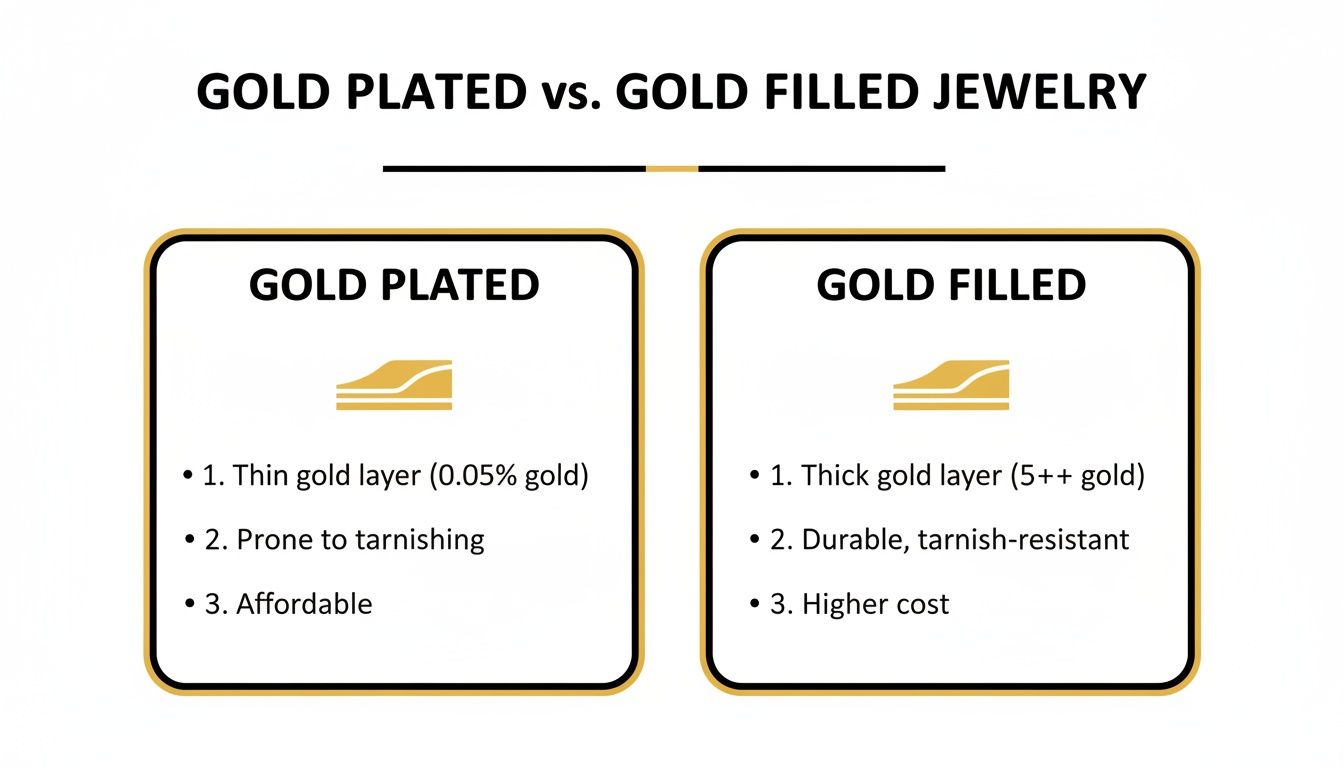
As you can see, the thickness of the gold is worlds apart, and that’s the single biggest factor influencing how a piece holds up over time.
Gold Plated vs. Gold Filled At a Glance
Sometimes, a quick side-by-side comparison is the best way to see the practical differences. Here’s a simple breakdown of what sets these two jewelry types apart.
| Attribute | Gold Plated | Gold Filled |
|---|---|---|
| Gold Content | Extremely low (typically <0.05%) | Substantial (at least 5% by law) |
| Durability | Wears off quickly; prone to tarnish | Long-lasting; resists tarnish for years |
| Value | Little to no resale value | Retains value due to gold content |
| Process | Electroplating (thin chemical coating) | Heat & pressure bonding (thick layer) |
The takeaway is clear: gold filled jewelry is built for the long haul, while gold plated pieces are more for temporary fashion.
For those of us here in Boise, knowing this difference is key to getting a fair price when you sell. At Carat24, we take the guesswork out of it. We use professional Xray Scanning and Gold Testing for free to accurately determine your jewelry’s exact composition right in front of you. This ensures you get transparent, hassle free offers without the uncertainty of shipping your valuables away. We even offer Price Matching to make sure you get the highest payout in Boise. For a deeper dive, you can also explore the difference between gold filled and solid gold in our guide.
How Gold Plated and Gold Filled Jewelry Is Made
To really get what separates gold plated from gold filled jewelry, you have to go back to how they're made. The manufacturing process isn't just some technical footnote; it’s the entire reason for the huge gap in durability, quality, and what the piece is ultimately worth. One is a delicate surface treatment, while the other is a robust, permanent fusion of metals.
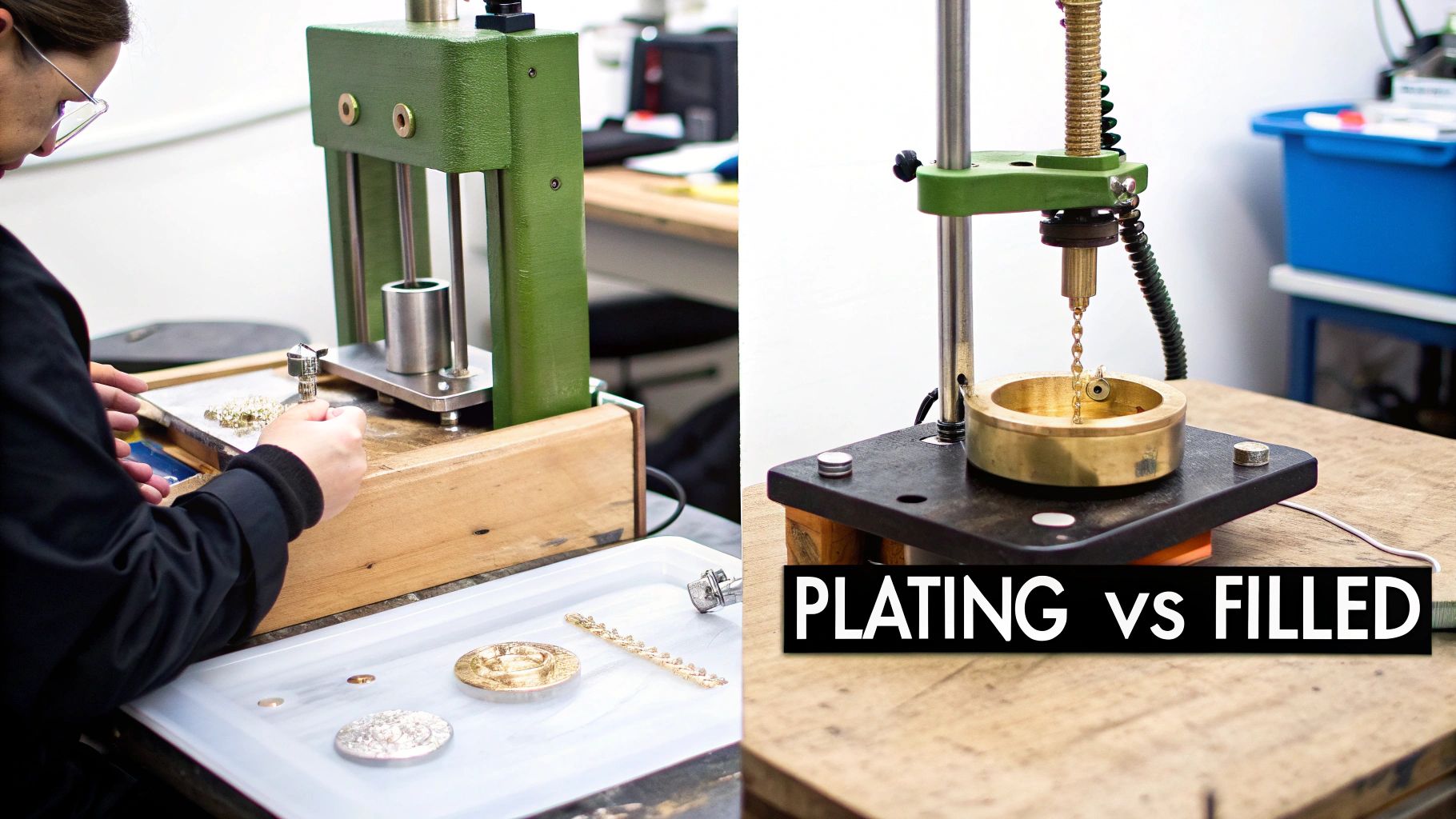
This fundamental difference in creation is exactly what our experts look for during a free Gold Testing session. A quick, non-invasive scan tells the story behind the shine, letting us see a piece’s true composition and offer the highest payout in Boise. This expertise is a key part of our Gold and Jewelry Buying services.
The Gold Plating Process: A Chemical Kiss of Gold
Gold plating is done through a process called electroplating. It starts with a base metal piece—usually something like brass, copper, or nickel—that's cleaned meticulously so the gold will stick. The jewelry is then dipped into a chemical solution that has dissolved gold particles floating in it.
An electrical current is sent through this bath, which causes the gold ions to chemically bond to the surface of the base metal. This process lays down an incredibly thin layer of gold, typically between 0.175 and 2.5 microns. To put that in perspective, a single human hair is about 70 microns thick. We're talking about a microscopic layer.
This method is fast and cheap, making it perfect for creating affordable, trendy jewelry that follows the latest styles. But that thin coating is also its biggest weakness, as it's easily scratched and will inevitably wear away with use.
The Gold Filled Process: A Mechanical Fusion of Metals
Gold filled jewelry is made using a totally different—and far more durable—technique. This method involves mechanically bonding a thick sheet of solid karat gold (usually 12k or 14k) to a core of high-quality jeweler's brass.
The process uses immense heat and pressure to permanently fuse the two metals together. The result isn't a thin coating but a substantial, layered material. In fact, by U.S. law, that gold layer has to make up at least 5% (or 1/20th) of the item's total weight.
Key Takeaway: The heat-and-pressure bonding of gold filled jewelry creates a permanent molecular bond, making the gold layer an integral part of the piece. This is fundamentally different from the surface-level adhesion of electroplating.
This robust construction makes gold filled jewelry a layered composite, not an alloy. Because the gold layer is 50 to 100,000 times thicker than what you'd find on gold plated items, it won’t flake, rub off, or tarnish easily. This durability is why gold filled pieces hold their value and can last for decades if you take care of them. You can learn more about how metals are combined by reading our guide on how to determine gold purity.
Understanding these methods helps explain why a simple visual inspection just isn't enough. For Boise residents looking to sell, we offer a hassle-free evaluation. Our free Xray Scanning technology precisely measures the gold content, so you can save the hassle and sell locally for more than online shipments. We provide transparent, no-obligation hassle free offers and even offer Price Matching to ensure you get the best value for your items and the highest payout in Boise.
Comparing Durability and How Each Type Ages
When you’re looking at gold jewelry, the real test isn’t how it looks under the display lights—it’s how it holds up over time. This is where the difference between gold plated and gold filled becomes crystal clear. One is made for a season of wear, while the other is crafted to last for years, sometimes even decades.
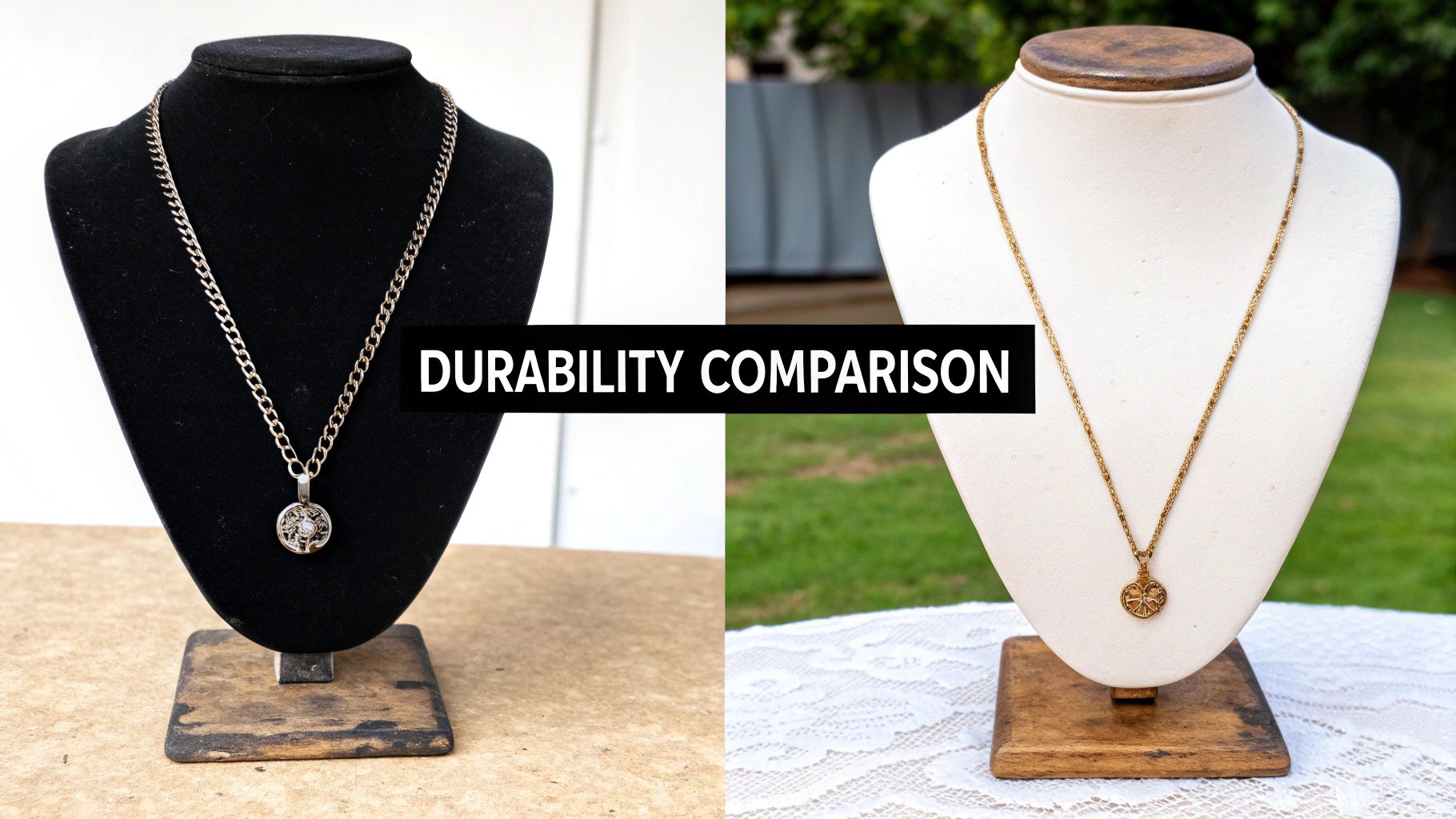
This distinction is a big deal for both Gold and Jewelry Buying. A piece that shines brilliantly today could be dull and discolored in just a few months. Understanding how each type ages is crucial for making a smart purchase or getting a fair price when you decide to sell.
The Short Lifespan of Gold Plated Jewelry
Gold plated jewelry has a thin, almost microscopic, layer of gold. It’s susceptible to pretty much everything. Because the gold is applied through electroplating, it’s just a surface-level coating that’s easily compromised.
Everyday life is the enemy of gold plating. Just think about these common situations:
- Lotions and Perfumes: The chemicals in your favorite cosmetics can eat away at the thin gold layer, causing it to fade, flake, or wear off entirely.
- Sweat and Oils: Your skin's natural oils and sweat create a slightly acidic environment that quickly tarnishes and erodes the plating.
- Friction and Abrasion: Simple things like a necklace rubbing against your shirt or a ring bumping against a desk can wear through the gold, sometimes in just a few months.
Once that thin gold layer is gone, the base metal underneath—usually brass or copper—starts to show. This not only looks bad but can also cause skin irritation or allergic reactions for people with metal sensitivities.
The Enduring Nature of Gold Filled Jewelry
On the other hand, gold filled jewelry is built to last. Its thick, pressure-bonded layer of karat gold behaves a lot like solid gold, offering fantastic resistance to tarnish and daily wear. The gold layer is 50 to 100,000 times thicker than what you'll find on plated pieces, so it simply doesn’t just rub off.
This durability means gold filled pieces can handle everyday life beautifully. You can wear a gold filled bracelet or necklace for years, and with a little care, it can keep its shine for decades. It won’t turn your skin green or reveal a dull base metal after a handful of wears, making it a fantastic, long-term alternative to solid gold without the hefty price tag.
"A well-cared-for gold filled piece can last 10 to 30 years, whereas a gold plated item often shows significant wear in under a year. This massive difference in longevity is a primary factor we assess when determining an item's value and payout."
For anyone looking to sell jewelry, especially pieces from an estate, this difference in aging directly impacts what it's worth. A flaky, tarnished plated piece has almost no resale value. A vintage gold filled item that’s been looked after, however, can still fetch a respectable price.
Here in Boise, we make that evaluation process simple and clear. Our experts provide free Xray Scanning and Gold Testing to figure out exactly what your items are made of, ensuring you get the highest payout in Boise. We offer Price Matching and hassle free offers, so you can save the hassle and sell locally for more than online shipments.
Understanding the Financial Value and Resale Potential
When you're buying gold jewelry, the price tag is just the start of the conversation. The real story unfolds over time, in the piece's long-term value and what it might be worth down the road. This is where the gap between gold plated and gold filled jewelry becomes a massive financial distinction, separating a fleeting accessory from a tangible asset.
Gold plated jewelry is temptingly cheap, making it perfect for hopping on a fast fashion trend. But let’s be clear: its value is almost entirely in the style, not the substance. The gold layer is so microscopically thin that it adds virtually nothing to the item's real worth. As soon as that plating inevitably rubs off and the cheap base metal underneath shows through, its resale value plummets to basically zero.
On the other hand, gold filled jewelry comes with a higher initial cost, and for good reason. That price directly reflects the significant amount of real gold bonded to its core. For a savvy buyer or seller, this is where the financial advantage really shines.
Why Gold Filled Jewelry Retains Value
The simple reason gold filled pieces hold their value is because they contain a substantial amount of real gold. By law, that gold layer must make up at least 5% of the item's total weight. That might not sound like a lot, but it’s a huge amount compared to the nearly non-existent trace of gold on plated items. This gold content gives the piece a real, lasting value that can be recovered.
This means even if a gold filled necklace goes out of style or a bracelet gets broken, the gold itself is still a valuable commodity. A worn-out gold plated chain is essentially junk, but that broken gold filled bracelet still has a measurable amount of gold with real monetary value. Knowing this is the key to getting the most for your items. You can learn more about how we figure this out in our guide on how your gold's worth is calculated.
Expert Insight: The resale market for gold filled items, especially vintage pieces that are still in good shape, is surprisingly strong. Collectors and informed buyers know it’s durable and high-quality, making it a much more liquid asset than any plated lookalike.
When you get down to it, gold filled jewelry just offers superior value. It uses 100 times more gold than plated items, and the process of heat-fusing thick sheets of gold to a base metal core is far more intensive. While a gold filled piece might cost between $30-$100, it holds that value well, even as the spot price of gold swings. Plated jewelry, in contrast, loses all its appeal once it starts to tarnish. You can read more about the market stability of gold filled jewelry on American Hartford Gold.
Maximizing Your Payout in Boise
For anyone selling locally, understanding this difference is crucial for getting the highest payout in Boise. So many people inherit jewelry boxes filled with pieces they can’t identify, and just writing something off as "costume jewelry" could be a very expensive mistake. A vintage gold filled locket can look a lot like a plated one at first glance, but their financial values are worlds apart.
This is exactly why a professional evaluation is so critical. We offer a completely free Xray Scanning and Gold Testing service to tell you exactly what your items are made of and what they’re worth. Our advanced tech accurately measures the gold content without leaving a scratch, giving you a transparent and precise assessment.
We make hassle free offers right on the spot, and we back them up with a Price Matching guarantee to make sure you get the best price possible. You can save the hassle and sell locally for more than online shipments, completely avoiding the risks, delays, and hidden fees that come with mailing your valuables to some faceless company. When you sell with us, you walk out with an instant payout, confident you received the true value for your jewelry.
How to Identify and Care for Your Jewelry
Figuring out exactly what you have is the first step to properly caring for your jewelry and understanding its true worth. It can be tricky to tell the difference between gold plated and gold filled pieces just by looking, but there are clues—like tiny stamps and the way a piece wears over time—that reveal a lot about its construction. This knowledge is crucial whether you're trying to preserve a family heirloom or thinking about selling part of your collection.
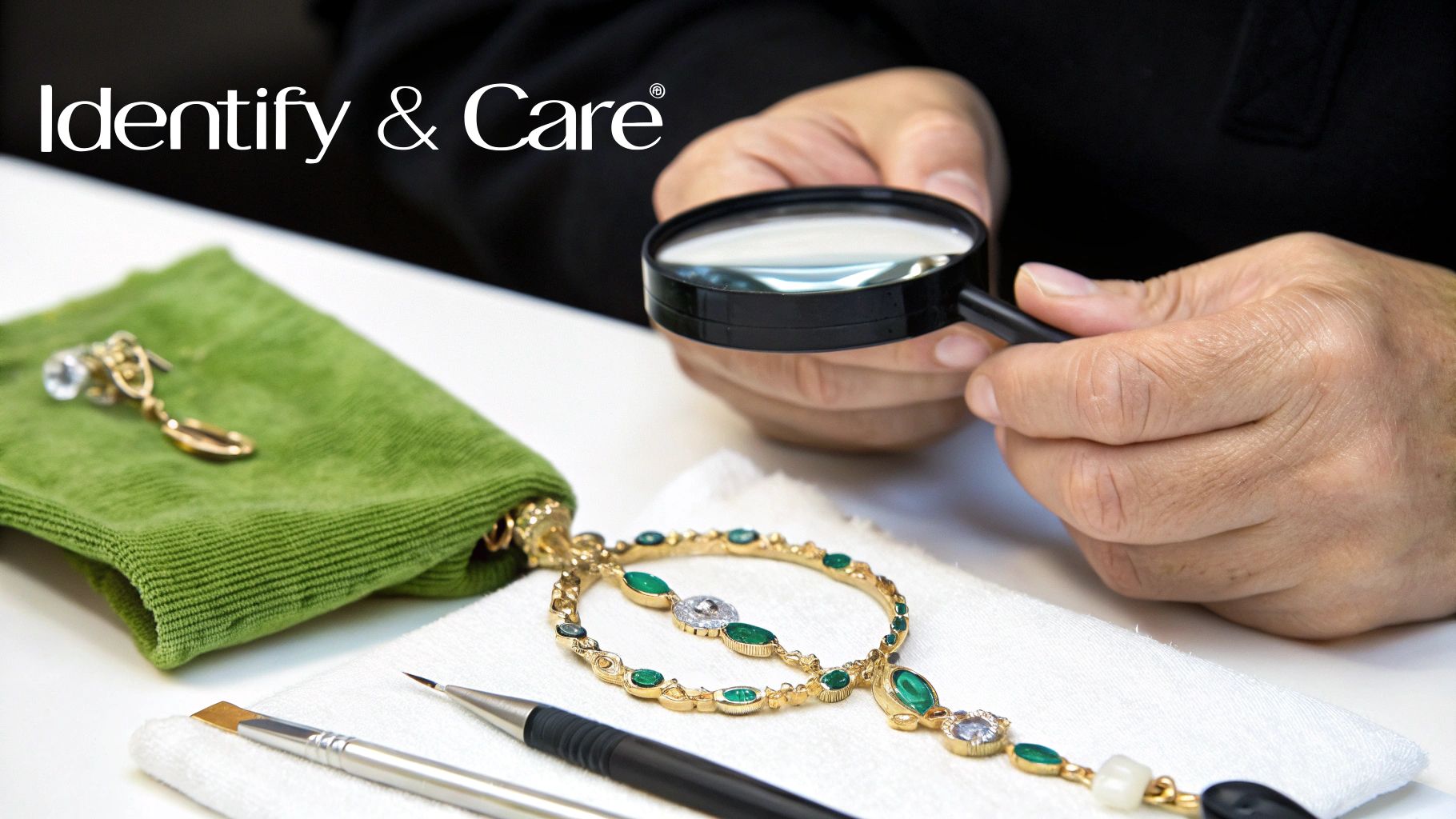
This kind of hands-on identification is a core part of any professional Gold and Jewelry Buying evaluation. For anyone local here in Boise, bringing your items to a trusted expert means you can skip the guesswork and get a straight answer on the spot.
Decoding Jewelry Hallmarks
The best way to identify your jewelry is to look for the hallmarks. These are tiny stamps, usually tucked away on a clasp, the inside of a ring shank, or the back of a pendant. Think of them as a code that reveals what the piece is made of.
While not all pieces are marked, here’s a quick guide to some of the most common hallmarks you might find.
Common Hallmarks and Their Meanings
| Hallmark/Stamp | Meaning | Associated Jewelry Type |
|---|---|---|
| GF or 1/20 14K GF | Indicates the piece is at least 5% (1/20th) gold by weight. The karat (e.g., 14K) is specified. | Gold Filled |
| GP or G.P. | Stands for Gold Plated, signifying a thin layer of electroplated gold over a base metal. | Gold Plated |
| HGE or H.G.E. | Heavy Gold Electroplate. A slightly thicker plating, but still considered plated with minimal gold value. | Gold Plated |
| GE | An abbreviation for Gold Electroplate. | Gold Plated |
If your jewelry doesn't have any markings at all, it's often (but not always) a sign that it’s gold plated. The only surefire way to know for certain is to have it professionally tested.
Tailored Care for Your Jewelry
How you care for your jewelry has a massive impact on its lifespan, especially when dealing with pieces that aren't solid gold. The right approach for plated and filled items is quite different.
Gold plated jewelry needs to be handled with extreme care. That gold layer is microscopically thin and can be damaged by just about anything. To make it last, always take it off before you shower, swim, or put on lotions and perfumes. Clean it gently with a soft, dry cloth and steer clear of any polishing chemicals or abrasive materials that could strip the finish right off.
Gold filled jewelry, on the other hand, is much more resilient. With its thick, bonded layer of gold, it handles daily wear far better. It's still a good idea to avoid harsh chemicals, though. For a complete breakdown, you can learn more about cleaning gold filled jewelry in our detailed guide.
Practical Tip: Always store your jewelry separately to prevent scratching. A soft pouch or a lined box is perfect for protecting delicate surfaces from damage and slowing down the tarnishing process.
The Reality of Repairs
When it comes to fixing broken jewelry, the material makes all the difference. A skilled jeweler can often resize a gold filled ring because the thick gold layer can withstand the heat and manipulation without being ruined.
Trying to repair gold plated jewelry, however, is almost never worth the expense. Soldering a broken plated chain, for example, will just burn away the thin gold layer, exposing the base metal underneath and leaving an ugly, discolored spot. Re-plating an entire piece is an option, but it’s often more expensive than the item’s original cost.
For Boise residents, this is where a professional evaluation really helps. At Carat 24, we offer free Xray Scanning and Gold Testing to accurately identify your items. This allows us to give you hassle-free offers and ensures you receive the highest payout in Boise. We even provide Price Matching to guarantee it. You can save the hassle and sell locally for more than online shipments, turning your unwanted pieces into cash right away.
Making the Right Choice for Buyers and Boise Sellers
When you’re navigating the world of gold jewelry, it really all boils down to your goals. Are you buying a new accessory or selling a piece from your collection? Knowing the real-world difference between gold plated and gold filled is what helps you make a financially smart decision. The right choice depends entirely on your budget, how often you plan to wear the piece, and your expectations for its long-term value.
For buyers, the decision is a classic tug-of-war between affordability and longevity. If you’re just looking for a trendy, inexpensive piece to wear occasionally, gold plated jewelry is a perfectly fine option. It lets you experiment with new styles without a serious financial commitment.
However, if you need something for daily wear, a classic gift, or a piece you expect to last for years, investing in gold filled is by far the wiser choice. Its durability and much thicker gold layer mean it can handle regular use and keep its beauty, offering a far better return on your investment over time.
Guidance for Sellers in the Boise Area
For sellers, especially those right here in the Boise area with estate jewelry or inherited collections, understanding what you actually have is the key to getting the most money. A piece that looks like simple costume jewelry might be a valuable gold filled item, while another could be a plated piece with almost no resale worth. Guessing is a costly mistake.
This is where a professional evaluation is absolutely essential. At Carat 24, we take all the guesswork out of the equation. Our Gold and Jewelry Buying experts give you a transparent, educational experience, showing you exactly what’s in your hands.
Don't settle for the uncertainty of online mail-in services. Selling locally means you get a firm, hassle-free offer on the spot, with no hidden fees or shipping risks. You stay in control of your valuables and walk away with an instant payout.
We use advanced, non-destructive technology to make sure you get the best possible price.
- Free Xray Scanning and Gold Testing: We’ll precisely determine the gold content and composition of your pieces, right in front of you.
- Hassle Free Offers: Our team provides clear, no-obligation offers based on real-time market values.
- Price Matching Guarantee: We are committed to giving you the highest payout in Boise and will match any competitor's written offer.
When you're ready to sell, presenting your items well can also make a difference. For sellers looking to showcase jewelry online to attract buyers, it's a good idea to use professional product photography services to highlight the intricate details and quality of your pieces.
Ultimately, the best way to get top dollar is to work with experts who value transparency. Save the hassle and sell locally for more than online shipments. To learn more about how we can help, check out our guide on the best place to sell your gold in Boise.
A Few Common Questions We Hear
When you're dealing with jewelry, especially pieces you've inherited or are thinking of selling, a lot of questions pop up. It's easy to get confused about what's valuable and what's not. Let's clear up a few of the most common things people ask us about gold plated versus gold filled items.
Can I Shower in Gold Filled Jewelry?
Technically, you can, but I wouldn't make a habit of it. While gold filled jewelry is worlds away from gold plated in terms of durability, you're still exposing it to a daily dose of soaps, shampoos, and hard water. Over time, that constant exposure can dull the finish and reduce its lifespan. My advice? If you want that piece to look great for decades, just take it off before you hop in the shower. It's a simple step that makes a huge difference.
Is Gold Filled Jewelry Hypoallergenic?
For the vast majority of people, the answer is yes. The magic of gold filled jewelry is that thick, pressure-bonded layer of real karat gold. That layer is substantial enough that your skin rarely, if ever, touches the base metal core. This makes it a fantastic choice if you have mild metal sensitivities. Gold plated pieces, on the other hand, are notorious for causing reactions once that microscopic gold layer wears off and exposes the nickel or brass underneath.
Will Gold Filled Jewelry Turn My Skin Green?
It's highly unlikely. That dreaded green stain on your skin is a chemical reaction between your body's natural acids and base metals, usually copper. Since a gold filled piece has a robust barrier of real gold, that reaction just doesn't happen. If you've ever had a cheap ring leave a green band on your finger, you’ll definitely appreciate the reliability of gold filled quality.
How Do I Know if My Jewelry is Worth Selling?
This is the big one, and the honest answer is that you often need an expert eye. The value is all in the material, and it’s nearly impossible to tell the difference just by looking. Gold filled pieces have real gold content, so they absolutely retain value. Plated jewelry, however, has virtually no resale worth.
The only way to be certain about your jewelry's value is to have it professionally evaluated. Trying to guess could mean leaving real money on the table, especially when you're dealing with vintage or estate collections.
For anyone here in the Boise area, the smartest move is to get a professional opinion. A reputable Gold and Jewelry Buying service gives you clarity and confidence. We use Xray Scanning and Gold Testing for free to tell you exactly what your items are made of. This lets us make transparent, hassle-free offers on the spot, backed by a Price Matching guarantee. You can save the hassle and sell locally for more than online shipments, ensuring you walk away with the highest payout in Boise without any of the risks or waiting.
Ready to find out what your jewelry is really worth? At Carat 24 - Trusted Gold Experts, we provide free, no-obligation evaluations and instant payouts. Come see us in Boise for a selling process that’s transparent, fair, and rewarding. You can learn more about how we work at https://carat24boise.com.
