
A published Idaho buying-price example reported by CoinShop Finder's guide to pawn shop gold pricing listed gold jewelry purchases at spot price minus 20 percent. That single percentage explains why two people selling identical rings leave with different checks. The spot price isn't the offer. The offer is spot minus a spread, and the spread is where the money goes.
American coins give you something better than a percentage to take on faith. The Mint published the alloy and the weight for the series it struck, so the silver in a coin is a calculation rather than a guess. A 1964 quarter and a 1965 quarter are the same size, the same color, and the same design, and one of them holds silver. A date, a denomination, and a gram scale that reads to 0.01 g settle the question in under a minute.
That's what this guide teaches. You'll start with the weight chart a coin desk keeps within reach, learn the two fineness standards behind it, sort the five families of silver coins away from their clad lookalikes, and work through the awkward cases: the 40 percent Kennedy halves, the wartime nickels, the commemoratives that say "silver dollar" without holding an ounce. Then you'll price a pile and compare offers with real numbers in front of you.
Silver Weight for the Coins People Sort
| Coin | Silver years | Fineness | Gross weight | Pure silver |
|---|---|---|---|---|
| Wartime Jefferson nickel | 1942–1945 | 35% | 5.00 g | 0.0563 oz t |
| Dime | 1837–1964 | 90% | 2.50 g | 0.0723 oz t |
| Washington quarter | 1932–1964 | 90% | 6.25 g | 0.1808 oz t |
| Half dollar | Through 1964 | 90% | 12.50 g | 0.3617 oz t |
| Kennedy half dollar | 1965–1970 | 40% | 11.50 g | 0.1479 oz t |
| Morgan or Peace dollar | 1878–1935 | 90% | 26.73 g | 0.7734 oz t |
| American Silver Eagle | 1986 onward | 99.9% | 31.103 g | 1.000 oz t |
| Dime or quarter | 1965 onward | Clad, no silver | Face-value planchet | 0 oz t |
Coin collectors often sort coins by denomination and stop. The chart asks for one more step, because the date decides which alloy the denomination is made of. Take a half dollar: a Franklin dated 1963 and a Kennedy dated 1965 are the same diameter, the same weight class, and both silver, yet one holds more than twice the metal of the other. Same pocket, half the silver.
How to Read a Row
Read across in a fixed order: coin type, silver years, fineness, gross weight, pure silver. If a coin's date falls outside the silver years on a row, it doesn't belong on that row at all. That first filter saves the most time, because a 1967 quarter never needs a second look.
Once the date matches, the pure silver column is the number that matters for a sale. It's already the product of gross weight and fineness, converted to troy ounces, so you don't do the arithmetic twice.
Every figure here is the nominal weight of an unworn coin. Circulation takes metal off a coin a little at a time: the high points flatten, the rim wears, the coin gets lighter. A quarter that has spent decades in a till can come in measurably under 6.25 grams, and the silver drops with the weight. The scale settles what the chart can't.
Practical rule: Find the date before you find the denomination. Two halves that look identical from across a counter can belong on different rows.
Where the Rows Stop Being Silver
The last row is the one people misplace. Regular dimes and quarters dated 1965 and later carry no silver at all, and by 1971 the coins in ordinary circulation held none. A 1975 quarter is a copper-nickel coin with a silver-colored surface, and it belongs in the spending jar.
The top row holds the odd one out. Wartime Jefferson nickels from 1942 to 1945 carry silver, which surprises nearly everyone who finds one in a drawer.
Match the denomination and the date to a single row and you have the metal content without further research. That's the whole of American coin silver content in one table. When the coin is a Kennedy half, a wartime nickel, or a modern commemorative, the sections below handle the exceptions those rows only hint at.
From the 1792 Standard to 90 Percent Silver
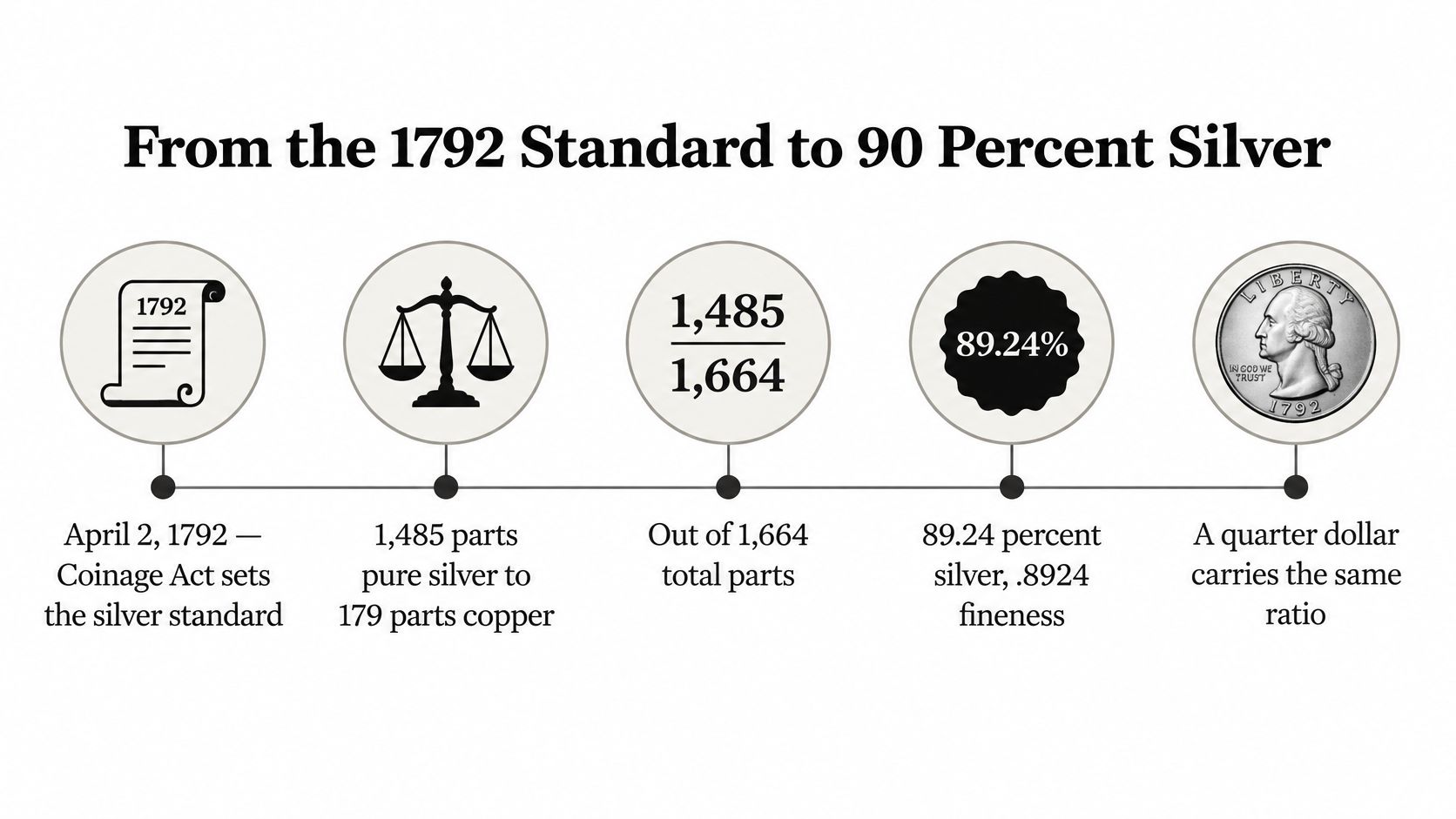
A silver coin's fineness is only one part of its metal value. The United States began with an alloy of 1,485 parts silver and 179 parts copper, or about 89.24 percent silver, as specified in the Coinage Act of April 2, 1792. The law also tied denominations to metal weight: a quarter dollar contained 104 grains of standard silver, while a half disme contained 20 4/5 grains.
An American coin was both money with a face value and a measured piece of metal. Its prescribed alloy and weight helped establish how much silver each denomination contained.
The 1837 Change and What It Did to the Math
By the 1830s, the standard for circulating silver coins had shifted to .900 fineness: 90 percent silver and 10 percent copper. That alloy became familiar in later dimes, quarters, half dollars, and silver dollars. The earlier standard remained different, so a coin's date can change the calculation even when its denomination looks familiar.
Fineness Is a Share, Weight Is an Amount
Fineness gives the share of a coin that is silver; weight gives the amount of coin being measured. Multiply the coin's weight by its fineness, then convert the silver weight to troy ounces to estimate recoverable silver.
That distinction matters for early coins. A larger coin made to the earlier standard may contain more silver than a smaller coin made to the later one. Wear also reduces a coin's weight, so the date, alloy, and actual weight belong in the same calculation. Learn how key dates can affect a coin's collector value.
Fineness is the fraction. Weight is the amount. Together, they show how much silver the coin contains.
Use the correct standard for the coin's date before calculating its silver content. A formula based on the later alloy can misstate the recoverable silver in an earlier coin.
Sorting Silver Families and Clad Lookalikes
Before anything goes on a scale, it goes into a family. Sorting first means you weigh once and price once, and it catches the coins that look right and aren't.
The Five Families
90 percent silver, the backbone of any pile. Pre-1965 Mercury and Roosevelt dimes (Roosevelt from 1946 to 1964), Washington quarters, Walking Liberty halves, Franklin halves, the 1964 Kennedy half, and Morgan and Peace dollars. The clue is the edge: one continuous silver-colored band, no seam and no stripe.
40 percent silver, the transition. Kennedy halves dated 1965 through 1970. The same alloy turns up in collector Eisenhower dollars from 1971 through 1976 sold in blue or brown packaging, which is a different coin from the Eisenhower dollars that circulated.
35 percent silver, the wartime nickel. Jefferson nickels dated 1942 through 1945, marked by a large mint mark above Monticello. That oversized letter is the identifying clue. A 1946 nickel has no silver and no oversized mark.
99.9 percent bullion. The American Silver Eagle. One troy ounce, reeded edge, and no doubt about what it is once it sits on a scale.
Modern commemorative and proof silver. Often the traditional 90 percent alloy, often described as a silver dollar, and almost never a full troy ounce despite the dollar on the face.
Five families, five different prices per coin, and no way to tell them apart by color alone.
What Leaves the Silver Pile
Copper-nickel dimes and quarters dated 1965 and later don't belong in the pile. Neither do clad halves from 1971 on, circulation Eisenhower dollars, or ordinary nickels from any year, which never contained silver. These are the coins that inflate a count and deflate an offer once a buyer inspects the lot.
Set a 90 percent coin beside a clad one and look at the edge. The silver piece shows one uniform band. The clad piece shows a copper core stripe, thin as a hair, running around the rim.
Plated copies and novelty rounds are the harder case. A silver-plated copper round can pass a glance and fail a scale, so compare diameter, edge style, and grams against the family specification, then hold back anything that doesn't line up. A mismatch isn't automatically a fake. It's a coin that needs a second look before it joins a total.
Why the Sort Comes Before the Scale
A mixed roll of half dollars is the clearest example. Sixty coins of one design, and some are 90 percent, some are 40 percent, some are clad. Weigh the whole roll and divide by sixty and you get an average that describes none of them, wrong in both directions at once.
Each family maps to a row on the weight chart, and no weight gets assigned until the family is settled. Get the family wrong and the arithmetic is wasted.
Identifying and Weighing 90 Percent Everyday Coins
The everyday 90 percent coins are the ones that turn up in change jars, estate boxes, and bank rolls. The U.S. Mint's historic coin production records confirm the standard: 90 percent silver and 10 percent copper by mass for pre-1965 circulating silver, with half dimes, dimes, quarters, half dollars, and dollars moving from .8924 to .900 fineness in 1837.
The set to look for: Mercury dimes, Roosevelt dimes dated 1946 to 1964, Washington quarters dated 1932 to 1964, Walking Liberty halves, Franklin halves dated 1948 to 1963, the 1964 Kennedy half, and Morgan or Peace dollars. Dimes struck before 1837 are .8924 fineness and belong to the earlier standard, not the .900 row.
Two Worked Examples
Ten dimes, two dates. Ten unworn 1964 Roosevelt dimes hold about 0.723 troy ounce of pure silver. Ten 1965 dimes hold zero. Same size, same color, same portrait, and the only difference is a date few people read.
One slick quarter. A quarter that spent forty years in circulation can weigh under 6.25 grams. Its fineness is still 90 percent, but it holds less than the chart's 0.1808 troy ounce because there's less metal left to be 90 percent of. The scale reading decides the value, not the composition column.
The Four-Step Check
- Confirm the date and type. Use the chart's silver years, not the design's reputation.
- Weigh it on a gram scale. Convert with 31.1034768 grams per troy ounce, which is the figure the Mint's own conversion rests on.
- Look at the edge. A copper stripe means clad, no matter what the face says.
- Compare against the row. A number well off the nominal weight means wear, damage, or a counterfeit, and each one gets handled differently.
Separate collector value before you quote a price. A rare date or an unusually attractive dollar can sell above melt, and paying melt for one is the same error in reverse, pricing a collector's coin as scrap. Our breakdown of pre-1965 silver quarters covers the quarter dates worth a second look.
Weigh the group, then read the date. A heavy coin with a common date and a light coin with a rare one are two different transactions.
Kennedy Halves from 90 Percent to Clad
Kennedy half dollars fall into three silver-content groups, and the date separates them. A 1964 half contains about 0.3617 troy ounce of silver. From 1965 through 1970, the halves contain 40 percent silver and about 0.1479 troy ounce. Ordinary circulating halves dated 1971 and later contain no silver.
The 1965 change came under the Coinage Act of 1965. The half dollar kept some silver, unlike circulating dimes and quarters, using a layered composition: outer layers of 80 percent silver bonded to a core containing 21 percent silver. The U.S. Mint's account of the first striking of half dollars from the new coinage material describes that construction.
Why the Coin Was Built in Layers
The layers make the alloy less obvious than a simple silver-or-copper distinction. The whole coin is 40 percent silver, even though its surfaces and core have different compositions. For estimating recoverable silver, use the coin's date and the silver weight for its group, not the surface color alone.
Three Cases, Side by Side
- 1964: 90 percent silver, about 0.3617 troy ounce.
- 1965 to 1970: 40 percent silver, about 0.1479 troy ounce.
- 1971 and later: No silver in ordinary circulating halves.
The difference between a 1964 half and a 1965–1970 half is about 0.21 troy ounce of silver. A mixed group should therefore be sorted by date before its silver value is estimated; counting every half as the same type would overstate or understate the total.
Proof and uncirculated set pieces can follow different specifications. Identify the issue and check its stated composition rather than applying the circulating-coin figures automatically.
Read the date before choosing a silver-content figure. For Kennedy halves, that one detail sets the calculation.
Silver Eagles Compared with Commemorative Dollars
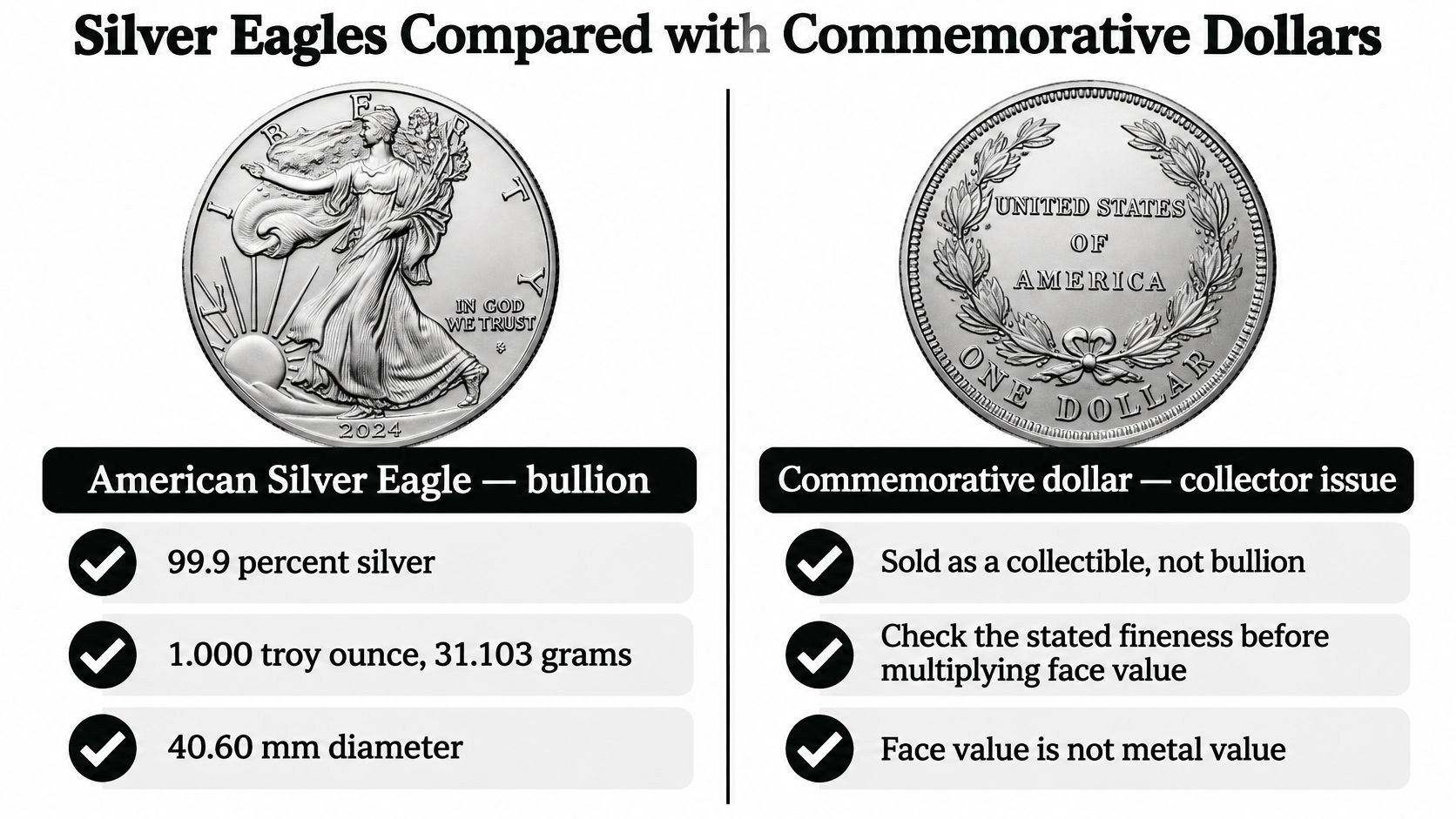
An American Silver Eagle contains one troy ounce of silver. A commemorative silver dollar can look similar, yet hold less: its face value names the denomination, not the amount of metal.
The Eagle's specifications list a weight of 31.103 grams and a fineness of 99.9 percent silver. Its diameter is 40.60 millimeters, and its edge is reeded. The U.S. Mint guarantees its weight, content, and purity.
Commemorative dollars vary by program. For example, the 2011 United States Army silver dollar has a stated composition of 90 percent silver and 10 percent copper, with a gross weight of 26.73 grams. That works out to about 0.7734 troy ounce of pure silver before wear, close to the silver content of a Morgan or Peace dollar.
What the Words Silver Dollar Actually Promise
A dollar denomination states face value. It does not promise one troy ounce of silver. A 90 percent silver commemorative with a gross weight of 26.73 grams contains about 0.7734 troy ounce of pure silver, so face value alone cannot estimate its metal value.
| Specification | American Silver Eagle | 2011 United States Army commemorative dollar |
|---|---|---|
| Fineness | 99.9% | 90% silver, 10% copper |
| Gross weight | 31.103 g | 26.73 g |
| Pure silver | 1.000 oz t | about 0.7734 oz t |
| Diameter | 40.60 mm | 38.1 mm |
| Edge | Reeded | Reeded |
| Face value as melt guide | No | No |
One Inventory Line, Eight Fields
Record each coin's program name, year, mint mark, alloy, gross weight, diameter, edge style, and calculated fine weight. These details make it easier to spot a mismatch between a coin and its stated specification.
If the scale reading differs from the program's specification, pause before classifying the coin by metal value or collector appeal. Learn how numismatic value differs from metal value before evaluating a modern issue that comes with a certificate.
Morgan and Peace dollars contain 90 percent silver and have a nominal gross weight of 26.73 grams, yielding about 0.7734 troy ounce of pure silver before wear. Clad commemoratives and medal-like rounds that are not legal tender should not be counted as silver until their composition is confirmed.
How to Estimate Silver Value from a Pile
A pile is where the chart earns its keep. The order of operations matters more than the arithmetic, because one misplaced group skews every total after it.
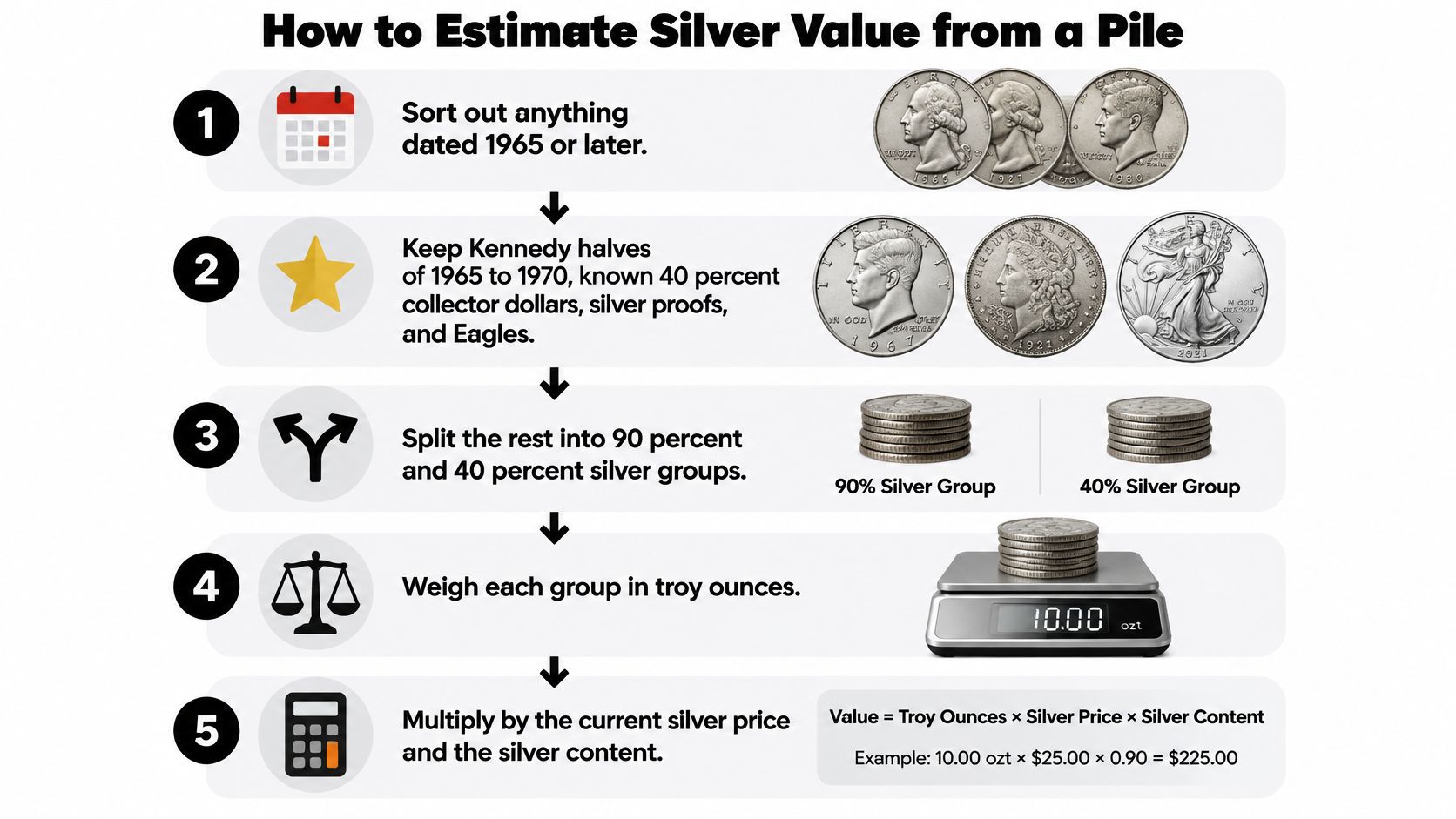
- Pull anything dated 1965 or later unless it's a Kennedy half from 1965 to 1970, a known 40 percent collector dollar, a silver proof, or an Eagle.
- Split the rest by row. 90 percent dimes, quarters, halves, and dollars in one group. 40 percent halves in a second. 35 percent nickels in a third.
- Count each group, or weigh a worn group and divide by the single-coin nominal weight when counting a hundred pieces isn't practical.
- For unworn coins, multiply the count by the row's pure-silver figure. Fifty quarter-row coins at 0.1808 each come to about 9.04 troy ounces.
- For worn coins, multiply measured grams by fineness, then divide by 31.1034768 grams per troy ounce. Weight first, fineness second, ounces last.
- Multiply total troy ounces by the current silver spot price. Our note on spot pricing for gold and silver explains why the timestamp on that number matters as much as the number itself.
- Set aside collector pieces before quoting a total. Rare dates, proofs, and unusually attractive dollars can sell above melt, and averaging them into a scrap figure undersells them.
Working a Jar of Quarters
Twenty average 1964 quarters come to about 3.616 troy ounces on the chart's quarter row. At a spot price of $30 an ounce, used here as arithmetic and not as a forecast, that jar would carry roughly $108 of silver.
The dealer's number will land below that. A spread covers refining, market risk, and the time a buyer holds the metal, and the spread is negotiable in a way the spot price isn't. Knowing the ounce count is what lets you argue about the spread instead of arguing about the metal.
Privately minted rounds aren't these coins and need their own stated weight and fineness. A one-ounce round from a private mint may be .999 fine, but nobody should assume it from the shape, and those rounds won't appear on any row of the chart.
Spot moves during the day. Write the timestamp beside the estimate, so the number still means something an hour later.
A local scale and a nondestructive test beat a mailed guess, particularly when the pile mixes gold jewelry, war nickels, and clad quarters in the same box.
Sell Tested Coins and Gold Jewelry in Boise
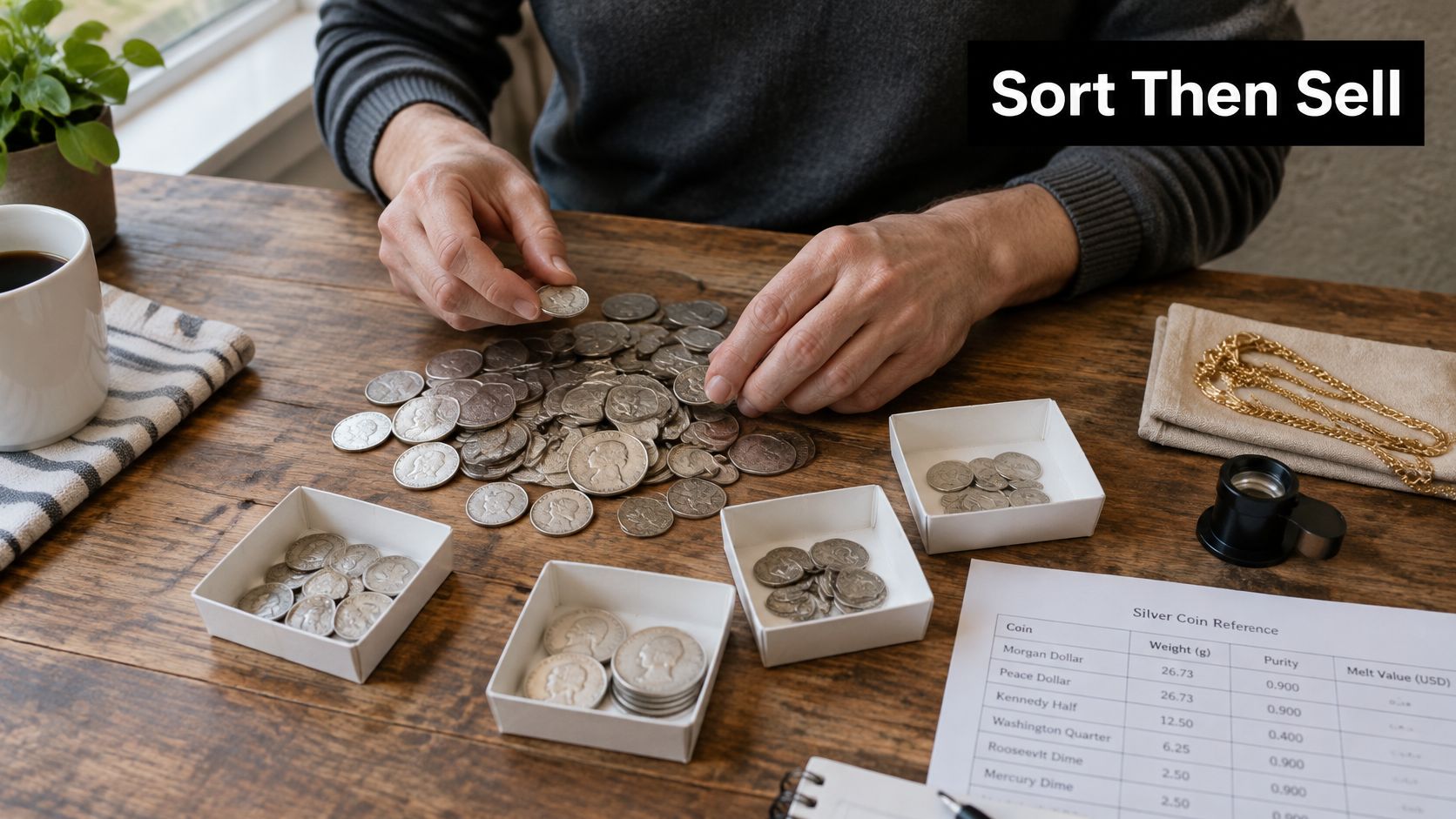
A mixed coin lot is easier to value when each family is sorted first. Keep 90 percent silver coins separate from 40 percent Kennedy halves, wartime nickels, and clad lookalikes. That lets a buyer assess each group by its date, alloy, weight, and recoverable silver rather than treating the whole pile alike.
Gold Works on Karat, Coins Work on Fineness
Gold jewelry is assessed by karat, while silver coins are usually identified by their alloy and fineness. The FTC's guidance on buying platinum, gold, and silver jewelry explains that 24-karat gold is pure gold, 18-karat gold contains 18 parts gold out of 24, or 75 percent, and 14-karat gold contains 14 parts out of 24, or approximately 58.3 percent. A karat mark is more informative when accompanied by the manufacturer's trademark or responsibility mark.
Metal content is only part of a jewelry valuation. Design, workmanship, gemstones, brand, and condition can affect value, so a scrap calculation may not capture what a piece is worth as jewelry. A signed piece with a desirable stone and a hollow, worn chain call for different assessments, even if their metal weights seem similar.
What a Free Test Actually Shows
X-ray fluorescence (XRF) measures metal composition without melting or scratching an item. In testing summarized by Thermo Fisher Scientific's comparison of portable XRF with fire assay, large, flat gold items commonly measured within 0.1% to 0.2% of fire-assay results, while small or irregular samples were generally within 0.5 percentage points.
XRF reads the surface, so plating, curved shapes, unusual geometry, or layered construction can affect the result. Surface condition, calibration, and alloy composition also matter. For items that may be plated, filled, or built in layers, a single surface reading may not tell the whole story.
Comparing Offers Instead of Promises
Selling locally avoids packaging and transit. For a mail sale, shipping adds time and the risk that a parcel is delayed, damaged, or lost before payment clears. USPS mailing standards for valuable articles describe mailing requirements for certain valuable shipments and limits on some services.
To compare offers, record the spot-price timestamp, the coin fineness or jewelry karat, the net precious-metal weight, and any deductions. Those details make it easier to see how a buyer arrived at a figure. For more preparation, read this guide to selling silver coins.
Carat 24's local Boise team provides prices and insights on gold, silver, jewelry, and diamonds. Its authentication process examines materials and craftsmanship and verifies serial numbers through certified websites before items are valued. For a coin lot, keep the different silver families separate; for jewelry, bring any available paperwork that helps identify the piece.
Carat 24 buys and sells gold, silver, bullion, coins, and other precious metals at 3780 W. State St. in Boise. Call (208) 314-9995 or email info@goldsilveridaho.com to ask about selling coins or gold jewelry.
