
A one-carat natural diamond averaged about $4,200 at retail in 2025 while a comparable lab-grown stone averaged about $1,000 or less, meaning a 30% resale recovery returns roughly $1,260 for the natural stone versus about $300 for the lab-grown one. Neither figure is a guaranteed offer, because actual cash bids depend on current market replacement prices rather than what appeared on the original receipt.
Behind that dollar spread sits a sharp gap in production economics. According to Edahn Golan's 2025 lab-grown diamond value-chain analysis, lab-grown stones cost roughly $11 per carat to produce and about $16 per carat as rough, compared with roughly $93 per carat for natural rough at the mine, while wholesale prices for lab-grown stones of 1 carat and above fell 13% year over year and 3-carat stones dropped 47%. When a dealer can buy a freshly minted replacement for a fraction of last year's cost, secondary offers adjust downward immediately.
Most guides on lab-grown vs. natural diamond resale value focus exclusively on retention percentages and treat the center stone as the entire transaction. That approach misleads sellers in two ways: it hides the actual dollar gap between categories, and it overlooks the precious-metal mounting, which often holds steadier, separately recoverable cash value than a depreciating lab-grown center stone.
Resale Numbers for a 1-Carat Diamond at a Glance
Start with dollars, not percentages, because percentage benchmarks distort what ends up in your hand. Based on BriteCo market data reported by Draco Diamond, a one-carat natural diamond averaged about $4,200 at retail in 2025, while a comparable one-carat lab-grown diamond averaged $1,000 or less. Because the starting retail bases sit more than four times apart, identical percentage recoveries produce completely different cash outcomes.
Published secondary-market recovery bands also vary by channel and stone quality. A July 2025 BriteCo diamond market report placed direct resale recovery at roughly 45-55% of retail for natural diamonds and 10-20% for lab-grown stones, whereas Labrilliante's 2025 resale retention overview cited broader secondary-market figures of 60-80% of retail for natural diamonds and 30-40% of purchase price for lab-grown diamonds. Applying illustrative recovery rates directly to 2025 average retail prices clarifies the cash spread in practice.
| Measure | Lab-Grown (1 ct) | Natural (1 ct) |
|---|---|---|
| Average retail price, 2025 | $1,000 or less | about $4,200 |
| Reported resale recovery, percent of original price | 20-40% (some sources 10-20%) | 40-60% (some sources 45-55%) |
| Dollars at 30% of original price | $300 or less | about $1,260 |
| Dollars at 15% of original price | about $150 | about $630 |
| Basis for any offer | Current comparable market, not the invoice | Current comparable market, not the invoice |
How to Read Each Row Without Overestimating Your Payout
The first row sets the retail ceiling, not a cash floor. Every retail ticket bundles jewelry store overhead, setting labor, branding, and sales tax, none of which a secondary buyer pays to acquire again.
The second row shows why quoting percentages alone creates false confidence. A seller who hears "30% recovery" without checking the underlying retail base expects far more from a lab-grown ring than the third row supports, where 30% of $1,000 or less tops out at $300 compared with about $1,260 on a $4,200 natural stone.
Drop down to the fourth row and the asymmetry sharpens further. At 15% recovery, the natural stone still generates about $630 before accounting for gold or platinum weight, while the lab-grown stone lands around $150, a sum that a heavy 14k or 18k gold mounting can easily exceed on its own.
The fifth row governs every legitimate transaction. Buyers price a pre-owned diamond against today's wholesale replacement list, never against what you paid three or five years ago.
Reality check for sellers: None of the dollar figures above are guaranteed offers. Cut quality, color grade, clarity, exact carat weight, grading lab, designer brand, physical wear, and whether you sell to a dealer, auction house, or private individual all move the final number.
Why Appraisals and Invoices Mislead Sellers
An insurance appraisal measures what a jeweler would charge to replace your ring brand-new at full retail, often with a cushion for future price increases. Cash liquidation value sits in a completely different market because a dealer needs room to inspect, refurbish, authenticate, hold inventory, and resell the stone at a profit.
Before taking a ring to any counter, test your assumptions with a diamond resale value calculator to see how grade and condition shift realistic cash expectations. Frame your evaluation around one practical two-part question: how many dollars can I realistically receive today, and what percentage of my original invoice does that cash figure represent?
Why Lab-Grown Resale Trails Natural Stones
The gap between lab-grown and natural resale bids did not appear because buyers suddenly decided lab-grown stones look different. Physically, optically, and chemically, they match. The divergence stems from a structural collapse in lab-grown replacement prices paired with an expanding manufacturing base that natural geology can't replicate.
The Multi-Year Price Compression
Historical pricing benchmarks show how rapidly lab-grown stones decoupled from mined equivalents. In its 2019 global diamond industry report, Bain & Company documented that comparable 1-carat, G-color, VS-quality lab-grown diamonds sold at roughly 80% of natural retail prices in 2017, then fell to around 20% by the end of 2019, while wholesale dropped from roughly 70% of natural prices to 15-20%. Bain's 2018 analysis had already noted that gem-quality lab-grown retail prices nearly halved over two years as wholesale prices dropped roughly threefold.
The slide continued as reactor capacity expanded across India and China. In Bain's 2021-22 global diamond report, polished lab-grown retail averaged roughly 30% of natural prices (down from 35% in 2020), while wholesale compressed to approximately 14% of natural prices (down from 20% in 2020). Under those averages, a lab-grown stone priced at $1,000 wholesale alongside a $5,000 natural stone in 2020 slid to around $700 wholesale against that same $5,000 natural reference a year later.
By 2024, industry analyst Paul Zimnisky noted, as cited by GrownLeo, that lab-grown stones often traded at a 90% or greater discount compared with equivalent natural diamonds. An IMF-published 2025 country report similarly cited wholesale lab-grown price declines of roughly 90% since 2019, placing a 2025 one-carat lab-grown benchmark near $800 versus $4,220 for a natural stone, while noting that De Beers reported a 90% wholesale decline since 2018 as pricing shifted toward a cost-plus manufacturing model ahead of its Lightbox closure.
For an individual seller, that price history creates a painful resale consequence. A lab-grown stone bought three years ago competes directly against brand-new, lower-cost production today, so its cash value can drop sharply even when its polish, symmetry, and grading report remain flawless.
Comparing the Five Core Value Factors
When dealers evaluate a ring across the counter, they weigh five distinct variables differently depending on origin.
| Value Factor | Lab-Grown Resale Effect | Natural Resale Effect |
|---|---|---|
| Replacement price trend | Wholesale reportedly down about 90% since 2019; offers track falling prices | Steadier, though the one-carat Rapaport index fell 9.9% in 2025 |
| Secondary-market buyers | Thinner; some dealers decline lab-grown purchases | Established estate, dealer and collector demand |
| Grading report | Must state laboratory-grown origin | Recognized grading supports buyer confidence |
| Metal and setting | Often a larger share of the total offer | Often valued separately from the stone |
| Original invoice as benchmark | Poor guide | Poor guide, since retail markup is not recovered |
Each row reflects concrete buyer behavior rather than vague sentiment. Look closely at secondary-market buyers: natural stones circulate through a mature global ecosystem of estate buyers, trade exchanges, pawnbrokers, and collectors who know how to hedge and move inventory. Lab-grown diamonds face a far thinner buyer pool, and many independent dealers refuse to buy used lab-grown stones altogether because tomorrow's fresh wholesale shipment may cost less than today's buyback bid.
That thinner demand explains why Lab Grown Central's 2025 resale guide reported typical retention of 20-40% of original purchase price for lab-grown diamonds compared with 40-60% for natural stones. The wider relative uncertainty on the lab-grown side stems directly from uneven dealer appetite: one shop may offer a modest stone credit, while the next shop prices only the gold band.
The center stone carries the market price risk, while the precious-metal mounting and setting often set the true cash floor.
Separating the mounting from the stone changes how sellers negotiate. Say a ring holds a one-carat lab-grown solitaire in a heavy platinum or 18k gold cathedral setting. The metal weight trades against live daily precious-metal spot markets, giving a buyer transparent, liquid value that doesn't suffer from reactor overcapacity. Separating those two lines on a quote prevents a low center-stone offer from obscuring the solid cash value of the gold or platinum holding it.
Origin verification also shapes dealer willingness to make an offer at all, which is why clear disclosure standards sit right alongside grading documentation when a stone changes hands.
Natural Diamonds Carry Downside Risk Too
None of this makes natural diamonds guaranteed wealth preservers. According to an August 2025 BriteCo diamond market report, the one-carat Rapaport index fell 9.9% in 2025, while round one-carat D-H, SI natural goods dropped 24.1%. Even a natural stone with an established resale channel can lose substantial money in dollar terms if you bought near a market peak or paid a steep mall-retail markup.
Because both categories move with wholesale supply and retail demand, treating an old invoice as a target price guarantees disappointment. A realistic valuation always starts with current comparable wholesale bids for the stone plus live melt or resale value for the mounting.
Documents and Disclosures That Protect Your Offer
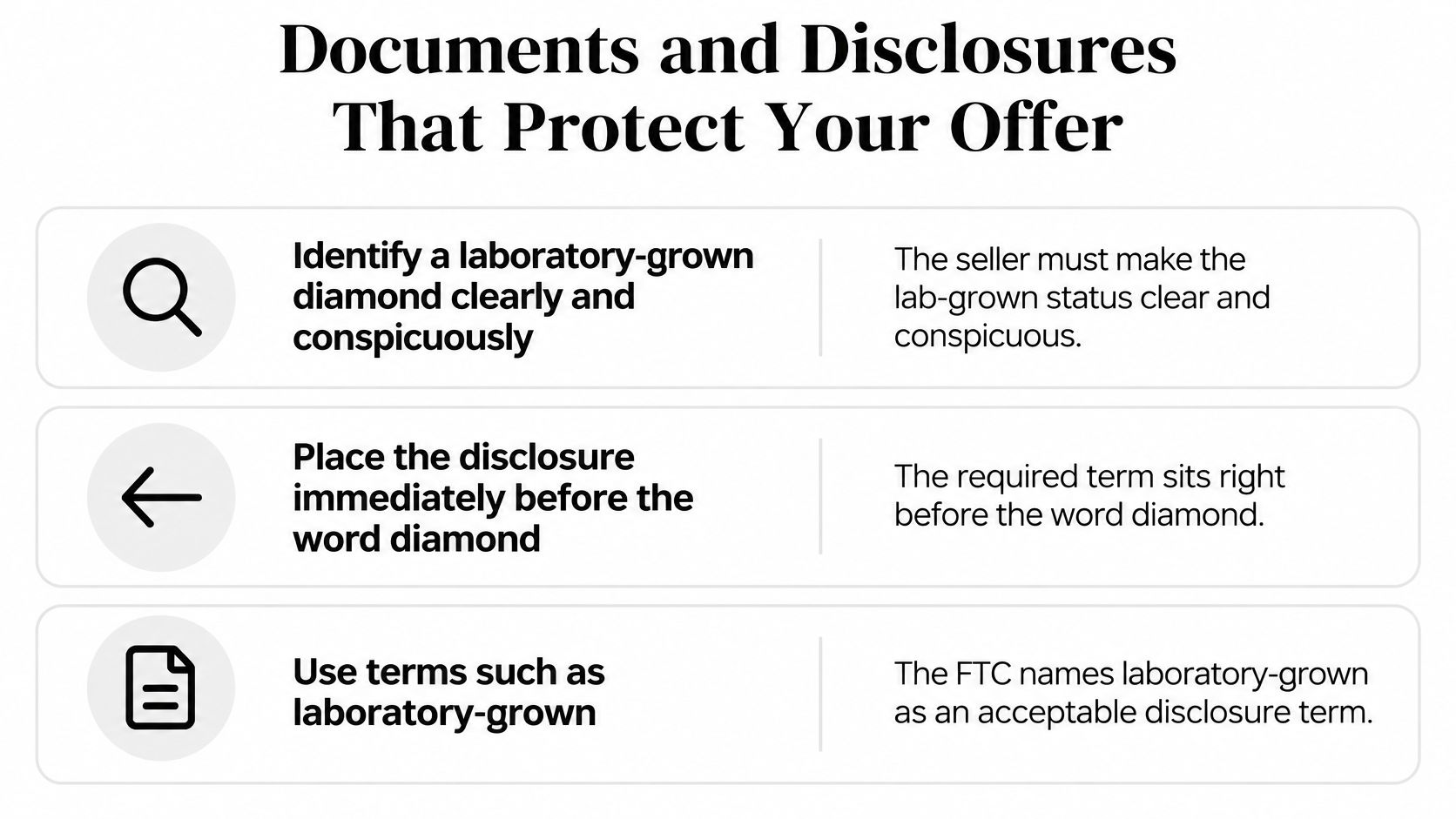
Federal disclosure rules draw a strict legal line between mined and laboratory-created stones, and following them directly protects the cash offer you receive. Under the Federal Trade Commission's diamond advertising guidance, sellers must identify a laboratory-grown diamond clearly and conspicuously immediately before the word "diamond," using terms such as "laboratory-grown," "laboratory-created," or a manufacturer-created designation, and may do so only when the stone shares the same optical, physical, and chemical properties as a mined diamond.
Shortcuts in wording don't pass legal muster or dealer scrutiny. The FTC's Jewelry Guides Federal Register notice specifies that the word "cultured" may describe a laboratory-created diamond only when paired with equal conspicuousness alongside "laboratory-created," "laboratory-grown," "synthetic," or an equivalent clear non-mined disclosure. More broadly, the FTC Jewelry Guides require truthful representation of type, grade, quality, metallic content, size, weight, cut, color, and origin, and the FTC's 2019 enforcement guidance makes clear that these rules govern invoices, contracts, grading reports, receipts, and online listings alike.
These requirements matter at the buying counter for a simple reason: every undocumented claim becomes a discount. A buyer facing uncertainty about origin, weight, or metal content prices the worst plausible case rather than the most likely one.
Paperwork converts a cautious estimate into a firm offer. The grading report prices the stone, the spec sheet prices the mounting, and ambiguity about either one is what shrinks the number on the table.
That second half of the equation is where sellers routinely leave money behind. A diamond's resale percentage gets all the attention in comparisons, yet the dollar value of the gold or platinum setting arrives through a separate, more stable channel. Documenting the mounting lets a buyer quote both lines cleanly instead of folding the metal into a visual guess.
Six Items to Bring Before Any Offer Is Written
- The official grading report (GIA, IGI, or GCAL): Confirm the laboratory name, report number, 4Cs, and explicit natural or laboratory-grown origin statement, because an uncertified stone forces a buyer to grade conservatively and discount the bid for lab-fee and grading-variance risk.
- The original sales invoice or receipt: Check that the origin wording matches the grading report and shows any designer brand or mounting details, since mismatched or vague paperwork triggers extra screening and slows down a cash offer.
- Laser inscription verification: Note the microscopic report number etched on the stone's girdle so the buyer can verify under a loupe that the diamond in the ring matches the certificate in hand, avoiding a sharp suspicion discount or outright refusal.
- Mounting and precious-metal documentation: Bring any jeweler specification sheet noting karat stamp (14k, 18k, or platinum), gram weight, and accent-stone count. This single page is what separates the setting's recoverable metal value from the stone's resale percentage, so the buyer prices each on its own merits.
- Your most recent appraisal with date and stated purpose: Keep it in your folder for style descriptions and historical context while recognizing that retail insurance figures never dictate cash bids; if an older appraisal omits origin, point that out upfront so the evaluator tests the stone immediately.
- Clear close-up photos of girdle inscriptions and inner-band hallmarks: Photographing tiny 14k/PT950 stamps and serial numbers under bright light creates a personal ownership record and helps resolve worn stamps quickly during inspection.
A complete folder removes the safety margin a cautious buyer would otherwise build into the quote, speeds up testing, and puts you in position to compare offers cleanly if you decide to sell diamonds for cash.
Selling Locally in Boise Versus Shipping Online
Choosing where to sell affects your net proceeds as much as the stone's grade. Every seller weighs two paths: mailing jewelry to a distant online buyer, or sitting across a counter from a local specialist who prices the mounting and the center stone as separate line items.
Cost, Speed, and Risk Side by Side
Online mail-in buyers promise convenience from your kitchen table, yet shipping high-value jewelry introduces friction at every step:
- Transit costs and insurance limits: Packing, tamper-evident sealing, and fully insuring a diamond ring across state lines eats into your net return, and standard carrier policies often cap jewelry coverage tightly.
- Inspection lag: You surrender physical control of the ring for days while it moves through intake, gemological review, and an electronic payout or a return shipment.
- Remote re-grading risk: Because you are not standing at the bench during evaluation, you cannot watch how the grader weighed the gold or assessed wear. If the revised offer lands far below the teaser quote, your choices shrink to accepting it or paying to ship the ring back.
An in-person sale reverses those mechanics. You watch the stone and setting get inspected together and ask questions in real time about how each component is valued. That distinction matters, because the gold or platinum in a mounting often carries a recoverable floor value that a single blended quote can obscure.
Local Gold and Jewelry Buying in Boise
For Boise-area sellers, Carat 24's local team provides prices and insights on gold, silver, jewelry, and diamonds, and buys gently used jewelry through its Buyback Program. A face-to-face evaluation makes the metal-versus-stone split visible: you hear one figure for the mounting's precious-metal value and a separate figure for the diamond's current secondary-market bid, so a low offer on the stone does not drag down what the metal alone is worth.
Condition matters at the counter: Prices for items sold to Carat 24 are based on items being in good, marketable condition, and pieces with significant wear or damage may receive lower offers or not be accepted. After authentication, accepted items are listed for resale, so the offer reflects what the piece can realistically bring on the secondary market.
Chipped girdles, bent prongs, or badly gouged shanks can push a piece below that marketable threshold, so inspect your ring under a bright lamp before visiting and weigh your options against our guide to the best place to sell diamonds.
The local-selling rule: sell in person when your stone and mounting are in good, marketable condition and seeing the offer calculated in front of you matters; ship to an online buyer when no comparable local buyer exists for a specialized piece.
When Waiting to Sell Makes Sense
Sellers often ask whether holding a diamond for another year or two will let prices bounce back. The honest answer depends on which specific situation brought the piece into your hands.
Scenario One Inherited Estate Jewelry With a Lab-Grown Center Stone
Estate rings and pendants containing lab-grown center stones rarely reward patience. Because manufacturing efficiency continues pressuring replacement costs, holding onto the stone exposes you to further downside while tying up the liquid gold or platinum value in the mounting.
Decision rule: Price the metal and setting separately and sell now rather than waiting for a lab-grown center stone to appreciate.
Scenario Two Holding Because Your Insurance Appraisal Looks High
Many owners delay selling because an insurance schedule lists a figure far above current dealer bids, hoping the resale market will eventually catch up to that paperwork. Insurance documents exist to fund a retail replacement after theft or loss, not to forecast a future cash buyout.
Decision rule: Keep the appraisal strictly for active insurance coverage, and judge any sale solely against today's cash offers rather than waiting for cash bids to match retail replacement text.
Scenario Three Recent Natural Diamond Purchase in Good Condition
If you own a clean, well-cut natural diamond accompanied by a recognized grading report, short-term holding rarely improves your payout. Natural wholesale indexes fluctuate in both directions, and carrying a stone you no longer wear adds insurance premiums and opportunity cost with no guarantee of a higher bid next quarter.
Decision rule: Sell as soon as local offers align with current comparable wholesale benchmarks, rather than speculating on short-term market swings.
Scenario Four Upgrading to a New Stone
Owners trading up sometimes delay selling an older ring while waiting to recover something closer to the original retail invoice. That delay works backward: if the market dips while you wait, both your old stone's resale value and your replacement stone's retail cost move together, leaving your out-of-pocket upgrade gap largely unchanged.
Decision rule: Time the sale of the old stone right alongside the current replacement price of the new one, ignoring what the older receipt originally said.
Waiting pays off only when you have a documented, verifiable catalyst pointing to a rebound, not a hunch that last decade's prices will return.
Why Waiting on Lab-Grown Supply Shifts Is Still a Gamble
Could a wave of factory closures or production cutbacks eventually stabilize lab-grown wholesale pricing? Possibly. Supply shakeouts can slow the pace of future declines once weaker producers exit the market.
Even if wholesale erosion slows down, however, a slower decline isn't a price recovery, and a low retail listing on an online marketplace doesn't prove an active secondary buyback bid exists. Treating any diamond primarily as a wear-and-enjoy asset rather than a financial instrument keeps your expectations grounded, a dynamic explored further in our analysis of jewelry as an investment. Unless you hold a rare, documented collectible with verified auction demand, sell when live offers reflect today's comparable market.
Get Three Local Offers Before You Sell
Buyers quote the same ring differently, and the gap usually hides in how they treat the stone versus the mounting. A disciplined comparison routine exposes that gap before you sign anything over. Work through these six steps in order.
- Assemble your verification folder first. Gather your grading report, original receipt, mounting specifications, and close-up hallmark photos, confirming that natural or laboratory-grown origin appears clearly on every document. Missing or conflicting paperwork invites automatic discounts before the stone even reaches the scale.
- Pull current comparable market prices, and ignore old receipts. Look up today's live pricing for stones matching your exact carat weight, cut, color, clarity, and grading laboratory so you walk into appointments anchored to reality. Use the original invoice only to confirm origin and brand, never as a price floor.
- Collect at least three itemized offers. Ask every buyer to quote the center diamond and the precious-metal mounting on separate lines so you can see whether a low overall number comes from the stone or from an underpriced gold band. Reviewing a breakdown of how much you can sell a diamond ring for beforehand helps you spot an unusually low bid right away.
A ring carries two recoverable values: the center stone and the metal in its mounting. A buyer who refuses to separate them is asking you to guess where the discount went.
- Bring your ring and paperwork to Carat 24 in Boise. Carat 24 buys gently used jewelry and offers an Authentication service, so an in-person visit produces a written local benchmark you can weigh against your other quotes. Expect both the diamond and the mounting to be authenticated before any final figure is set, and expect that figure to reflect the item's condition, since prices are based on pieces being in good, marketable shape.
- Compare written bids on real dollars and wear adjustments. Rank the cash dollars offered across all three quotes rather than getting distracted by theoretical resale percentages, then ask how prong wear, surface scratches, or chipped facets affected each number. That question reveals whether a buyer is pricing fair condition adjustments or lowballing. Items with significant wear can draw lower offers, so find out early whether a quote already assumes one.
- Apply a strict acceptance threshold. Accept an offer only when the combined stone-and-metal payout tracks closely with current comparable prices and beats your net proceeds after shipping and insurance elsewhere. If every local bid falls noticeably short, hold the piece briefly or test another sales channel instead of selling under pressure.
Ready to see what your natural or lab-grown diamond and gold mounting are worth in real dollars today? Visit the Boise showroom at 3780 W. State St. for an itemized evaluation backed by a rigorous authentication process, or learn more about gold and jewelry buying at Carat 24 - Trusted Gold Experts.
