
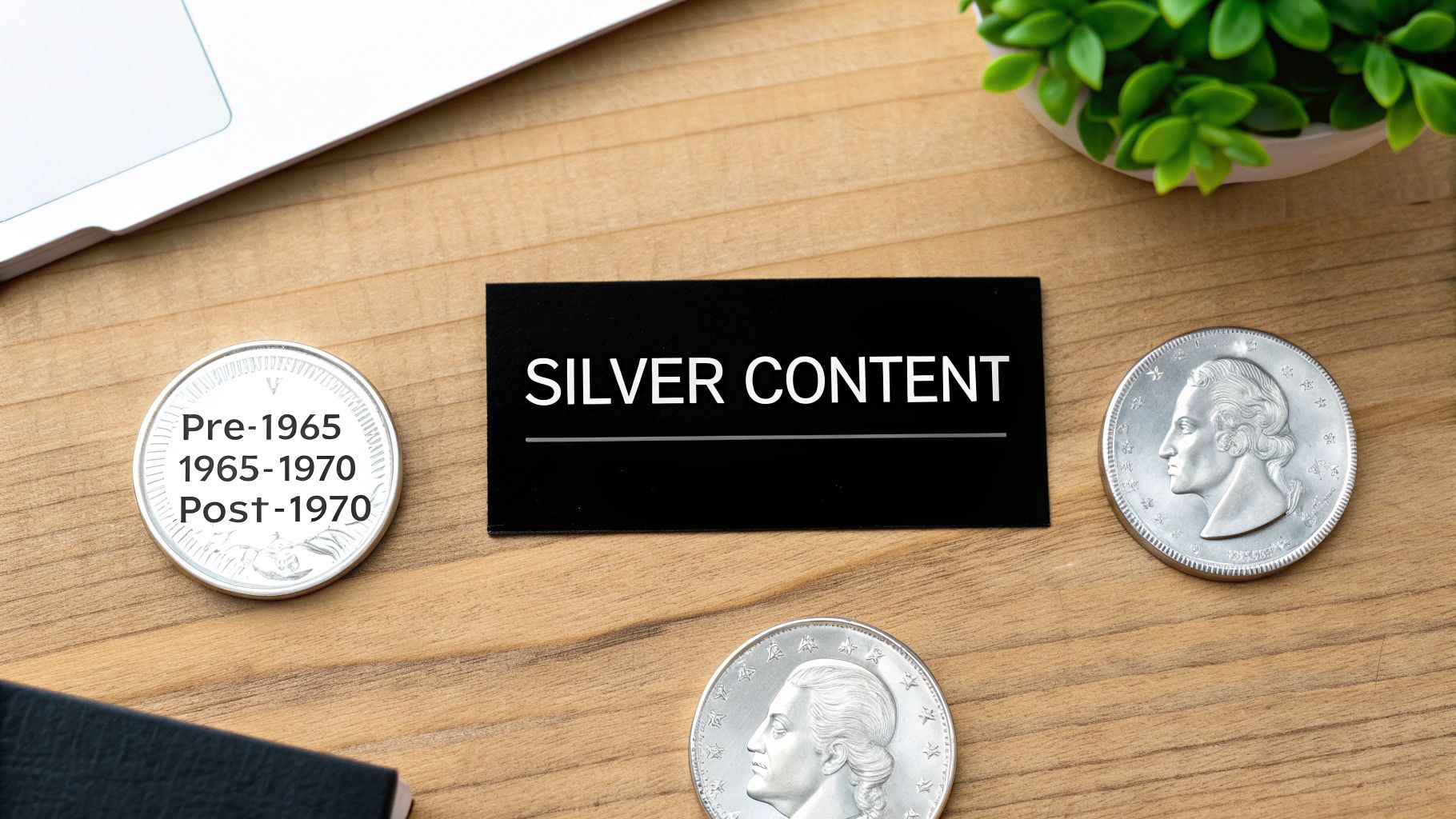
When you're sorting through a jar of old coins, the U.S. half dollar is one you should always pull aside for a closer look. Its silver content—and therefore its real value—depends entirely on the year stamped on its face. It's a simple rule of thumb: half dollars minted before 1965 are the big prize, containing 90% silver.
From 1965 to 1970, the U.S. Mint reduced the silver to 40%. After 1970, they removed it altogether for circulating coins. That date is the most critical piece of information you need.
Your Guide to Half Dollar Silver Content
Understanding the silver content in half dollars is key, whether you're a serious collector or just looking to cash in on a lucky find. The value of these coins can swing wildly from one year to the next, all because of changes in U.S. coinage laws. This guide will break down exactly which half dollars contain that valuable precious metal.
This chart gives you a quick visual on the three distinct eras of silver content in U.S. half dollars.
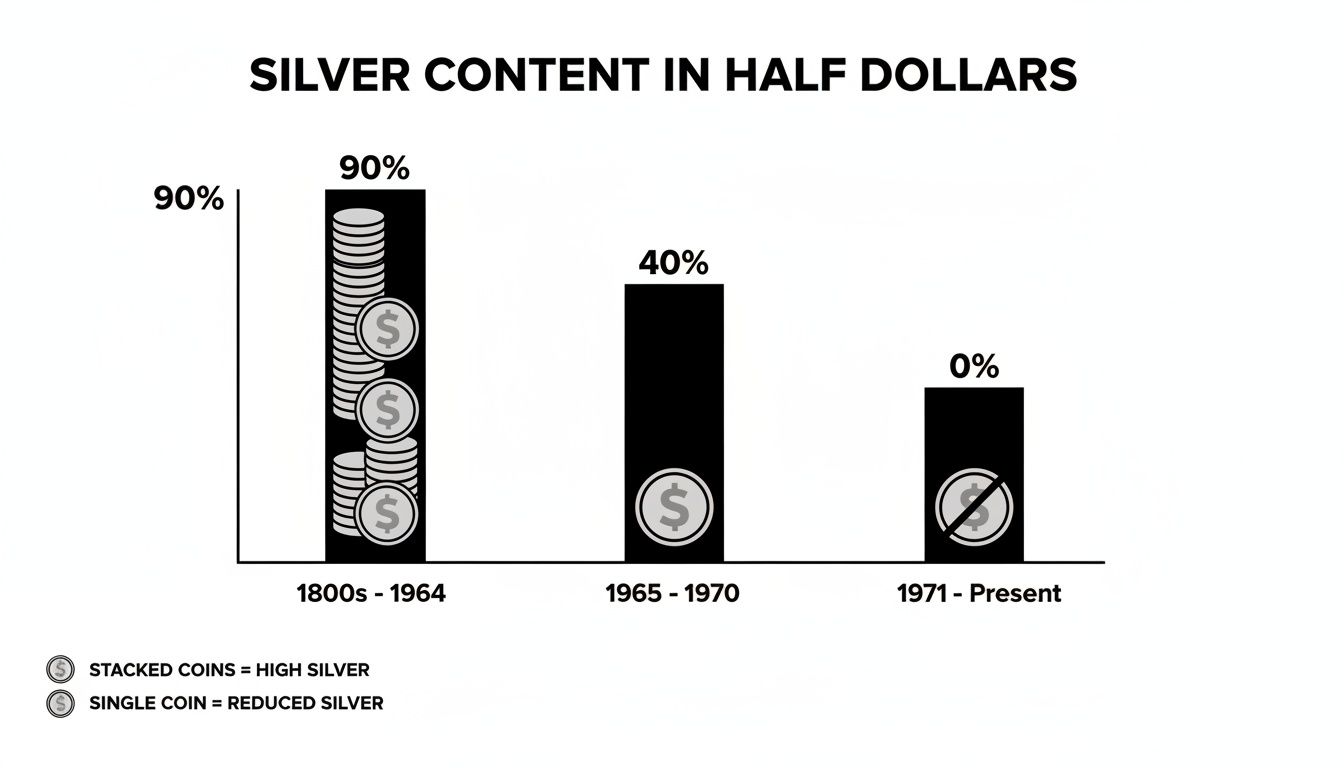
As you can see, the drop-off was dramatic. We went from a long history of high-purity silver coinage to its complete elimination in just a few short years. This is why checking the date is the first and most important step.
To make things even easier, here's a quick reference table breaking down the silver content for each major half dollar series.
US Half Dollar Silver Content at a Glance
This table provides a straightforward summary of which U.S. half dollar series contain silver, their years of mintage, and how much pure silver you can expect to find in each one. It's a handy tool for quick identification.
| Half Dollar Series | Years of Mintage | Silver Content Percentage | Pure Silver Weight (grams) |
|---|---|---|---|
| Barber Half Dollar | 1892–1915 | 90% | 11.25 g |
| Walking Liberty | 1916–1947 | 90% | 11.25 g |
| Franklin Half Dollar | 1948–1963 | 90% | 11.25 g |
| Kennedy Half Dollar | 1964 | 90% | 11.25 g |
| Kennedy Half Dollar | 1965–1970 | 40% | 4.60 g |
| Kennedy Half Dollar | 1971–Present | 0% (Clad) | 0 g |
Keep this chart in mind when you're sorting through your coins. The difference between a 1964 Kennedy and a 1965 Kennedy is significant—more than double the silver!
Why Knowing Your Coins Matters
Knowing which half dollars contain silver is the first step to unlocking their true value. A lot of people have these coins stashed away in drawers or safes, completely unaware that they're worth far more than just fifty cents. If you have a collection of old coins, gold, or jewelry, getting an expert evaluation is always the best move.
For our customers here in Boise, selling locally is a great way to avoid the risks and hassles of shipping your valuables. We offer free, non-invasive Xray Scanning and Gold Testing to give you a transparent, no-pressure offer right on the spot. You can dive deeper into specific coin series in our detailed guide on which half dollars are silver. We're confident we provide the highest payout in Boise for your valuables.
The Era of 90 Percent Silver Half Dollars
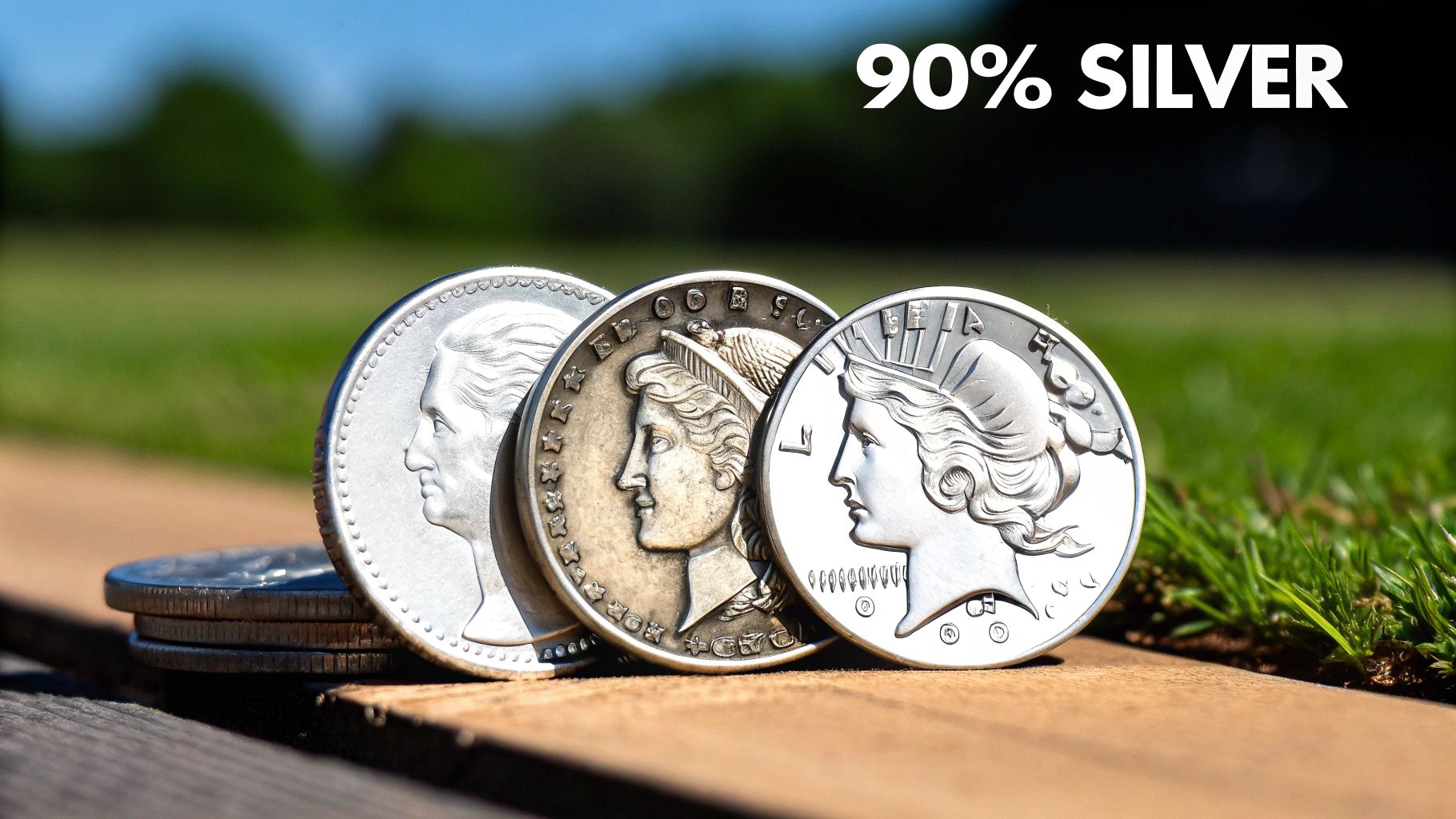
For a solid seventy-plus years, the U.S. half dollar was a heavyweight in American pockets, minted from 90% pure silver and 10% copper. This classic era gave us some of the most beautiful and recognizable coin designs, each one a little piece of history you can actually hold.
These coins are the backbone of what collectors and investors call "junk silver"—a somewhat misleading name for silver coins valued purely for their precious metal content, not their numismatic rarity. This historic period produced three major series, each a tangible asset with an intrinsic value that blows its fifty-cent face value out of the water.
Iconic 90 Percent Silver Designs
The age of 90% silver half dollars is defined by a few distinct and artistically celebrated series. Knowing them is key to spotting treasure in a pile of old change:
- Barber Half Dollar (1892–1915): Named for its designer, Chief Engraver Charles E. Barber, this coin features a classic, stoic profile of Lady Liberty. It was a true workhorse coin, circulating widely for nearly a quarter of a century.
- Walking Liberty Half Dollar (1916–1947): This is the one many people consider the most beautiful coin in American history. Adolph A. Weinman's design of a striding Liberty, draped in the flag, is both powerful and incredibly elegant. It’s an absolute collector favorite.
- Franklin Half Dollar (1948–1963): Honoring one of America’s most brilliant Founding Fathers, Benjamin Franklin, this design was the very last half dollar series to be struck entirely in 90% silver for its entire production run.
The Last of Its Kind: The 1964 Kennedy
The move away from 90% silver was swift and rooted in a national tragedy. Following President Kennedy's assassination in November 1963, the U.S. Mint rushed to honor his memory, releasing the Kennedy half dollar in early 1964.
These first-year coins were struck with the traditional 90% pure silver composition, but public sentiment quickly turned them from currency into keepsakes. Americans held onto them, refusing to let them circulate.
This massive hoarding effectively marked the end of silver coinage for general circulation. The 1964 Kennedy wasn't just money; it was a tribute that people refused to part with, cementing its status as the final 90% silver half dollar intended for the American public.
If you have these or any other silver coins, gold, or jewelry, getting a fair and accurate valuation is key. Here in Boise, we make it easy. We offer hassle-free offers with free Xray Scanning and Gold Testing, so you can save the hassle and sell locally for more than online shipments. We even have a Price Matching guarantee to ensure you get the highest payout in Boise.
The Shift to 40 Percent Silver Clad Half Dollars
The wild popularity of the 1964 Kennedy half dollar created a massive headache for the U.S. Mint. People were hoarding them as fast as they were made. With silver prices climbing and the nation's reserves shrinking, pumping out 90% silver coins just wasn't sustainable anymore. The government had to find a middle ground—a way to keep half dollars in circulation without completely stripping them of their precious metal content.
The answer came in the form of the Coinage Act of 1965, a landmark decision that reshaped American currency. This act set the stage for a six-year transitional period for our coinage. From 1965 through 1970, the Kennedy half dollars you'll find were struck with a unique 40% silver composition.
Understanding the Silver Clad Composition
These new coins had a totally different layered structure, which is why we call them "silver clad." The Mint’s new recipe created a sort of silver sandwich. The outer layers were made of 80% silver and 20% copper, bonded to an inner core of just 21% silver and 79% copper.
All told, this gave each coin a total silver weight of 4.6 grams, which comes out to roughly 0.1479 troy ounces of pure silver. You can dig even deeper into the specifics of these silver clad coins over at JM Bullion.
This change managed to keep some real intrinsic value in the coins while making them much cheaper for the government to produce. But history repeated itself. Just like their 90% silver cousins, these 40% silver halves were also yanked out of circulation by a public that knew they were worth more than fifty cents.
Identifying and Valuing 40 Percent Silver Coins
Even with less silver, Kennedy half dollars from 1965–1970 are still worth far more than face value. For anyone looking to invest in or collect silver, these coins are an essential piece of the puzzle.
Here’s how to spot them in a pile of change:
- Check the Date: This is the easiest part. You're looking for any half dollar dated between 1965 and 1970.
- Examine the Edge: Look at the coin's rim. Unlike the bright, solid silver stripe of a 1964 half, a 40% silver coin has a much fainter, less brilliant edge. It’s still there, just not as obvious.
- Trust the Experts: When in doubt, there's no substitute for a professional eye. A quick evaluation can tell you exactly what you have.
If you’ve got a jar of half dollars, old gold, or other jewelry, getting an accurate value is simple when you work with local experts. Here in Boise, we offer completely free and non-invasive Xray Scanning and Gold Testing. Save the hassle and sell locally for more than online shipments. We even offer a Price Matching guarantee, so you can be confident you’re getting the highest payout in Boise.
How to Calculate the Melt Value of Your Silver Half Dollars
Figuring out the silver content in your half dollars is one thing, but converting that into actual dollars is where the real value becomes clear. This is what we call the melt value—it's the raw, intrinsic worth of the pure silver inside your coin, completely separate from any collector or "numismatic" value. For the vast majority of common-date half dollars, this melt value is what really drives their price.
The good news is that calculating this isn't complicated at all. Once you know the simple formula, you can demystify what your coins are actually worth in today's market.
The Basic Melt Value Formula
To pin down the melt value of any silver half dollar, you just need two key things: its pure silver weight in troy ounces and the current market price for silver.
It breaks down like this:
- Identify the Silver Content: First, you have to know what you're holding. Is it a 90% silver coin (minted before 1965) or a 40% silver coin (from the 1965–1970 period)? This is the most crucial step.
- Find the Pure Silver Weight: A 90% silver half dollar contains 0.36169 troy ounces of pure silver. The later 40% silver half dollar has 0.1479 troy ounces.
- Multiply by the Spot Price: Take that pure silver weight and multiply it by the current market price of silver. You can learn more about how the constantly changing spot price of silver affects your coin's value right here on our blog.
Example Calculation (90% Silver): Let's imagine the spot price of silver is $30 per troy ounce. If you have a 1964 Kennedy half dollar: 0.36169 oz × $30/oz = $10.85 (Melt Value)
Getting the Most for Your Silver in Boise
Knowing your melt value gives you the power to make a smart decision when you're ready to sell. Instead of just guessing, you now have a solid baseline for what your coins, gold, and jewelry are worth. To get the best payout, save the hassle and sell locally for more than online shipments.
Here at our Boise location, we make hassle-free offers with zero obligation. We provide free Xray Scanning and Gold Testing to verify the exact precious metal content of your items on the spot. With our Price Matching guarantee, you can walk away confident you’ve received the highest payout in Boise for all your valuables.
How the Great Silver Melt Shaped Coin Values
The world of 90% and 40% silver half dollars was changed forever by one dramatic event. If you ever wonder why finding these coins in the wild is so tough, look no further than the silver boom of 1979–1980. Precious metal prices went through the roof, creating a massive financial incentive for everyday people to cash in their old silver coins. This frenzy kicked off what collectors now call the "Great Silver Melt."
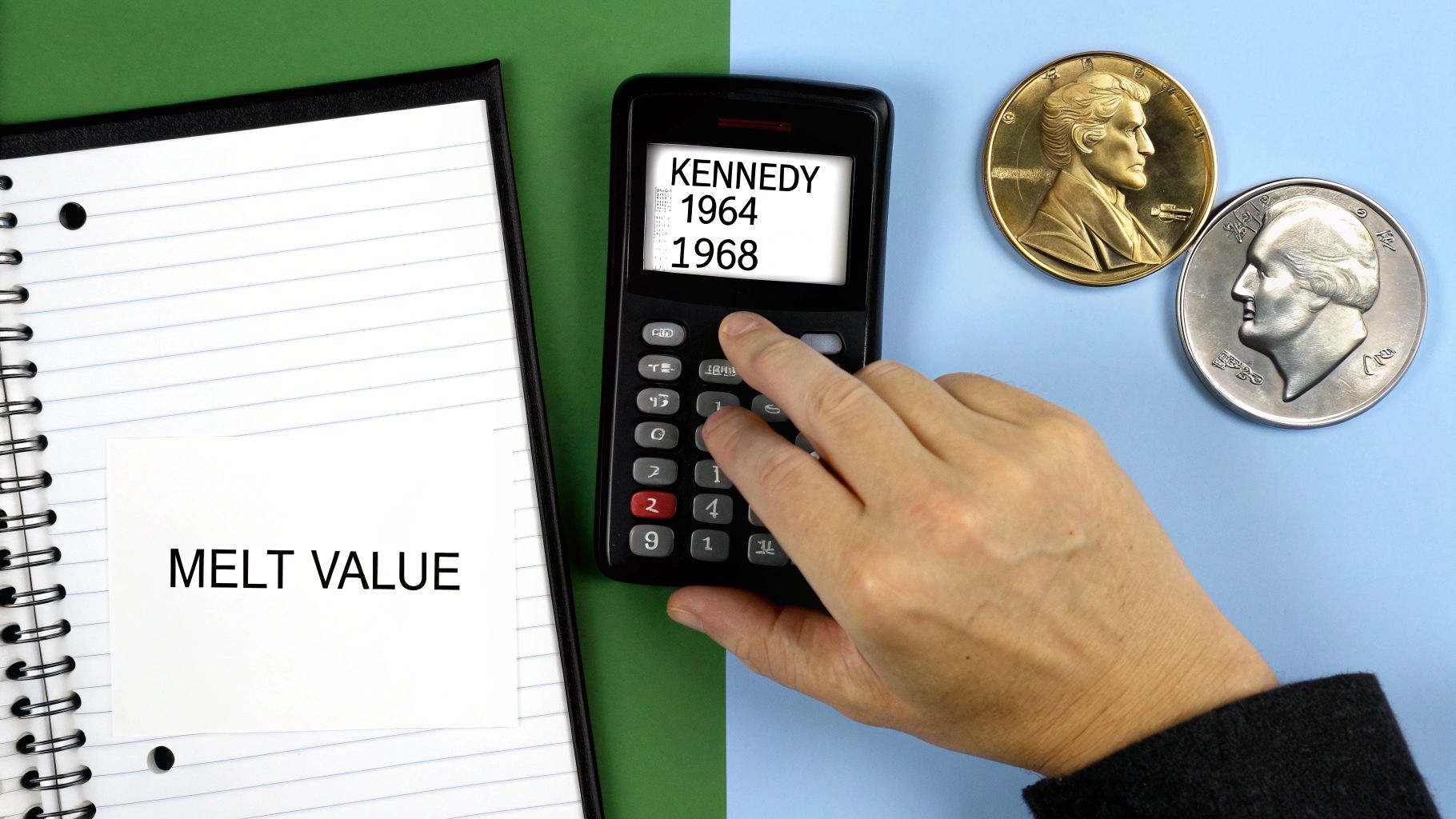
This wasn't just a small trend; it was a tidal wave. People from all over the country raided their piggy banks and sock drawers, selling off untold numbers of half dollars, especially those from the 1964–1969 period. Countless bags of these coins were melted down, representing a huge loss to numismatic history and permanently shrinking the surviving population.
The Lasting Impact on Scarcity
The Great Silver Melt didn't just thin the herd of common-date coins. Its real tragedy was the indiscriminate destruction of high-grade, uncirculated specimens. When the focus is purely on melt value, nobody cares about a coin's condition or rarity. What would have been prized collector's pieces today were simply tossed into the furnace.
This event is a huge reason why your silver half dollars aren't just bullion. They're historical artifacts, and they get scarcer every year. Understanding how market events shape a coin's population is a crucial part of grasping its true worth—a concept that applies across the board in successful antique inventory valuation for any collectible.
The melt of 1979-1980 fundamentally reshaped the landscape for silver coin collectors. It created a clear dividing line between the coins that survived and the millions that were lost forever, increasing the rarity of what remains.
If you're interested in the market forces that can trigger events like this, you can see the volatility for yourself in our article on historical silver prices over the last 100 years.
When you have valuable Gold and Jewelry to sell, understanding its history helps. At our Boise location, we offer free Xray Scanning and Gold Testing to provide hassle-free offers. We guarantee the highest payout in Boise with Price Matching. Save the hassle and sell locally for more than online shipments.
Sell Your Silver Coins in Boise for the Highest Payout
So, you’ve sorted through your half dollars and have a good idea of their silver content. Maybe now’s the time to sell. When you're ready to part with your silver coins, gold, or jewelry here in Boise, finding a trusted local expert is the key to getting the best possible price.
A lot of people think about selling online, but dealing locally means you can save the hassle and sell locally for more than online shipments. It completely cuts out the risk and delays of mailing precious metals and gets cash in your hand much faster.
Why Choose a Local Boise Expert
At Carat 24, we make the process easy with hassle-free offers and zero obligation. We believe in being completely upfront, which is why we offer free, precise Xray Scanning and Gold Testing right in front of you. This isn't just a guess; our technology gives us the exact value of your items, so you know precisely what you have.
We’re deeply committed to our Boise community, and that shows in how we do business:
- Gold and Jewelry Buying: Our expertise isn't limited to coins. We evaluate a huge range of precious items with the same professional eye.
- Highest Payout in Boise: We’re confident in our offers and even provide a Price Matching guarantee to back it up.
- Secure Transactions: You get a secure, face-to-face transaction with immediate payment. No waiting, no wondering.
Don't settle for a lowball offer from someone who doesn't know the local market. When you work with us, you can be sure you’re getting the most for your precious metals. For a deeper dive into the process, check out our complete guide on how to sell silver coins and what to expect.
Common Questions About Silver Half Dollars
When you're sorting through a jar of old change, a lot of questions pop up. We get them all the time. Here are some of the most common ones we hear about the silver content in half dollars.
Are All Half Dollars Before 1965 Really 90 Percent Silver?
You bet they are. Every single U.S. half dollar struck for circulation in 1964 or earlier is made of 90% silver. It’s a reliable rule of thumb for coin hunters.
This isn't just one or two series, either. It covers the entire lineage of modern half dollars right up to that key date, including:
- Barber Half Dollars
- Walking Liberty Half Dollars
- Franklin Half Dollars
- The famous 1964 Kennedy Half Dollar
If the date on your half dollar is 1964 or older, you're holding 90% silver. Simple as that.
Is It Worth Selling Just One 40 Percent Silver Half Dollar?
Honestly, the melt value of a single 40% silver half dollar isn't going to be a huge windfall, which is why most people sell them in rolls or bags. But that doesn't mean it's worthless.
When you bring yours into our shop for Gold and Jewelry Buying in Boise, we'll give you a free, no-pressure evaluation for any amount you have—even if it's just one coin. Our hassle-free offers let you know exactly what your coin is worth on the spot, so you can decide what to do next.
How Can I Be Sure I'm Getting a Fair Price for My Silver Coins?
Getting the best price comes down to trust and transparency. Your best bet is always to work with a reputable local dealer who can show you exactly how they determine their offer.
We always say save the hassle and sell locally for more than online shipments. Here in Boise, we back that up with free Xray Scanning and Gold Testing using live market data. Plus, we offer a Price Matching guarantee to ensure you get the absolute highest payout in Boise.
For an expert evaluation of your coins, gold, and jewelry, visit Carat 24 - Trusted Gold Experts in Boise. We guarantee a transparent process and the best local prices. Learn more at https://carat24boise.com.
