

The ring sits in a zip bag on the kitchen table, and three siblings are looking at a typed page dated 2009. Someone reads the number at the bottom out loud, and within a minute everyone has decided what it means. One wants to sell it and split the money. Another wants to keep it and pay the others their share. A third wants to insure it and stop thinking about it. All three are working from a figure that may not answer any of their questions.
An estate jewelry appraisal isn't a price tag, and it isn't an offer. It's a written opinion of value, prepared for a stated purpose, on a stated date. Change the purpose and the number moves, sometimes by thousands of dollars on the same piece. That single idea explains most of the confusion families bring to an appraiser's counter.
Which Appraisal Value Fits Your Estate
The most common estate jewelry mistake isn't hiring a careless appraiser. It's taking a careful appraisal and using it for a job it was never written to do.
The same ring can carry a five-figure insurance figure and a four-figure cash offer on the same afternoon, and both numbers can be honest. One describes the cost of buying a comparable ring at retail. The other describes what a buyer will hand you today for the ring in your hand.
An appraisal answers the question you asked. Ask the wrong question and the answer is accurate and useless at the same time.
Five value types cover almost every estate situation, and they rarely produce the same figure.
| Value Type | Question It Answers | Typical Use | Watch For |
|---|---|---|---|
| Fair market value | What a willing buyer and seller would agree on at the valuation date | Estate division and tax records | Needs a stated effective date |
| Replacement (insurance) value | What it costs to buy comparable jewelry at retail | Insurance schedules | Usually higher than market value and not valid for charitable donations |
| Liquidation value | What the piece might fetch in a quick sale | Urgent settlement or fast cash | Lower than fair market value and depends on timing |
| Date-of-death valuation | What the item was worth on the owner's date of death | Probate and inheritance records | Must match the stated date of death, not today's market |
| Dealer or resale estimate | What a buyer would pay now | Deciding whether to sell locally | Offers differ by buyer, so compare more than one |
The IRS Publication 561 classifies gems and jewelry as specialized property that almost always requires an appraisal by a specialized jewelry appraiser, and for tax-related valuation it asks for a signed, dated report from a qualified appraiser whose education and experience can be verified and whose work follows the substance and principles of the Uniform Standards of Professional Appraisal Practice. A weight-based guess from a generalist doesn't meet that bar.
The IRS also draws a hard line between an insured number and a market number, warning that an insurance appraisal does not establish the value of jewelry donated to charity because insured value reflects replacement cost rather than an open-market transaction (IRS Publication 561, charitable contributions). That one sentence has saved donors from some very uncomfortable deductions.
Four mistakes that quietly shrink the number
- Relying on age alone. One hundred years old means nothing without provenance. A hallmarked Art Deco brooch with a receipt and a signed clasp can outperform its metal value. A plain gold band from 1920 usually can't, because its only selling point is the gold.
- Using an insurance figure as a sale price. Inherited expectations get set by replacement numbers, then collapse at the counter. Tell the appraiser in advance that you want a resale or fair market figure and the report will point at a realistic range.
- Hiding repairs, replacements, or missing stones. A resized shank, a replaced clasp, or a missing side stone changes both value and the credibility of the whole report. Disclose it and the appraiser can price what's there.
- Judging by weight or karat without inspecting the stones. A heavy ring with a badly cut, included stone may be worth less than a lighter ring with a clean one. Karat sets a floor, never a ceiling.
Condition enters the conversation at the point of sale as well. Items sold to Carat 24 with significant wear or damage may be offered lower prices or not accepted, which is why the appraisal and the offer should be read as two documents, not one.
What auction records do and don't tell you
Rapaport's review of the 2025 auction year reports that Christie's Geneva Magnificent Jewels sale in May 2025 reached $72.3 million with a 100% sell-through rate, and Sotheby's jewelry department totaled $317.7 million in 2025, up 18% from 2024. Observer puts the wider global jewelry auction market at $3.2 billion in 2024, projected to reach $6.6 billion by 2031 at an expected annual growth rate of 11%.
None of that tells you what your mother's 1980s tennis bracelet is worth. Those results come from rare stones, documented provenance, and buyers who fly in for the sale. A signed piece with real history may deserve specialist auction research. An attractive but common gold chain gets priced on metal content, condition, and what local buyers are paying this week.
Working rule: name the purpose before you order the report, ask for a range rather than a single number, and ask the appraiser to print the intended use and effective date on the document.
If diamonds are the piece you're weighing, run the diamond resale value calculator first, so you sit down with a realistic trade figure instead of a hope. Estates rarely hold only jewelry, and if the same drawer turned up coins, medals, or autographed items, this guide to appraising rare coins and memorabilia explains how probate treats those categories.
How to Choose a Qualified Appraiser
An appraisal used for probate, a gift-tax return, or an insurance schedule is only as strong as the person who signed it. A report with the wrong credentials doesn't fail loudly. It gets rejected months later by an insurer or a reviewer, usually when the estate is already closing.
Run these five checks in order, before any fee changes hands.
- A recognized designation, or the education-plus-experience equivalent. The IRS criteria include a recognized appraisal designation or a minimum level of education plus at least two years of relevant valuation experience (IRS Publication 561). The reason is practical: the report has to survive scrutiny from someone who wasn't in the room.
- Regular paid appraisal work in jewelry specifically. A general personal-property appraiser who values furniture and equipment may never have graded a mounted diamond. Ask how many jewelry assignments the appraiser completed in the last year.
- A declaration of qualifications inside the report itself. The appraisal should state the appraiser's background, not just carry a logo on the cover. Without that declaration, a reviewer has no way to judge the opinion.
- A signature, a date, and adherence to USPAP. The substance and principles of the Uniform Standards of Professional Appraisal Practice are what make two appraisers' reports comparable, because they require stated assumptions and a defined market.
- A scope that covers style as well as stones. Look for language about the piece's style, gemstone cut and setting, fashion relevance, and the stone's color, weight, brilliance, and flaws. An estimate built only on gram weight and karat can't produce any of that.
Verify education and experience before you pay, not after. The IRS requires those qualifications to be verifiable, so a legitimate appraiser will hand over the details without being pushed.
What a Complete Appraisal Report Contains
A finished report should be readable by someone who never saw the jewelry: an executor in another state, an insurer, an attorney, or a buyer sitting across a desk. Read it the way they will.
The header decides whether the report is usable
Four lines at the top do the heavy lifting. The effective valuation date fixes the moment being valued, which matters when metal prices move and an estate takes a year to settle. The intended use tells a reviewer whether this is an insurance schedule or a probate document. The appraiser's name and credentials establish who is accountable. The stated market definition says whether the figure reflects retail replacement, fair market, or liquidation.
Identification data, in the order a reader checks it
For diamonds and mounted stones, the technical record should capture:
- The count and shapes of the stones, so a missing side stone is obvious later
- Estimated total carat weight, labeled as an estimate when the mounting limits measurement
- Color and clarity ranges, not a single grade, when the setting blocks a clean look
- Total jewelry weight and metal-testing results
- Hallmarks and maker's marks, recorded exactly as they appear
- An overall description of style, construction, and era
The GIA jewelry report service makes the underlying logic clear: value depends on interacting variables, so a heavier stone doesn't automatically command a higher price if color, clarity, cut appearance, treatment status, or mounting condition is weaker. Attach dated photographs, condition notes, and any laboratory report you already hold.
A laboratory report is evidence, not an appraisal. As GIA states, its reports provide technical characteristics and do not state monetary value, which is why the two documents belong in the same folder but never substitute for each other.
Disclose what's wrong as plainly as what's right: missing stones, prior repairs, treatments, altered settings, and any gap in provenance. An appraiser who learns about a replaced clasp after writing the report has to start over.
Practical rule: when a setting prevents full grading, insist on a range. A precise grade on a stone nobody could remove is false precision, and false precision is the first thing a reviewer questions.
Test any report with three questions. Is every field filled in, including the ones that expose flaws? Is the valuation date stated? Does the value match the purpose printed at the top?
What Moves a Piece's Value
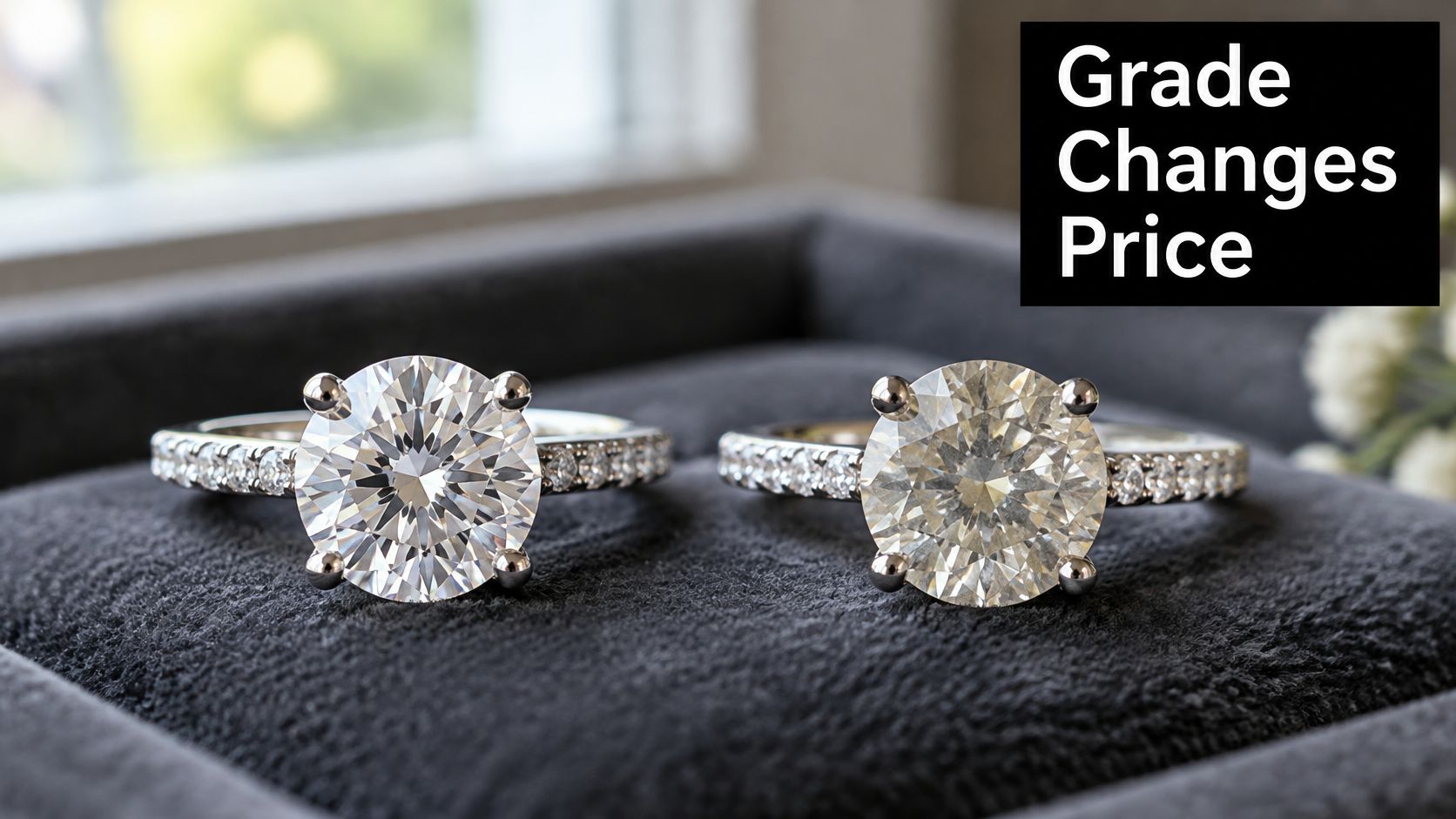
Two rings leave the same house in the same week. Same stamped karat, near-identical weight, both yellow gold, both inherited from the same aunt. One sells close to its metal value. The other draws a real premium, because the stone grades well, the maker's mark is legible, and the setting is original. Weight alone would have priced them identically.
| Factor | What the Appraiser Checks | How It Moves Value |
|---|---|---|
| Diamond carat weight | Estimated total weight and mounting limits | Heavier stones gain value only when color and clarity hold up |
| Color and clarity | Grades on the GIA D-to-Z and clarity scales | Higher grades sell for more per carat |
| Metal type and purity | Testing by X-ray fluorescence or fire assay | Gold weight and karat set the metal floor for many pieces |
| Maker and provenance | Hallmarks, signatures and documentation | Signed or documented pieces can outperform metal value |
| Condition | Wear, repairs and missing stones | Damage lowers offers and undisclosed repairs lower credibility |
| Authentication | Verification of genuine stones and brands | Unverified luxury items may be declined or priced lower |
Why weight sets a floor and not a ceiling
Carat weight is the easiest factor to measure and the easiest to over-trust. An appraiser records estimated total weight and notes where the mounting blocks a clean measurement, then tests whether the color and clarity grades support a premium. When they don't, the stone is priced as a commodity.
Color and clarity work because everyone uses the same vocabulary. GIA introduced its D-to-Z color scale for diamonds in 1953, with D as the top colorless grade, and developed the 4Cs framework of color, clarity, cut, and carat weight in the early 1940s. That shared language is why a report written in Boise can be read by an insurer in another state without argument about what "fine white" means.
Metal testing comes next. X-ray fluorescence reads composition without touching the piece, and Bruker's XRF jewelry testing data puts gold concentration and full alloy chemistry at approximately 2 to 5 seconds per sample, with accuracy within a few tenths of a percent of fire assay. Nothing gets filed, heated, or scratched, so stones and settings survive intact.
Maker marks, signatures, and paperwork decide whether a piece is jewelry or a collectible. Condition decides whether anyone wants it. Authentication sits on top: each luxury item at Carat 24 is authenticated using Entrupy or expert review, because an unverified designer name is worth less than a verified one.
If you'd rather see how those factors turn into a working number before you walk into an appointment, this explanation of how to price jewelry walks through the order of the math.
Metal weight sets the floor. Stones, signatures, and condition decide whether there's anything above it.
How to Prepare Pieces Before the Appraisal
An organized visit produces a better report. Not because appraisers reward tidy clients, but because missing details force estimates where measurements belong. A weekend of sorting is usually enough.
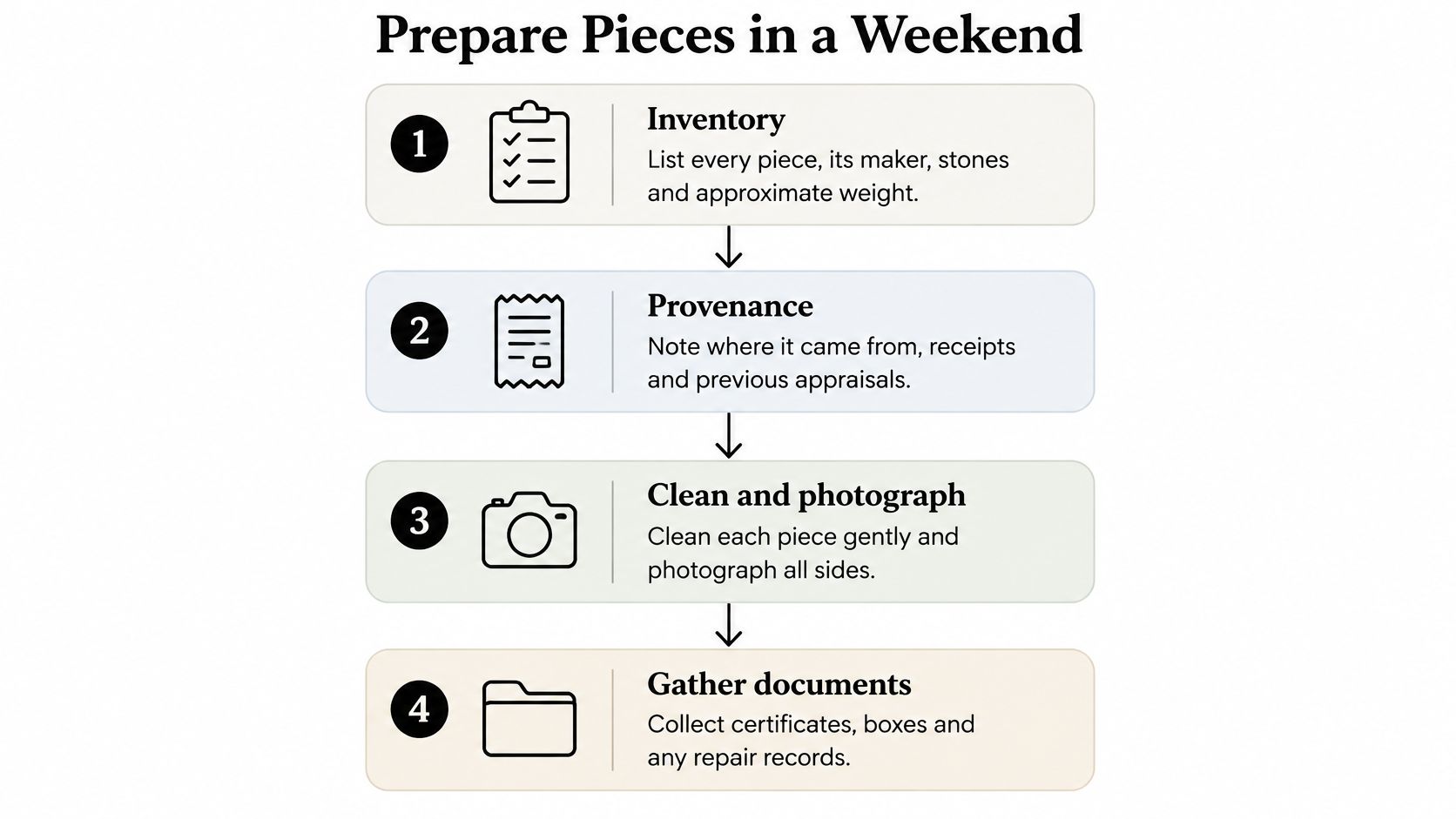
- Build a simple inventory. List every piece with its maker, stones, approximate weight, and where it came from. You don't need a professional format; you need the appraiser to see the whole collection at once instead of piecing it together piece by piece.
- Gather the paperwork and keep it with the piece. Receipts, earlier appraisals, insurance schedules, and lab reports all shorten the work. Keep the original box with its item, since documentation and packaging travel together in any later transaction, and jewelry, luxury bags, bullion, or watches must be returned in their original condition with all packaging and paperwork.
- Photograph everything in daylight. Shoot each piece front, back, hallmarks, and any signature, on a plain background. These photos become your record of condition before the appraisal and your evidence if a piece is ever lost.
- Write down condition and repairs. Missing stones, resized shanks, replaced clasps, and old solder joints all belong on the list. Undisclosed repairs lower the credibility of the entire report, and the appraiser will spot them anyway under a loupe.
- Keep pieces separated by owner or purpose. If two siblings' inheritances are being valued, use separate pouches and labels. Do not clean or polish antique items, because aggressive polishing can soften hallmarks and strip the patina that supports a period attribution.
- Book the appointment with the purpose stated up front. Say whether you need a date-of-death figure, an insurance schedule, or a resale opinion, and ask whether the report includes metal and stone testing. The answer tells you whether to bring everything or just the pieces in question.
If a stamp reads gold filled rather than solid gold, that's a different material and a different value, and this comparison of gold filled and solid gold explains what the wording on the clasp means.
What happens at the appointment
Expect a visual exam, loupe inspection of stones and mountings, and non-destructive metal testing. Loose stones may be measured and graded individually; mounted ones may only be estimated in ranges. Nothing should be cut, filed, or dipped without your consent.
Selling Locally Versus Shipping Online
A family ships a gold bracelet to an online buyer. The tracking stalls for nine days, the box arrives empty of its contents, and the claim paperwork eats three weeks before anyone sees a resolution. The bracelet's value never changed. The cost of getting paid did.
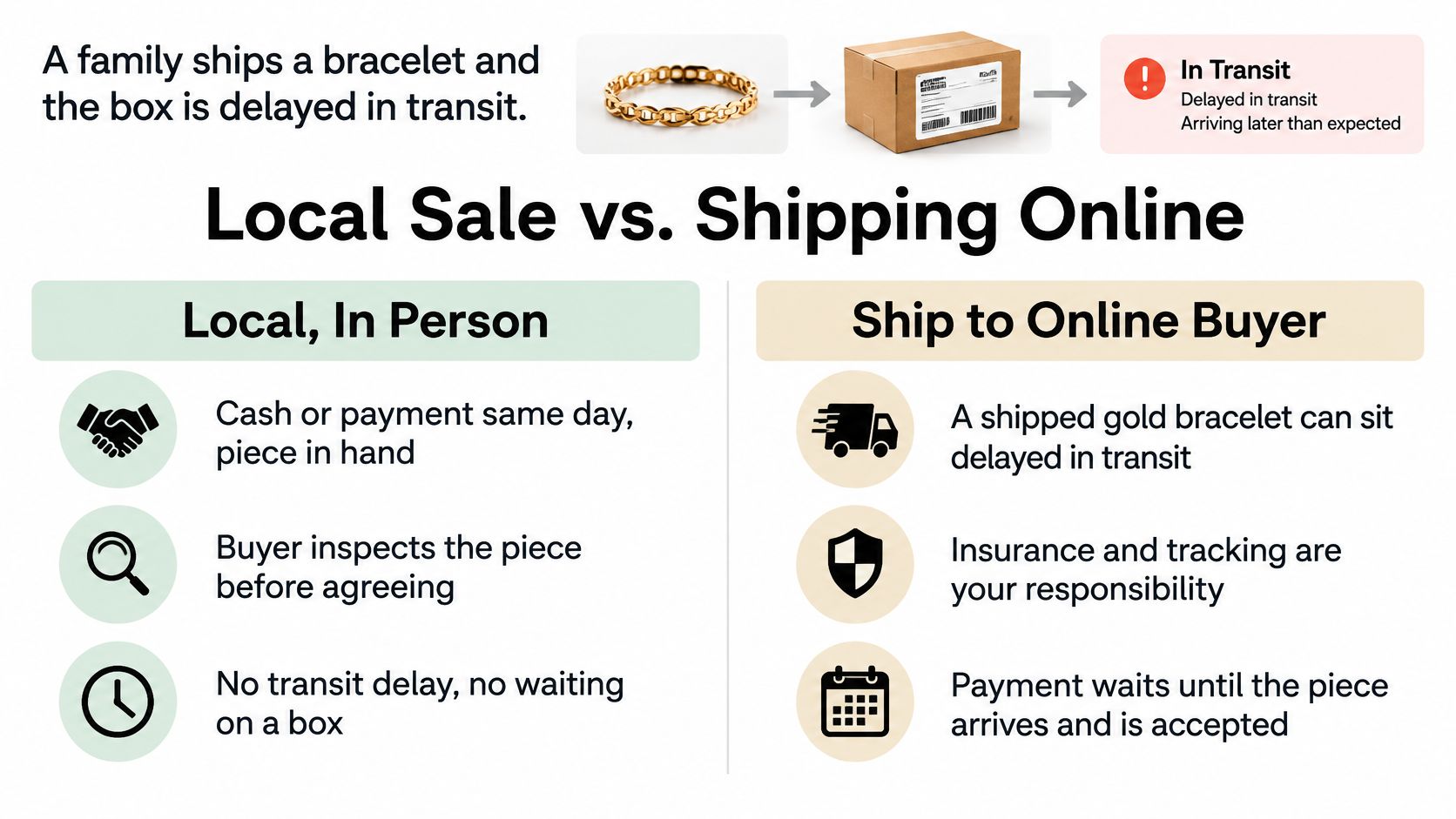
Shipping creates obligations that a counter transaction doesn't. The USPS claims process states that insurance coverage can protect mailpieces for up to $5,000, with fees based on declared value. You must keep the mailing receipt and proof of value, and a claim for loss, damage, or missing contents generally must be filed no later than 60 days after mailing.
| Factor | Local In-Person Sale | Online Shipment |
|---|---|---|
| Insurance | Handled in person with no transit risk | USPS coverage up to $5,000 with fees based on declared value |
| Paperwork | Sales receipt or bill of sale at the counter | Keep the mailing receipt and proof of value |
| Claim window | Not applicable | Loss or damage claims filed within 60 days of mailing |
| Time to payment | Often the same visit | Payment follows delivery and buyer inspection, so days later at best |
| Net after costs | Often higher once shipping and insurance are removed | Reduced by packaging, insurance and shipping costs |
The claim rules, in plain terms
USPS accepts a sales receipt, paid invoice, bill of sale, or a reputable dealer's value estimate as proof. That list is worth reading twice, because it means the documentation you need to recover a loss is the documentation you should have created before the box left your hands. If you can't prove what was inside, the declared value is just a number you typed.
Online buyers also inspect on arrival, and an offer can shrink after that inspection. Add packaging, insurance fees, transit time, and the chance of a revised offer, and the gap between the two routes gets wider than the headline quote suggests.
Compare the number that lands in your bank account, not the number in the email.
That comparison usually favors selling locally, where the piece stays in your hands until money changes hands and no transit risk enters the math. If you want the full sequence of questions to ask before you hand anything over, this guide to how to sell jewelry covers it step by step. Get two or three local quotes before you decide, and ask each buyer to write the offer down. Carat 24's local team in Boise provides prices and insights on gold, silver, jewelry and diamonds, so you can weigh a real, dated offer against your appraisal range instead of against an auction headline.
Book a Local Appraisal and Confirm Your Next Step
Decide first, shop second. Name the value type your purpose requires, then choose the fastest route to a defensible number. For Boise families, that means bringing the pieces to Carat 24 at 3780 W. State St. in Boise, where the team handles gold, silver, jewelry, and diamonds and buys gently used jewelry.
In-store drop-off and pickup are available for added security, which matters when the pieces are the whole estate and every handoff feels risky. You can also ask about the estate liquidation service if the collection is larger than one or two pieces and the family needs a plan rather than a single quote.
Bring a short checklist with you. Receipts and original packaging, because provenance supports value. A clear statement of purpose in one sentence, whether that's probate, insurance, division among heirs, or a sale. And a request for any offer in writing, with its valuation date, so it can be compared against your appraisal range without relying on memory.
The gold and jewelry buying process here stays simple. Free X-ray scanning and gold testing happen before any number is discussed, offers are hassle-free with no pressure to accept, and price matching applies against competing written quotes. If your goal is the highest payout in Boise, that combination of free testing, written offers, and price matching is how you get there, and it saves the hassle of boxing up heirlooms and hoping the shipment clears.
Schedule the visit this week, bring two pieces or twenty, and set the written offer beside the appraisal range. Then you'll know which number is which.
Carat 24 - Trusted Gold Experts buys gold, silver, jewelry, and diamonds from Boise families who want a straight answer instead of a shipment label. Bring your inherited pieces to 3780 W. State St. for free X-ray scanning and gold testing, a hassle-free written offer, price matching against competing quotes, and a local team working for the highest payout in Boise. Visit Carat 24 - Trusted Gold Experts to plan your visit and turn an appraisal range into a decision.
