

If gold has a published market price, why can't you multiply your jewelry's weight by that price and expect the same amount in cash? Because the scale measures the whole piece, while a gold buyer is valuing its recoverable gold, then accounting for the cost of buying and processing it.
The useful answer to how much do gold buyers pay isn't a universal dollar amount or percentage. It's a calculation you can check: measured gold content, a clearly identified market benchmark, and an offer with understandable deductions. For Boise sellers, that makes comparing buyers much more useful than comparing advertising promises.
What Gold Buyers Pay by Karat and Weight
A gold buyer doesn't pay the original retail price or the number on your receipt. For a melt-based purchase, the buyer pays a percentage of the value of the pure gold inside the piece, using a current market benchmark.
The table below shows calculated gold content for a hypothetical item of the same weight at each karat. These are metal-content calculations, not cash quotes, and they assume the entire measured weight is the stated gold alloy.
Pure gold in a 10-gram piece by karat
| Karat | Gold share of the metal | Pure gold in a 10 g piece |
|---|---|---|
| 10K | 41.67% | 4.17 g |
| 14K | 58.33% | 5.83 g |
| 18K | 75.00% | 7.50 g |
| 22K | 91.67% | 9.17 g |
| 24K | 100.00% | 10.00 g |
Weight times karat, divided by 24, gives pure grams; pure grams times the benchmark price per gram gives melt value; the buyer pays a percentage of that melt value.
What the difference means for your offer
In this calculated example, the 14K piece contains roughly 1.7 grams less pure gold than the equally heavy 18K piece. They could look almost identical across a counter, but their metal values wouldn't be equal.
That's why a heavier-looking ring doesn't automatically deserve a higher offer. A hollow piece, a large stone, or a lower-purity alloy can make appearance misleading. Our explanation of whether 18K gold is worth more than 14K helps distinguish purity from the other qualities that make jewelry desirable.
Before calling a buyer: Establish the approximate weight and read the hallmark, but treat both as starting information rather than a guaranteed valuation.
Use a milligram-readable scale on a stable, level surface, and photograph the karat stamp under good light. Calculate estimated pure grams before requesting offers, while remembering that stones and other components may make your home estimate higher than the payable metal weight. Different buyers can apply different payout percentages, so the table helps you prepare, not predict a particular dealer's quote.
How Buyers Calculate Your Payout Step by Step
A clear offer should let you follow the item from the scale to the final cash figure. Each adjustment should have a reason, and the buyer should distinguish a measured fact from an estimate.
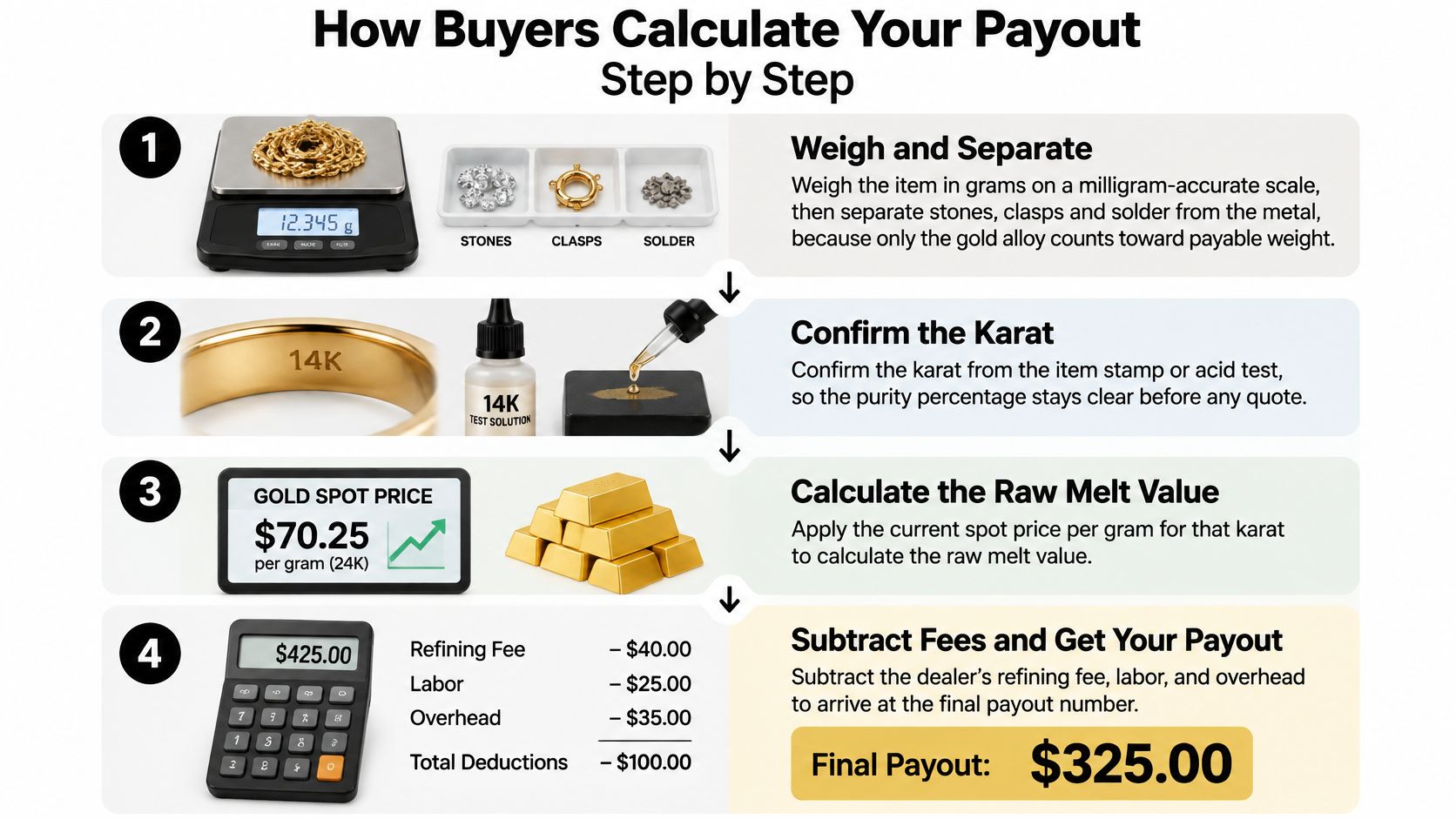
Establish the payable gold content
- Weigh and separate the components. Record the item's gross weight in grams on a milligram-readable scale. Identify stones, non-gold clasp mechanisms, and other components before calculating payable weight. Don't cut out stones or dismantle a valuable setting yourself. Ask how the buyer estimates excluded weight, and remember that solder can contain precious metal rather than being entirely worthless.
- Confirm the karat. Read the stamp, then verify it with testing. A worn hallmark, repair, or mixed-metal construction can make a stamp an incomplete description of the piece.
- Calculate the fine-gold content. Apply the karat calculation to the payable alloy weight, not automatically to the whole item. The Federal Trade Commission's jewelry guide explains that 14K means 14 parts gold in a 24-part alloy, while 18K means 18 parts gold. Getting that identification right materially changes the valuation.
Convert metal value into an offer
- Identify the benchmark. Ask which market reference the buyer uses and when it was recorded. Many professional transactions use the London Bullion Market Association Gold Price. Confirm that the quoted price has been converted into a pure-gold price per gram before using it.
- Calculate theoretical melt value. Multiply the measured fine-gold content by that benchmark-equivalent price. This is the value of the contained gold before the buyer's commercial allowance, not a promise of cash.
- Apply the payout terms. Establish whether refining, testing, handling, insurance, and resale risk are already included in the stated payout percentage. If the buyer subtracts additional charges, request an itemized list so you don't count the same expense twice.
- Write the calculation through to payment. For a hypothetical worked example, start with an unstoned piece, confirm its alloy weight and tested karat, calculate its fine-gold grams, and multiply by the agreed benchmark. Apply the buyer's stated payout rate, then subtract only separately disclosed charges. The result should match the written cash offer.
The last check matters as much as the first weighing. Ask the buyer to record the net offer as a percentage of fine-gold value, after all deductions. That gives you a comparable figure even when dealers describe their pricing differently.
X-ray Scanning and Gold Testing Before You Sell
A hallmark is useful evidence, but a measured composition gives a stronger basis for discussing price. X-ray fluorescence, or XRF, lets a buyer examine the metal without beginning with a scratch, cut, or melted sample. The instrument reads the metal's signature without removing material.
A portable analyzer excites the material and measures the secondary X-rays it emits. Those signals help identify the elements present and estimate the gold concentration. Thermo Fisher Scientific's XRF explanation describes this nondestructive approach, which can help distinguish solid precious-metal alloys from plating. In offer terms, that reading is the measured karat to test a quote against: compare the net payout with the fine-gold value implied by that karat and the buyer's benchmark, then check stated deductions.
See the reading, understand its limits
Testing in your view makes the conversation more concrete. Instead of hearing only a karat label, you can ask what composition the instrument measured and whether different areas of the piece produced consistent results. Speed helps with a group. Bruker describes portable precious-metal analysis producing results in approximately 2-5 seconds per sample, without the metal loss associated with destructive sampling. That doesn't mean a full appraisal takes only seconds. Identification and valuation require more than an instrument reading.
XRF is surface-focused. A reassuring surface result doesn't prove every part of a thick or suspicious object has the same composition. A careful buyer may recommend secondary testing when plating, an unusual interior, or inconsistent readings raise questions. Ask what the surface reading covers before treating it as a full description.
A nondestructive test preserves your options. Agree to any scratch, filing, or sampling only after you understand why it's needed and how it could affect the item.
Carat 24's Boise team provides prices and insights on gold, silver, jewelry, and diamonds, so you can discuss what your item is worth before deciding whether to sell. The guide to how to test gold purity adds context for comparing testing methods.
Before accepting, use this checklist:
- View the result. Ask to see the reading and its karat interpretation.
- Discuss the interior. Ask how the buyer assessed possible plating or internal composition.
- Keep documentation. Retain the receipt, hallmark photograph, and any authentication paperwork.
- Resolve discrepancies. If the test and stamp disagree, request an explanation before discussing payment.
Why Two Buyers Quote Different Prices
A used-car dealer doesn't normally buy at the price displayed on the windshield. The dealer still has to inspect, prepare, finance, and resell the vehicle. Gold buyers make a similar distinction between a reference value and what they can pay to acquire material.
The LBMA describes its Gold Price as a globally recognized benchmark for unallocated gold delivered in London, established through independently administered auctions at 10:30 and 15:00 London time. A piece of jewelry isn't that same deliverable product. A buyer may need to sort, test, transport, and refine it before recovering saleable metal.
Factors that move a gold buyer's offer
| Factor | How it changes the offer | What to ask the buyer |
|---|---|---|
| Benchmark and timing | Sets the price per gram used for melt value | Which benchmark and what time does the offer use? |
| Payout percentage | Sets the share of melt value paid in cash | What percentage applies, and is it in writing? |
| Weight basis | Gross weight versus fine-gold weight changes the base | Is the percentage applied to gross or pure weight? |
| Stones and solder | Excluded non-gold material reduces payable weight; solder requires an appropriate purity allowance | Are stones, clasps and solder deducted, and how? |
| Testing and refining | Processing costs reduce the amount paid | Which costs are deducted and how much? |
Compare the same calculation
Inventory financing, overhead, and the risk of an incorrect purity assessment also affect what a buyer can offer. A dealer with a different resale route or cost structure may quote differently without using a different gold price.
That doesn't make every deduction reasonable. The buyer should still explain what it covers and whether it's built into the payout rate.
Our guide to finding reputable gold buyers can help you evaluate that transparency. Compare each net percentage against the same fine-gold value, rather than accepting a headline rate with an unclear weight basis. Brand and collectible value require a separate judgment from processing costs.
Check Any Offer Against Fine-Gold Value
The most useful calculation happens after you receive the offer. Divide the cash payment by your independently calculated fine-gold value, then express the result as a percentage.
A hypothetical offer you can reproduce
For this example only, assume a 10-gram 14K ring has 5.83 grams of pure gold, with no additional excluded weight. Assume a benchmark-equivalent price of $100 per pure-gold gram. These are illustrative inputs, not today's gold price or a Carat 24 quote.
| Hypothetical calculation | Result |
|---|---|
| Fine-gold content multiplied by assumed benchmark | 5.83 × $100 |
| Calculated melt value | $583 |
| Hypothetical cash offer | $500 |
| Cash offer divided by melt value | About 85.8% |
That final percentage describes what you receive. If the buyer describes a higher payout rate, reconcile the difference against the written deductions rather than assuming the advertised rate is your net return.
Run the calculation backward, too. Divide the cash offer by the stated payout percentage, expressed as a decimal. Without separate fees, the result should match the melt value used by the buyer; with separate fees, add those fees back before performing the reverse calculation.
Acceptance rule: You should be able to reproduce the offer from the measured weight, tested purity, chosen benchmark, and listed deductions.
Use the right comparison for the item
Our explanation of what the gold spot price means helps separate a market quotation from a dealer's buying price. Use the benchmark applicable when the offer is made, not a price saved from a previous day.
For a bullion comparison, Gold IRA Association's explanation of the current value of one gold bar provides context for thinking about metal content and bar value. Don't transfer a bar valuation directly to jewelry.
Coins and scrap require the same arithmetic discipline, but their gold content may come from specifications or testing rather than a readable jewelry stamp. Recognizable bullion can require less processing than mixed jewelry scrap. Neither form excuses an unexplained gap between the buyer's calculation and the payment.
Selling Locally Versus Shipping Gold Online
Boise sellers have local options before committing valuables to the mail. JM Bullion's Boise dealer directory describes an established trade in gold, silver, platinum, coins, jewelry, dental gold, and flatware, including a dealer operating since 1979 with three Boise locations and one in Nampa.
That local infrastructure makes face-to-face comparison practical. Our Boise team provides prices and insights on gold, silver, jewelry, and diamonds, so you can discuss the valuation rather than relying only on a mail-in advertisement.
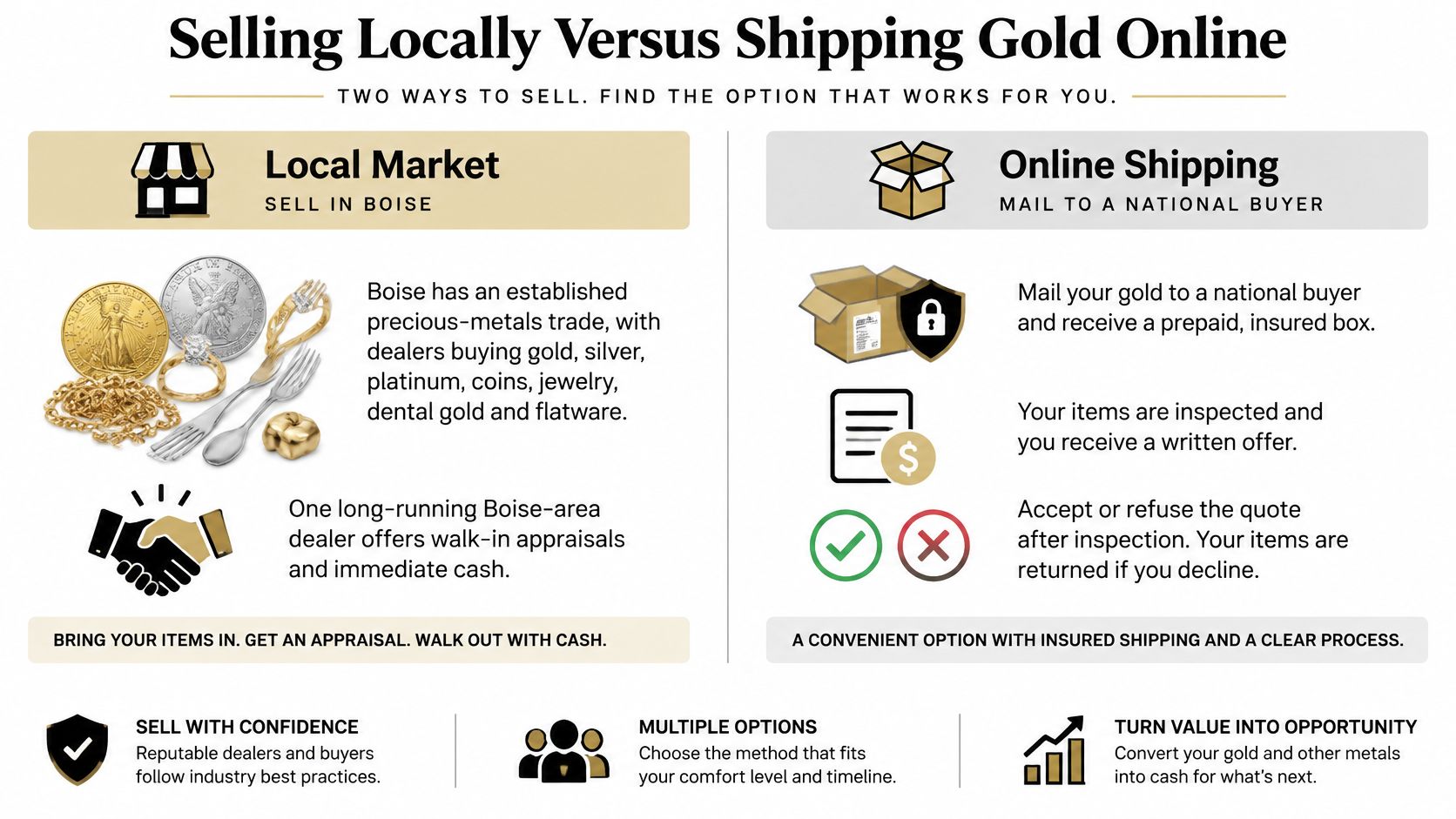
Compare logistics as well as price
Local dealer versus mail-in online buyer
| Factor | Local Boise dealer | Mail-in online buyer |
|---|---|---|
| Testing | Can be performed in view, on the spot | Performed after the package arrives |
| Shipping and insurance | No shipment needed for an in-person visit | Confirm who supplies packaging and pays for delivery and insurance |
| Comparing offers | Visit different dealers while retaining your items | A final tested offer generally requires sending the items |
| Payout certainty | Review the offer before completing the sale | Acceptance, payment, and return terms follow the buyer's written policy |
| Deduction visibility | Request an explanation before accepting | Obtain fee and deduction terms before shipping |
Mail-in selling can suit someone who can't visit a dealer, but the return process matters as much as the outbound shipment. Check coverage limits, delivery confirmation, acceptance deadlines, and who pays to return rejected items.
Local selling removes those shipping tasks, not the need to compare prices. Our guide to selling gold locally helps you prepare for an in-person evaluation and a hassle-free offer discussion.
Test payout claims rather than trusting them
A claim of the highest payout in Boise needs comparable written offers to support it. There's no verified local-versus-online payout difference that justifies promising everyone more money because they sell nearby.
You can save the hassle and sell locally for more than an online shipment when the local net offer exceeds the mail-in buyer's net terms. Treat that as a result to establish, not a guarantee.
Obtain competing local offers and written mail-in terms. Ask about Price Matching, but don't assume it's a Carat 24 policy or an automatic entitlement. Compare the final payment, return costs, and deductions before deciding which route pays more.
Sell, Appraise or Keep Your Gold
Say your family has an 18K ring in a signed designer setting. A melt-only quote accounts for the gold, but it may overlook craftsmanship, brand recognition, and the value of keeping the setting intact. Before asking whether the offer is high enough, decide whether scrap is the right market.
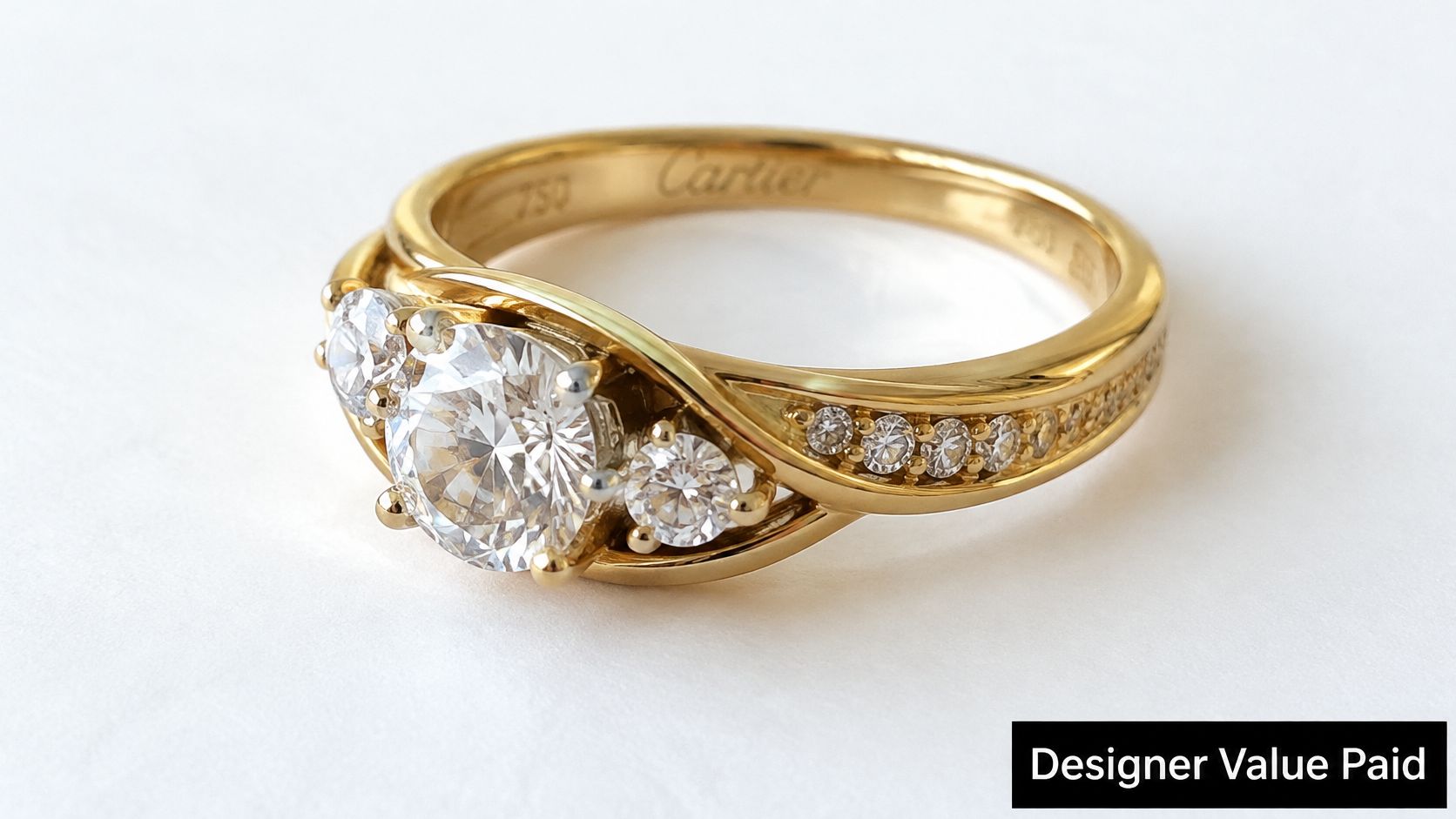
Choose the route that fits the piece
Sell for metal value when the item's main economic value is its recoverable gold. Broken chains, incomplete earrings, and heavily worn unbranded jewelry are sensible candidates for a metal-focused evaluation. Even then, distinguish damage to the design from a reduction in gold content.
Seek a resale or collectible valuation for signed jewelry, rare coins, and authenticated watches. An intact piece may attract a buyer who values more than its metal. A collectible valuation should address authenticity, condition, and likely selling costs, not provide an impressive replacement figure.
Keep the item when its family significance or your financial plans outweigh the offered cash. Retention doesn't guarantee a future price increase, and selling isn't automatically a mistake because gold later rises. Make the decision around your needs rather than a prediction you can't verify.
World Gold Council market reporting provides context for gold demand and recycling, but aggregate activity can't tell you why a particular family keeps its jewelry. Your ownership rights, cash needs, and attachment to the piece are more useful decision criteria than assumptions about what other sellers intend.
Prepare before making an irreversible decision
Use a short estate-sale checklist before authorizing a sale or destructive test:
- Gather documentation. Keep receipts, certificates, hallmark photographs, and any records of repairs or provenance.
- Confirm authority. For inherited property, establish who owns the item and obtain any necessary family or estate approval.
- Define the appraisal purpose. Insurance replacement, resale, and metal liquidation answer different questions.
- Consider taxes and security. Preserve purchase and estate records, consult a qualified tax professional when appropriate, and transport valuables discreetly.
- Collect written offers. Request competing valuations that identify whether the buyer is pricing the item intact or for its metal.
At Carat 24, prices for items sold to us assume good, marketable condition. Significant wear or damage may result in a lower offer or an item not being accepted. That distinction is particularly important when you're comparing a resale proposal with a scrap calculation.
Melt value is a reference for contained gold, not a guaranteed minimum cash payment and not necessarily the ceiling for a desirable piece. A fair decision accounts for both the metal and anything you'd lose by treating the item only as scrap.
This week, gather the pieces and their paperwork, arrange an evaluation, and request the calculation in writing. Keep a competing local offer alongside it before making your final choice.
Carat 24 - Trusted Gold Experts offers Gold and Jewelry Buying, buys and sells gold, silver, bullion, coins and other precious metals, and buys gently used jewelry, with free X-ray scanning and gold testing to help you understand an offer. Visit Carat 24 - Trusted Gold Experts at 3780 W. State St., Boise, and bring your documentation so you can request a written valuation to compare with another local dealer. Call (208) 314-9995 or email info@goldsilveridaho.com to confirm hours and the evaluation process before visiting.
