

Yes, by weight, 18K gold is worth more than 14K because it's about 75% pure gold versus about 58.3%, so an equal-weight 18K piece holds roughly 28.6% more pure gold. That's a comparison of gold content, not a promise that every higher-karat piece will sell for more.
For someone sorting inherited rings, comparing necklaces, or considering an offer in Boise, that distinction matters. A buyer may value an item as reusable jewelry, as a collectible, or as metal. Understanding which kind of offer you're getting is just as important as reading the stamp.
18K Gold Carries More Pure Gold Than 14K
18K gold has the higher intrinsic value when you compare equal weights of verified gold alloy. Karat measures how much of the metal is gold, not how heavy the piece is or how much someone originally paid for it.
The Federal Trade Commission's jewelry guide explains karatage as parts out of 24: 18K contains 18 parts gold and 6 parts other metals, while 14K contains 14 parts gold and 10 parts other metals. Those proportions give approximately 75.0% and 58.3% gold, respectively, a difference of 16.7 percentage points.
Gold content by karat per 10 g
The comparison below applies that parts-of-the-whole calculation to hypothetical pieces made entirely of the stated alloy. Fineness expresses purity in thousandths, while the gold-weight columns show the approximate amount of actual gold.
| Karat | Gold share | Fineness | Pure gold in 10 g | Pure gold in 5 g |
|---|---|---|---|---|
| 24K | Nominally 100% | 999 for near-pure gold | About 10 g | About 5 g |
| 18K | 75.0% | 750 | 7.50 g | 3.75 g |
| 14K | 58.3% | 585 commercial marking | 5.83 g by karat fraction | About 2.92 g by karat fraction |
| 10K | 41.7% | 417 | About 4.17 g | About 2.08 g |
Rounding matters: the mathematical karat fraction and a commercial fineness mark aren't always identical. For an actual valuation, use the verified fineness rather than treating every rounded percentage as exact.
At equal weight, 18K contains roughly 28.6% more pure gold than 14K. That's a relative increase in gold content, not the percentage-point difference between their purity labels.
A larger share of gold explains the higher metal value. It doesn't mean that an entire jewelry piece must command a corresponding premium.
Karat isn't the final price
A diamond ring made in a lower-karat alloy can sell for more than a plain higher-karat chain. A recognized maker, desirable design, original paperwork, and marketable condition can all influence what a jewelry buyer will pay beyond the metal.
Weight can also reverse the apparent advantage. In a hypothetical comparison, a 20 g chain tested at 585 fineness contains 11.70 g of gold, whereas a 10 g chain tested at 750 contains 7.50 g. The heavier lower-karat chain contains more gold overall.
The reference price matters, too. Understanding what the gold spot price means helps you distinguish the market's gold benchmark from a retail jewelry price.
The working rule is straightforward: compare total pure-gold weight first, then consider stones, maker's marks, condition, craftsmanship, and the way the item will be sold. Karat gives you a starting point, not a complete appraisal.
Verifying Karat Marks and Trademarks Before You Buy or Sell
The Federal Trade Commission's buying guidance advises against buying gold jewelry without both a karat mark and the registered trademark or company name standing behind that mark.
For Gold and Jewelry Buying, identifying the metal should come before discussing its price. A readable stamp helps, but it's a claim to verify rather than a substitute for testing.
Use this checklist when examining an item or preparing it for an appraisal.
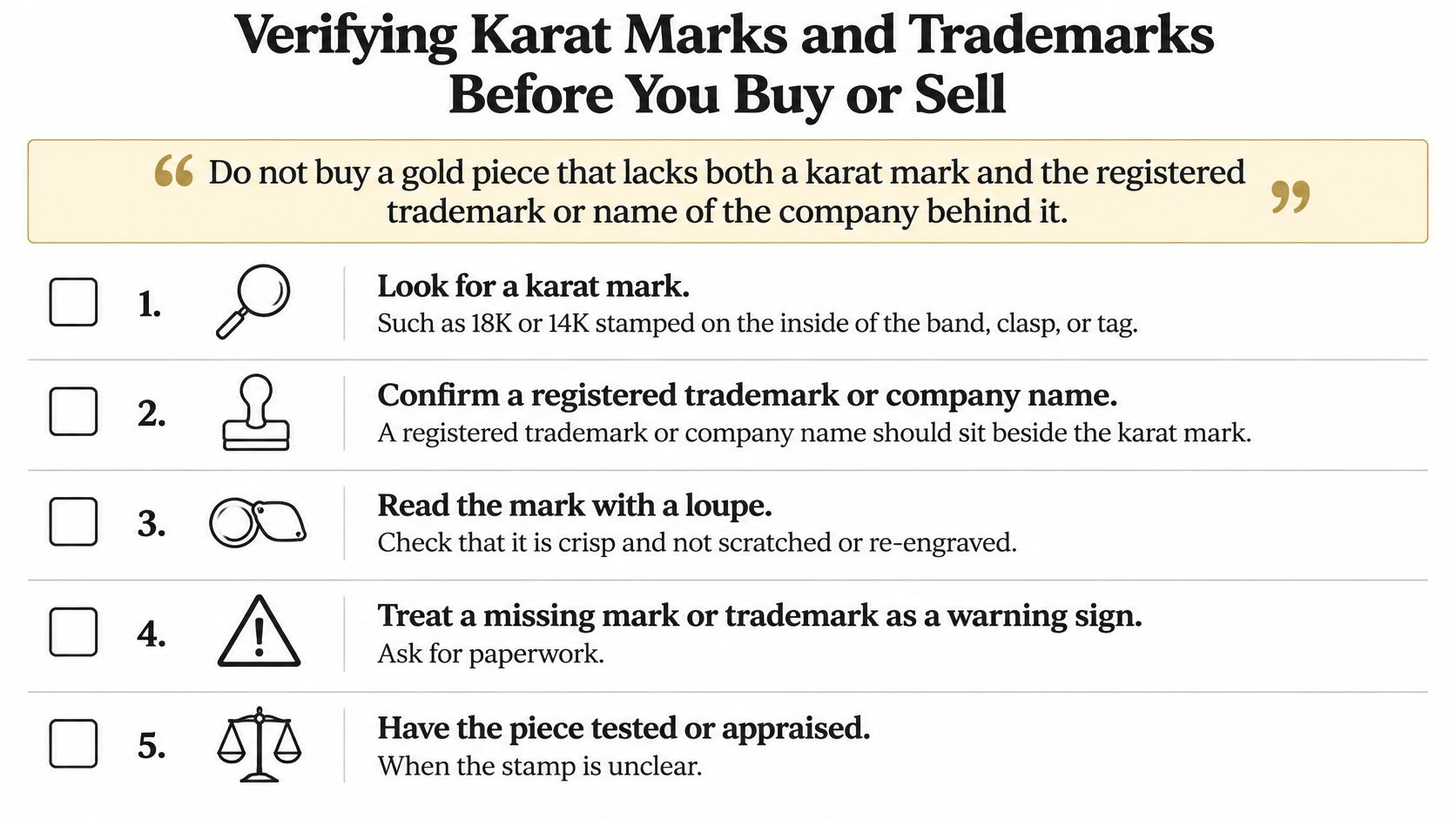
- Find the purity mark. Inspect the inside of the ring shank, clasp, tag, or reverse of a pendant with a jeweler's loupe. Record the mark exactly rather than guessing what a worn character used to say.
- Identify the maker. Look for a company name or trademark associated with the purity stamp. That identification helps establish who stands behind the stated quality.
- Flag damaged or missing marks. A rubbed, altered, or unreadable stamp calls for independent testing. Don't scratch or file the piece yourself to investigate.
- Collect the paperwork. Bring receipts, appraisals, certificates, and any estate records. Documents may help identify the item, although an old appraisal doesn't establish today's sale value.
- Have the metal tested independently. Acid testing and X-ray fluorescence, often called XRF, can help assess the alloy. Ask the examiner to explain the method and whether any surface preparation could leave a mark.
What a stamp can't tell you
A convincing-looking mark doesn't prove that the entire piece is solid gold. Counterfeit stamps, plated surfaces, replacement clasps, and previous repairs can complicate identification.
XRF examines composition near the surface, so an examiner must consider plating and construction when interpreting the result. Acid testing also needs appropriate technique and permission before any potentially marking preparation.
Country-of-origin descriptions aren't purity guarantees either. If an inherited chain is described as Italian, this guide to what Italian gold means can help separate origin and craftsmanship from metal content.
Missing marks don't automatically mean fake gold. Older jewelry may have worn stamps, and resizing can remove part of a hallmark. But uncertainty can lead a buyer to offer less or decline the piece until its composition is established.
Keep a simple record for each item: purity mark, maker, weight, paperwork, and test result. That gives you a consistent description to use when comparing offers.
How to Calculate Melt Value for 18K and 14K Pieces
Melt value estimates the gold component, not the value of the whole jewel. It's useful because it separates measurable metal content from design premiums and sales costs.
The World Gold Council's gold-jewelry guidance supports calculating pure-gold weight from metal weight and fineness: pure gold in grams = metal weight × fineness ÷ 1,000. Using the exact karat fractions, its comparison gives about 7.5 g of gold in a 10 g 18K piece, versus 5.833 g in a 10 g 14K piece, or roughly 28.6% more gold in the higher-karat example.
This visual summarizes the calculation before you account for the item's construction and the buyer's deductions.
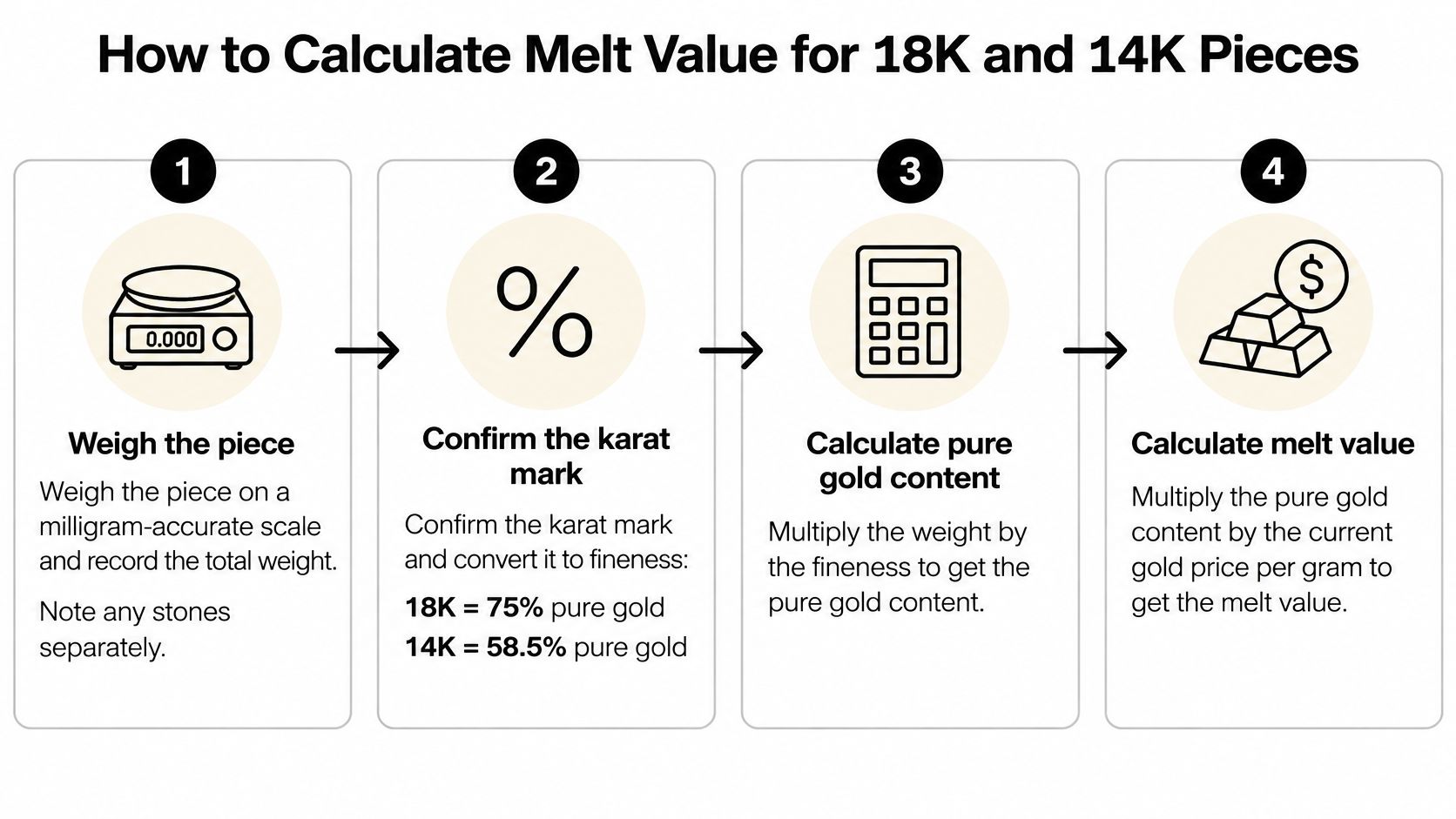
Work from metal weight to estimated value
- Weigh the item accurately. Use a calibrated jewelry scale with milligram resolution on a stable surface. Record the gross weight, then identify stones, steel springs, and other components that aren't part of the gold alloy. Don't remove stones yourself just to improve a home estimate.
- Confirm the purity you'll use. A stamp is a starting point; testing establishes whether it's appropriate for the calculation. Use the measured or confirmed fineness consistently rather than switching between a rounded karat percentage and a commercial hallmark.
- Calculate the pure-gold weight. For the hypothetical 10 g 18K piece, multiply the metal weight by 750 ÷ 1,000 to obtain 7.50 g. For the same-weight 14K example, the exact karat fraction gives 5.833 g; using a verified 585 fineness instead gives 5.85 g. That small difference is a purity convention, not a separate buyer's fee.
- Apply the reference gold price per gram. Use a live pure-gold reference price from the day you're comparing offers. Make sure the currency and weight units match. Multiply that price by the calculated pure-gold weight, not by the gross weight of a stone-set piece.
- Compare like with like. Apply the same reference price, timestamp, and purity convention to both items. Otherwise, a difference in assumptions can look like a difference in the buyer's generosity.
- Separate exclusions from payment deductions. Remove stone and non-gold weight before calculating gold content. Then identify refining costs, testing charges if applicable, and the buyer's margin. Don't subtract the same component twice.
Read the result correctly
The result is an estimated gross metal value. A scrap buyer's payment will usually be lower because the buyer incurs costs and needs a margin.
A reusable jewel deserves another question: does it have resale value beyond its gold? A signed piece, attractive gemstone, or desirable design may justify a jewelry offer rather than a scrap-only calculation. This guide to working out what your gold is worth helps frame that distinction.
For another explanation of the valuation process, watch the following video.
Ask for the final offer in writing, with the metal weight, tested purity, reference price, and deductions identified. A clear calculation lets you compare buyers without mistaking a retail appraisal for cash proceeds.
Melt value is a ceiling for the gross gold-content calculation, not a guaranteed offer. It isn't a ceiling on the resale value of a desirable finished jewel.
Durability and Color Differences in Daily Wear
Higher purity doesn't automatically mean a better daily-wear ring. The alloy's hardness, the setting's construction, and your activities all affect how the piece holds up.
Goldsmiths combine gold with metals such as copper, silver, zinc, or nickel to change its working properties and appearance. A lower-karat alloy generally contains more of these other metals, which can make it harder and more resistant to scratches or dents than a comparable higher-karat alloy.
Compare the same design and use
For daily wear, 14K often has a practical advantage. A well-made band can tolerate routine contact well, and the harder alloy may resist wear at vulnerable areas such as prongs and a thin shank.
For appearance, 18K yellow gold usually looks richer and warmer. Its softer alloy can acquire surface marks more readily, particularly on exposed ring edges. That doesn't make it unsuitable for daily use, but it makes sturdy construction and sensible care important.
Consider a ring worn while typing, carrying bags, and handling household objects versus a pendant worn occasionally. The ring encounters repeated contact and friction; the pendant usually encounters less mechanical wear. Choosing the same karat for both isn't necessary.
Construction can outweigh a general alloy preference. A substantial, carefully made higher-karat band may be a better practical choice than a thin, poorly supported lower-karat setting.
Color and skin comfort need separate checks
Yellow-gold comparisons are relatively straightforward, but white and rose gold depend heavily on the maker's alloy recipe. Surface finishes can also change what you see, so compare actual pieces under the same lighting rather than relying on a product photograph.
For readers comparing rose-gold watches rather than plain jewelry, Chopard buying advice from Heritage Timepieces provides useful context for evaluating the finished watch alongside its metal description. The case, condition, and complete item deserve attention, not just the gold color.
Nickel-containing alloys can cause reactions in sensitive wearers. Higher karat isn't a guarantee of skin compatibility; ask for the alloy composition, particularly when choosing white gold for prolonged skin contact.
Also confirm that you're comparing solid alloys rather than a gold layer over another material. The difference between gold-filled and solid gold affects how you interpret surface wear and long-term appearance.
Before choosing or selling a frequently worn piece, inspect:
- Prong tips: Look for flattened, uneven, or missing tips and stones that move.
- Ring shank: Check the underside for thinning, cracks, or distortion.
- Clasp and connecting rings: Watch for weak closures and worn attachment points.
- Previous repairs: Note visible seams or areas that may need professional assessment.
Remove jewelry before abrasive work, store pieces separately, and use cleaning methods appropriate for their gemstones.
Purity drives gold-content value; alloy and construction drive durability. Neither karat label replaces an inspection of the actual piece.
Choosing 18K or 14K for Your Purpose
The useful question isn't “Is 18K gold worth more than 14K?” It's whether the extra gold content serves the reason you're buying or keeping the piece.
A wedding band, an occasional necklace, and an item intended for resale have different jobs. Choose according to the job rather than treating higher purity as a universal upgrade.
Best karat by situation
| Situation | Better karat | Why |
|---|---|---|
| Daily-wear engagement or wedding band | 14K | A typically harder alloy resists scratches and prong wear |
| Occasional necklace or earrings | 18K | Richer yellow color and more gold per gram |
| Gold held for resale or melt | 18K | More pure gold at equal weight |
| Sensitive skin | Check the alloy | Nickel content depends on the maker, so ask |
| Budget-limited gift with the same design | 14K | Lower gold content generally supports a lower price |
| Heirloom to keep | Either | Condition, marks, and documentation matter more than karat alone |
A daily bridal band should suit the wearer's routine. Someone who works extensively with their hands may prefer a practical lower-karat design with a substantial shank. The setting still needs to be appropriate for the stone and the expected wear.
An occasional necklace or pair of earrings can prioritize appearance. If the warmer yellow tone is what makes the piece appealing, choosing the higher-karat version can be reasonable. Check clasps, earring backs, and comfort rather than assuming occasional wear eliminates construction concerns.
A resale-focused purchase needs disciplined pricing. More gold per gram doesn't guarantee a better return if you pay a large design premium upfront. Compare the total acquisition cost with a realistic resale route, not just the purity label.
Run the wear, resale, and budget checks
Start with how often you'll wear it. A piece intended for constant use needs a different inspection from one kept for celebrations, particularly around exposed settings and thin links.
Next, decide whether resale is likely. A bridal band bought for personal use can be a good choice even if its future scrap payment is modest. A higher-karat band bought specifically for resale needs a purchase price that leaves room for selling costs.
Finally, set the complete budget. Include any necessary sizing, setting work, or repairs when deciding what you can afford. A less expensive item that immediately needs structural work may not be the economical option.
For a gift with the same design, the lower-karat version often leaves more room in the budget without sacrificing the intended look. For sensitive skin, however, price and purity should come after confirming that the actual alloy is suitable.
An heirloom deserves a broader decision. A worn family ring may have little commercial value beyond its metal yet still be worth preserving for its history. Keep identifying marks and estate paperwork with it, and avoid polishing away evidence before it's assessed.
The better choice is the piece that fits its purpose at a sensible total price. Neither alloy is automatically an investment, and neither is automatically disposable.
Selling Gold and Jewelry Locally in Boise
Compare what you keep after costs and conditions, not only the advertised offer. A distant online buyer can quote a strong number that shrinks once packaging, signatures, coverage, and claim rules are included.
The USPS insurance and extra-services guidance describes insurance of up to $5,000 for eligible mailpieces and Registered Mail coverage up to $50,000, with claims generally needing filing within 60 days. Coverage restrictions matter, and jewelry, precious metals, and gemstones are prohibited in Priority Mail Express International shipments.
An online sale may require careful packaging, tracking, signatures, suitable coverage, and retained claim documents. An ordinary shipping label does not automatically protect the full value of jewelry. Insurance works like a ceiling on a claim, not a guarantee that every loss is paid in full.
Compare the actual Boise offers
Selling in person lets you keep possession while discussing testing and payment. You can compare written terms before the piece leaves your hands.
Gold content sets melt value. The amount a buyer pays can still change with condition, stones, marks, and the sales channel. Two pieces with the same tested karat can produce different offers for that reason.
Use this checklist:
- Testing: How is karat checked, and is there any obligation to sell afterward?
- Calculation: Does the written offer identify metal weight, tested karat, and deductions?
- Condition: Does the offer assume good, marketable condition, and how do wear or damage change it?
- Competing offers: Can you set this written offer beside another written offer on the same item?
- Net proceeds: What will you receive after every fee or deduction?
Carat 24 buys and sells gold, silver, bullion, coins, and other precious metals. Its local team in Boise provides prices and insights on gold, silver, jewelry, and diamonds. Purchase prices assume good, marketable condition. Items with significant wear or damage may receive lower offers or may not be accepted.
Test payout claims rather than assuming them
No neutral comparison establishes which buyer delivers the highest payout in Boise. Get competing written offers using the same item, weight, purity, and market reference, then choose the best net terms.
A local offer may leave you with more after shipping-related costs, but that has to be checked against the actual numbers. Our guide to selling gold locally explains the practical considerations.
Keep purchase and sale records as well. If the sale may involve a taxable gain, Allied Tax Advisors' explanation of how to figure capital gains offers useful background before you discuss your circumstances with a tax professional.
Bring the item, its paperwork, and a record of its karat mark and weight. Stones and marks can move the offer even when the gold content does not. Those details make an informed comparison possible.
Carat 24 - Trusted Gold Experts, at 3780 W. State St. in Boise, buys gently used jewelry and precious metals and can relate a tested karat to a purchase offer. Bring marked pieces and any estate paperwork to Carat 24 - Trusted Gold Experts before deciding whether to sell.
